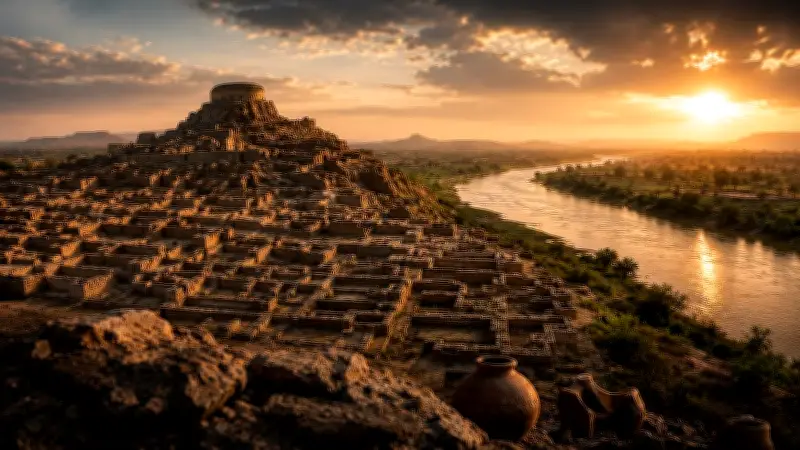
The so-called "Pashupati Seal" discovered at Mohenjo-daro has sparked intense debate for decades. Buried for thousands of years, this seal was unearthed in 1928 or 1929 and is approximately 4,300 years old according to carbon dating. Many Indians insist the engraved figure is Lord Shiva, concluding that the Indus Valley Civilisation people were Hindus. Since Pakistan was founded on the Two-Nation Theory, they argue Pakistan has no connection to this civilisation. However, this assumption is misleading.
The Naming and Misidentification of the Pashupati Seal
Sir John Marshall named the seal "Pashupati" after associating the image with a manifestation of Shiva. Later scholarship challenges this identification. Some scholars suggest the figure resembles a Central Asian deity, while others argue it may not represent a deity at all—it could be a ruler's seal, a priest, a shaman, or merely an artistic creation. The truth remains uncertain because the Indus Valley script is undeciphered. Historian Audrey Truschke noted on Twitter, "This isn't Shiva. It's more likely adapted from proto-Elamite iconography, showing an Eurasian deity 'lord of animals.'"
The Saraswati River Myth and the Vedas
Another common argument claims that the Saraswati River mentioned in the Vedas corresponds to the Indus River system, making the Indus Valley Civilisation part of India's heritage. However, historians and archaeologists have never reached a consensus on whether the Saraswati existed as described. The Vedas describe it as a mighty river between the Sutlej and Yamuna, but the Indus itself does not flow there. Even if a branch of the Sutlej once fed such a river, reconciling it with the described "majestic" river is difficult. The term "Indus-Saraswati Civilisation" gained popularity after the 1980s, coinciding with the rise of the BJP in Indian politics, suggesting a cultural war against Pakistan.

Geographical Reality of the Indus River
The geographical relationship is clear: the Indus River flows through Pakistan, emptying into the Arabian Sea. Harappa lies near Sahiwal in Punjab, watered by the Ravi, a tributary of the Indus. Mohenjo-daro sits only two miles from the Indus River. Over 4,500 years, the Indus has shifted only a couple of miles. In contrast, the Saraswati remains elusive. According to Hindu mythology, Saraswati is also a goddess, and it's possible the goddess preceded the river in mythology.
Two-Nation Theory and Historical Continuity
The argument that Pakistan, founded on the Two-Nation Theory, has no connection to the Indus Valley Civilisation is flawed. By that logic, modern Egypt—a Muslim-majority country—would have no connection to the Pharaohs, and Italy—overwhelmingly Christian—should renounce the Roman Empire. The people of this region embraced Islam; their DNA did not change. Genetic studies show continuity, just as Palestinians share DNA with ancient inhabitants. Modern Punjabis and Sindhis are indigenous to their regions. The Vedas were composed after the decline of Harappa and Mohenjo-daro, with estimates placing several centuries between them. Preserving traditions before paper was invented was far more difficult.
Distinct Identity of Sindh and Pakistan
The territory of modern Pakistan has historically maintained a distinct identity. In The Indus Saga, Aitzaz Ahsan argues that the region known as India was united under a single ruler for only about 500 years in the last 5,000 years. Zulfikar Ali Bhutto Jr. recently argued at ThinkFest that the territory now called Pakistan has historically existed as a political entity, known as Sapta Sindhu, Gandhara, the Sikh Empire, or ruled by dynasties like the Kalhoras and Talpurs. The Indus River provides unity. This distinction is reflected in historical documents, such as a letter by the Shah of Iran before the 1857 War of Independence, which referred separately to Muslims of Hind and Sindh.

Pakistan as Custodian of the Indus Valley Civilisation
Pakistan has regarded itself as a custodian of the Indus Valley Civilisation since its inception. Choudhry Rahmat Ali wrote in 1934 that Pakistan was the birthplace of human civilisation. During Zulfikar Ali Bhutto's era, he reminded the Shah of Iran at Mohenjo-daro that Pakistan possessed an even older civilisation. As for the argument that the Two-Nation Theory requires rejecting all pre-Islamic peoples as unbelievers, Pakistan today is home to millions of non-Muslims. The people of the Indus Valley Civilisation may have been monotheists, atheists, or polytheists—nobody cares. Pakistan was created to safeguard political rights and prevent tyranny of majority. Our ancestors changed their religion, not their geography. Harappa and Mohenjo-daro belonged to them, and their descendants continue to live in the Indus Valley today.