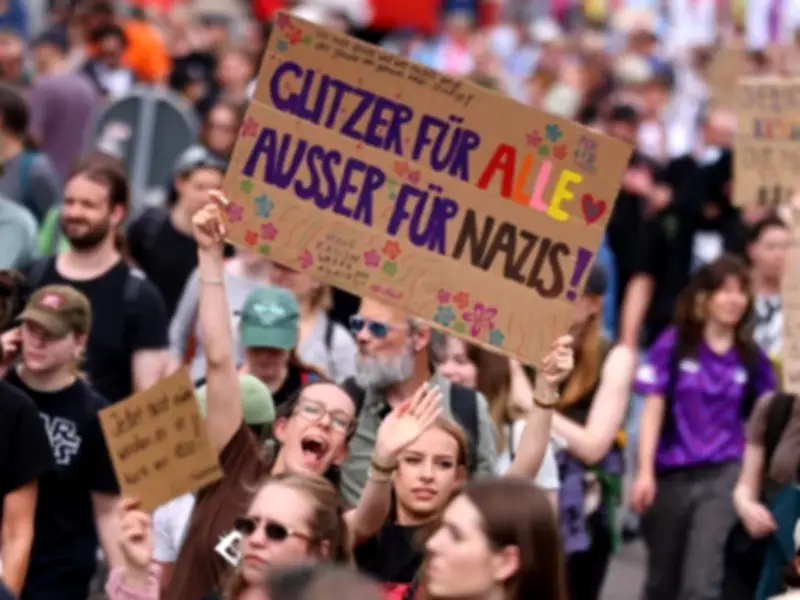
Thousands of protesters gathered in Erfurt, Germany, on Saturday to demonstrate against the far-right Alternative for Germany (AfD) party, blocking roads leading to its annual conference. Police estimated around 15,000 people joined the demonstrations, with reinforcements deployed from across the country. The AfD re-elected party chiefs Alice Weidel and Tino Chrupalla, under whose leadership the party has surged to the top of national opinion polls, ahead of Chancellor Friedrich Merz's conservatives.
Protesters Block Highways, Police in Riot Gear
Protesters from unions, civil society groups, and left-wing parties sat in rows to block highways and roads leading to the convention centre. Police in riot gear monitored the situation. Georg Becker, a spokesperson for Widersetzen, an anti-AfD umbrella group behind the protests, said: "We want to make it clear that we simply won't tolerate this, that fascism is on the rise here in Germany."
AfD Leaders Mock Protesters, Celebrate Rise
Inside the conference, opening speeches mocked and lambasted the protesters as anti-democratic. Weidel said: "For this remains our last chance to save our country. More and more people in this country want to support us in the fight against Germany's decline, in the fight for our fatherland and for our identity." Bjoern Hoecke, a radical figure, pointed to Germany's motorway toilets as an example of national malaise, saying: "A great Germany is a Germany where one need not fear taking a walk through the city park in the evening."

Hardline Immigration Stance
Underscoring the party's hard line on immigration, a song called "Send them back" played on the AfD's social media stream before the convention opened. Inside, vintage-style cards with slogans such as "You will be deported" were on sale. Weidel stated: "Criminals and illegal migrants have no place in Germany any more. We will deport them rigorously, because our country deserves better."
AfD's Electoral Prospects and Opponents' Concerns
The conference comes ahead of elections in the eastern states of Saxony-Anhalt and Mecklenburg-Vorpommern, which the AfD hopes will pave the way for national success. Recent polls put AfD support as high as 29%, compared with around 22% for Merz's CDU/CSU conservatives. Opponents accuse the AfD of promoting racist policies and threatening Germany's democratic values. Mainstream parties maintain a "firewall" strategy to isolate the party. AfD leaders deny opposing democratic foundations and won a court injunction earlier this year against a previous classification of the party as "extremist".