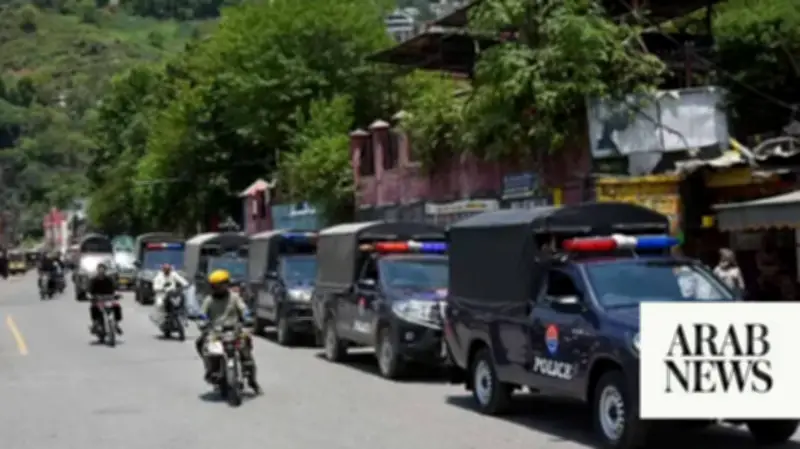
Protest leaders in Azad Jammu and Kashmir (AJK) said on Monday that two demonstrators were killed in fresh clashes with security forces in Dadyal tehsil of Mirpur district a day earlier, with the regional police chief disputing the claim. The latest violence comes amid demonstrations led by the recently banned Joint Awami Action Committee (JAAC), which has staged rallies and sit-ins across the region since early June.
Background of the Protests
The movement, which previously focused on economic and governance issues, has shifted its attention to demanding the abolition of 12 seats in the AJK assembly reserved for refugees who migrated from Indian-administered Kashmir after the 1947 partition of the Subcontinent. Speaking to Arab News, Liaqat Hayat, a member of the National Awami Party (NAP) who is hosting the JAAC sit-in in Rawalakot, said Sunday’s violence was confined only to Dadyal.
“There was no clash in Rawalakot despite massive turnout, but in Dadyal two protesters were killed and three others were injured,” Hayat said, adding that around 60,000 people, including women, were present at the Rawalakot sit-in on Sunday. He identified those killed as protesters and said they had no verified information about police casualties. “As far as the confirmed reports available to us are concerned, the casualties have been civilians,” he said.

Police Dispute Casualty Claims
Protesters later blocked the two main crossings leading into Dadyal and vowed to continue their sit-ins until July 8, according to Hayat. JAAC has separately warned of a long march to the regional capital of Muzaffarabad if the government did not negotiate a settlement by July 8. “If there is no serious engagement by July 8, we will announce our next course of action on July 9,” Hayat said, adding that the movement may start its long march on July 13.
Last month, at least seven people, including four police personnel and three protesters, were killed in violence in Rawalakot, where authorities accused JAAC supporters of attacking law enforcement personnel and laying siege to a military-run hospital. JAAC denied the allegations, accusing security forces of opening fire on peaceful demonstrators.
Referring to Sunday’s violence in Dadyal, AJK Inspector-General of Police Liaqat Ali Malik alleged that it was the protesters who first fired gunshots. “They fired the first shot. If this is a protest, then what kind of protest is it?” he asked. Malik rejected reports that two civilians had been killed. “They should go to hospitals and get the post-mortem done. They should bring the evidence to me and we will take action according to the law,” he said, adding that casualty claims should be backed by verifiable evidence. “I encounter 15 to 20 such pieces of fake news every day,” he said. “This is all information warfare.”
Clash of Narratives
Arab News could not independently verify conflicting accounts of Sunday’s clashes in Dadyal. Authorities have yet to release an official figure about the casualties. Malik said another 92 police personnel had been injured since the unrest began last month, including many with gunshot wounds. “This is not a peaceful protest anymore. It is an armed conflict,” he told Arab News.
JAAC supporters have pressed ahead with protests despite the group being banned last month under anti-terrorism laws. Protests, sit-ins and business strikes paralyzed daily life across much of the region, though both sides offer contrasting accounts of the conditions. Malik said roads leading into and out of the region remained “largely open” and that normal commercial activity continued in most districts. “Jhelum is fully open. Muzaffarabad is fully open. Kotli is fully open. Haveli is fully open,” he said, adding that only a few areas in Mirpur remained affected.

Hayat, however, said transport disruptions were limiting the supply of essential goods because drivers feared being stopped or harassed by authorities. “Transporters are afraid to travel because they fear being stopped, harassed or delayed by the authorities,” he said. “When supplies do reach the markets, people buy everything quickly and the shelves are empty within a short time.” He rejected accusations that protesters were deliberately blocking supplies. “We want essential goods to continue reaching people because if ordinary citizens suffer, public opinion will naturally turn against us,” Hayat said.
Negotiations Stalled
Both sides remain far apart on the prospect of negotiations. Malik questioned the purpose of talks while alleging that protesters continued to resort to violence. “What negotiations should we hold?” he questioned. Hayat, meanwhile, accused the government of making no serious effort to begin dialogue. “Since early June, there has been no serious indication from the government that it wants negotiations. No committee has been formed and no formal offer for talks has been made,” he said. “If the government appoints representatives, negotiations could begin within 12 hours.”
The dispute comes ahead of legislative elections scheduled for July 27 in the mountainous region, which lies within the broader Kashmir territory claimed in full by both India and Pakistan but administered in parts by each. The AJK government banned the rights alliance on June 5, citing reports about its involvement in “potential violence, acquisition of weapons, attacks on law-enforcement personnel, and plans to disrupt normal life.” JAAC denies the allegations and says its struggle for rights is peaceful.
Political Implications
JAAC called for protests across AJK on June 9 after talks with Pakistan’s federal government failed to resolve the dispute over the refugee seats. The group argues that the reserved seats allow Pakistan’s mainstream political parties to influence government formation in AJK and has demanded their immediate abolition. However, JAAC’s campaign suffered a setback last month when the AJK Supreme Court observed that the seats enjoy constitutional protection and cannot be abolished through executive or administrative action.