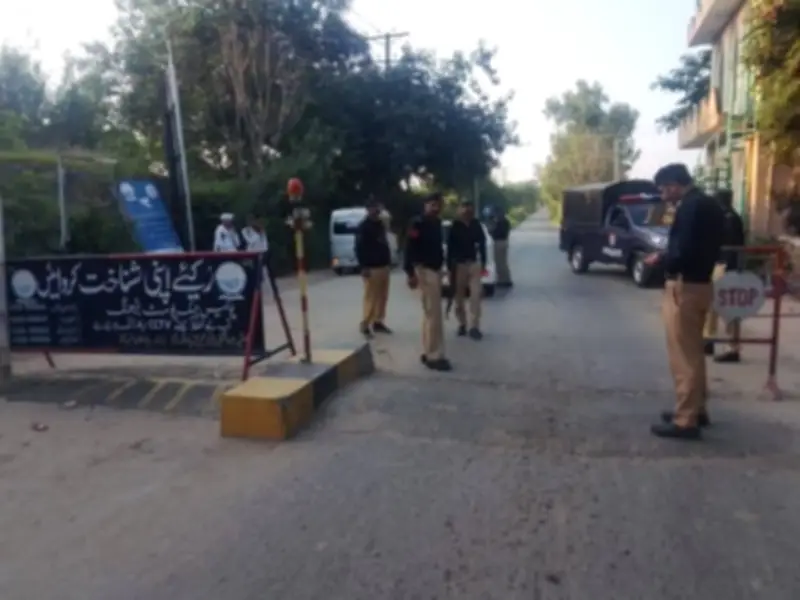
Four law enforcement personnel were martyred, and more than 20 others sustained injuries in a firing incident in Rawalakot on Sunday, according to a statement by the Inspector General of Police of Azad Jammu and Kashmir (AJK).
Planned attack by proscribed group
The statement revealed that armed elements linked to the proscribed Joint Awami Action Committee (JAAC) opened fire on law enforcement officers deployed in the area. The police chief strongly condemned the incident, calling it a “coordinated, armed and terrorist act” aimed at undermining public order and targeting state institutions.
He further said that the attackers also targeted CMH Rawalakot, describing it as a serious violation of law and a threat to the safety of patients, medical staff, injured personnel, and civilians. “Direct firing on law enforcement personnel, martyrdoms, gunshot injuries, and later the attack on CMH Rawalakot is clear terrorism. The legal outcome of this attack will be inevitable, evidence-based and strictly in accordance with the Constitution and law. No armed group will be allowed to hold the peace, safety of citizens and state order hostage,” the statement added.

Police tribute and legal action
The statement clarified that the incident was not a peaceful protest but a “planned and armed terrorist action” aimed at state institutions and public safety. AJK police paid tribute to the deceased personnel, who were “martyred in the line of duty,” and assured that all necessary arrangements were being made for the treatment of the injured. The administration and police vowed not to compromise on public order, state authority, and citizen safety, promising legal action.
Separately, JAAC in a post on X claimed, “Blind firing by the forces and shells are being lobbed in Rawalakot. Shells are being lobbed at CMH, but people are not ready to move from their places.” It added, “Today, when tear gas and bullets rained down on the resolute people sitting in the sit-in, instead of fleeing, they became even more steadfast. The skies of Rawalakot echoed not with fear, but with chants of revolution. Salutes to that courage, that determination, and that fearlessness.”
Background of unrest
The region witnessed one of its most turbulent periods in October last year when protests led by the JAAC erupted over demands for constitutional and governance reforms. At least nine people, including three policemen, were killed during the unrest. The JAAC had presented a charter of demands, including an end to privileges for the ruling elite, abolition of 12 assembly seats reserved for refugees, and scrapping of the quota system.
Two days after the violence, the government and JAAC reached an agreement covering 12 core and 13 additional points, including a high-level committee to examine the refugee seat issue. The unrest also triggered political upheaval, leading to a no-confidence motion against then Prime Minister Chaudhry Anwarul Haq. On Nov 17, Raja Faisal Mumtaz Rathore became the 16th prime minister of AJK.
Current political situation
With elections approaching and the refugee seat issue unresolved, the AJK government convened an All Parties Conference (APC) in Muzaffarabad. Almost every major party attended except PTI and JAAC, who boycotted. JAAC argued that the government had rejected its written proposals submitted on May 30, making attendance futile. JAAC proposed either keeping symbolic refugee representation until the Kashmir dispute is resolved or replacing the 12 assembly seats with 4 seats in the AJK Council. The APC rejected changes outside the constitutional framework, stating only the elected assembly could alter refugee seat arrangements. JAAC called the resolution trivial and accused participants of serving their own interests. JAAC has called a major protest for June 9 in Muzaffarabad.