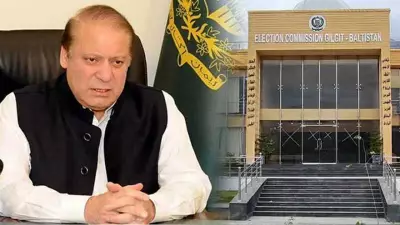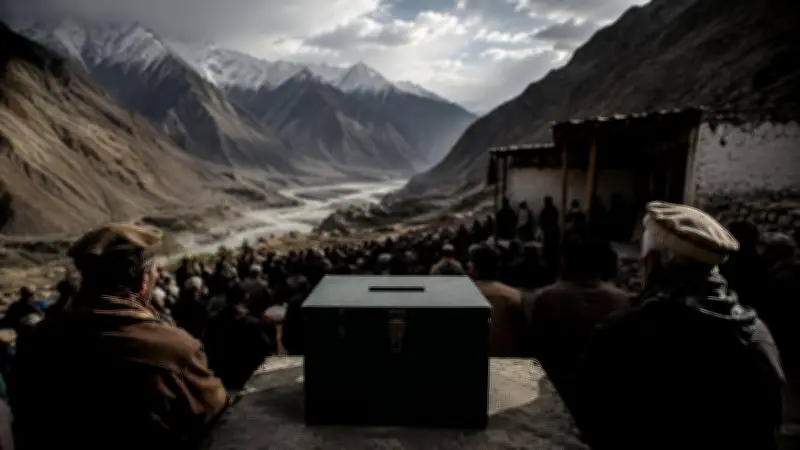
The Hungarian British orientalist Gottlieb Wilhelm Leitner, who came to Gilgit in the second half of the nineteenth century as an agent of the British Empire, left something more enduring than a travelogue. Leitner recounted an ancient legend of the legitimate rule of the Dards of Gilgit in his works on the Dards of Gilgit and Baltistan. This mythological tale was, in its own way, more truthful about power than anything the Election Commission of Pakistan has ever published.
The Legend of Azru Shemsher
According to the legend, Azru Shemsher, the youngest of three fairy brothers, was sent to save the people of Gilgit from Shiribadatt, a tyrant cannibal. He was not endorsed by any party or returning officer as an eligible candidate. His leadership was tested when he fired an arrow across a mountain and hit a wild goat. On the spot, astonished peasants called him their leader. He destroyed the tyrant with fire and was acclaimed as king. From divine choice to popular approval to official proclamation, everything was predicated on a radical idea: the people are the process. Their amazement, recognition, and enthusiasm constituted their authority. After the result, no one came from Rawalpindi, Lahore, or Sindh to declare the outcome.
Historical External Control
During the Maharajas' rule, they sent people to govern the region as their pawns. By the mid-nineteenth century, the selection of rulers in Gilgit was no longer a matter of divine approval or community council. For Srinagar, it was a logistical issue. The Maharaja of Kashmir established his own thanadars and zilladars to administer the land. He held legitimate descendants of the Dard as hostages in Srinagar, not out of cruelty, but for strategic convenience. When he needed a governor in a disputed territory, he supplied troops and chose a family member most likely to remain 'subject to no one but the Maharaja,' as Leitner himself noted. The template was set. Names changed over time: the Maharaja became the British Resident, then the Political Agent of Pakistan, and later the Prime Minister empowered by the Gilgit-Baltistan Order 2018 to function as the ultimate sovereign. But the arrangement—an external hand placing a local face in position and calling it governance—has remained unchanged.

Current Electoral Manipulation
In the midst of this chaos, the banned Tehreek-e-Labbaik Pakistan has fielded its candidate. Yes, they are allowed to contest the elections. The election of 2026 is simply the latest appointment covered by a ballot paper. The playing field for political actors is selectively leveled for favorites. This is not unusual; it has always been the case. In the Legislative Assembly elections of 2009, 2015, and 2020, many political candidates were jailed, and some were added to the list of missing persons. Allegations of rigging have persisted. But this year, the scale of unleveling is unprecedented. The leader of the Awami Workers Party, Baba Jan, and the candidate Fida Muhammad Nashad from the Pakistan Peoples Party have been disqualified for alleged 'concealing facts.' The Pakistan Tehreek-e-Insaf has been deprived of any political space. Its regional president and former Chief Minister, Khalid Khursheed, has been expelled from the region. Central leaders like Asad Qaiser, Junaid Akbar, and many others are not even allowed to enter due to unannounced orders.
Selective Enforcement of Election Code
The Chief Election Commissioner of Gilgit-Baltistan asserted in a press conference that all political parties violated the election code of conduct, resulting in a ban on all central political leaders, federal ministers, and even the Prime Minister from visiting the region for political activity. Yet a day later, Federal Minister and PML-N member Khawaja Saad Rafique, PPP Chairman Bilawal Bhutto, Asifa Bhutto, and retired Captain Safdar arrived in Gilgit-Baltistan for campaigning. Making sense of this democratic mockery is irrational. Since elections in Gilgit-Baltistan are not held concurrently with general elections in the four provinces, favorites become predictable. The rule of thumb is that whichever party holds the federal government automatically gets to govern Gilgit-Baltistan as a free reward.

The Illusion of Independent Governance
Although the Gilgit-Baltistan Order 2018 directly vests ultimate power in the Prime Minister of Pakistan to decide and head the Legislative Assembly, the mirage of independent governance is sold to keep the region's people engaged in a democratic theatre. The Queen of Britain once held ultimate sovereign powers in her colonies. Similarly, the Federal Government, especially the Prime Minister, acts as the monarch of this region. Voters are blindsided, knowing they can never attain rights due to the most illogical reason adopted by policy analysts: the political status must remain undecided until the UN plebiscite on Kashmir. This myth has long been shattered, with the final nail driven by Indian Prime Minister Modi's change to Indian-occupied Kashmir's status. So many take the money offered by candidates. A few choose to remain liberated and hungry as a consequence of upholding their principles.
Political Participation as the Only Lever
Political participation is the only lever the people of Gilgit-Baltistan actually hold, which is precisely why so much effort goes into ensuring they cannot pull it properly. The repulsion being engineered is not accidental. A citizen who stops voting becomes less inconvenient. So the answer is not to stay home. The solution is to be present in such numbers that theft becomes embarrassing, easily seen, and costly. Make rigging challenging. The machinery proved a blessing for PTI in 2020; it is now against them. The machine is not loyal to anyone; it follows instructions. Understanding this makes it easier to navigate. As for whom I am casting my vote, I genuinely do not know yet. Perhaps I will find out after the elections when I discover which candidate the presiding officer decided I voted for. The only agency exercised in elections is the one in Rawalpindi.