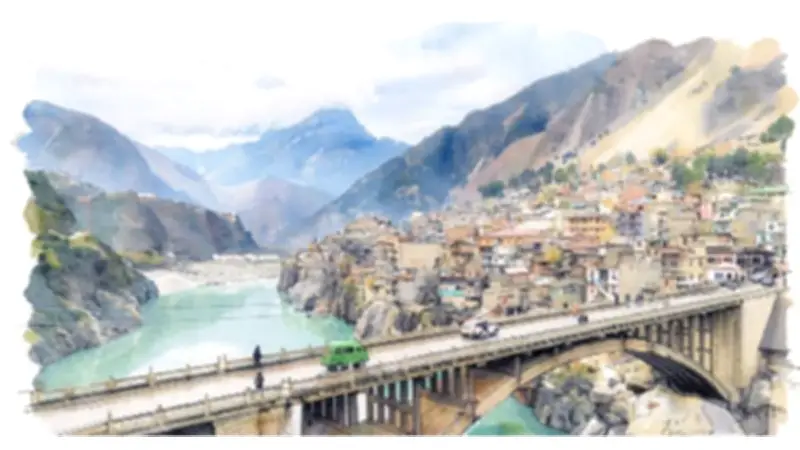
Kohistan, a rugged and distinct human world situated within the mountainous northern regions of Pakistan, is a society shaped by its harsh geography, deep religiosity, linguistic diversity and complex social organisation. Comprising the separate administrative districts of Upper Kohistan, Lower Kohistan, and Kohlai-Palas Kohistan, the region has historically been misrepresented in national discourse as merely a remote or backward periphery. In reality, it is a culturally rich and highly adaptive human system with its own internal logic, in which institutions such as the family and traditional networks serve as vital political, protective and economic structures. However, this unique terrain and its historical semi-isolation have also created developmental challenges. To understand the state of development in Kohistan, one must move past superficial labels and examine how geography, institutional gaps, climate vulnerability and state-driven mega-projects intersect to shape the region's contemporary reality.
The Current State of Development in Kohistan
The developmental landscape of Kohistan is defined by a complex tension between traditional survival strategies and the uneven forces of modernisation. Rather than being a product of mere cultural stagnation, the region's development is deeply constrained by its physical environment and by the state's structural marginalisation. Geography acts as the silent architect of both society and its infrastructure. Towering mountains, narrow valleys, and the fast-flowing Indus River have long isolated various communities, leaving many valleys loosely connected to the outside world. While this terrain allowed local customs, indigenous languages and customary justice to persist, it presents a tacit barrier to modern development. Constructing and maintaining roads, health facilities, and schools is an ongoing battle against landslides, heavy snow and volatile weather. Even though the construction of the Karakoram Highway shattered the region's absolute isolation by integrating it into national markets and introducing state presence, the internal infrastructure within the deep valleys remains severely fractured and inaccessible.
Poverty, Remittances, and the Illusion of Progress
Locals are expected to make massive ecological and ancestral sacrifices for national energy production, yet they are largely excluded from meaningful decision-making and the long-term benefits. This infrastructural deficit directly undermines human development, most notably in education and healthcare. The educational crisis in Kohistan is fundamentally structural rather than a lack of community interest. It is characterised by severe institutional failures, including a lack of physical schools, rampant teacher absenteeism, and deep gender disparities. Furthermore, a deep linguistic barrier exacerbates this crisis. Kohistan is linguistically diverse, home to indigenous languages such as Indus Kohistani, Shina Kohistani, Bateri and Gojri. When local children enter formal schools, they are forced to learn in unfamiliar national or regional languages, leading to systemic alienation, high dropout rates, and the gradual erosion of their cultural memory. For women, the developmental gap is even wider. Formal structures of power, property ownership, and public decision-making are entirely male-dominated, leaving women's key contributions to the domestic and agricultural economy unrecognised and excluded from development planning.

Mega-Projects and Internal Colonialism
In recent years, the political economy of Kohistan has been dominated by large-scale energy projects, most notably the Dasu Dam. While the state frames these initiatives using the language of national progress and modernisation, their localised impact reflects a pattern of internal colonialism or extractive development. For the people of Kohistan, these mega-projects bring immediate disruptions, including forced land acquisition, displacement, economic uncertainty, and altered social configurations. Locals are expected to make massive ecological and ancestral sacrifices for national energy production, yet they are largely excluded from meaningful decision-making and the long-term structural benefits of the development, receiving only temporary employment or fleeting compensation. This creates a deep sense of marginalisation and mistrust toward state authorities.

Climate Vulnerability
Adding to these structural injuries is Kohistan's acute ecological vulnerability. As part of the wider Hindu Kush-Himalayan region, Kohistan faces severe structural environmental risks driven by climate change. Recent years have seen an escalation in unpredictable weather patterns, devastating flash floods, and landslides that immediately wipe out fragile local infrastructure. Because the everyday local economy is highly dependent on subsistence agriculture, livestock management, and natural pastures, any environmental instability poses an immediate threat to human survival, trapping the population in a state of ongoing insecurity.
The Way Forward
Transforming the state of development in Kohistan requires a paradigm shift. The state must abandon top-down, non-participatory models of intervention and adopt strategies that are culturally respectful, ecologically just and socially inclusive. First and foremost, the political economy of infrastructure must be democratised. Mega-projects like the Dasu Dam must transition from extractive ventures into participatory partnerships. The state and corporate entities need to include local populations as equal stakeholders in decision-making processes regarding land and resource management. Beyond temporary compensation, development must offer long-term structural wealth-sharing. This includes binding agreements for permanent subsidised or free electricity for the host districts, dedicated royalty funds channelled into local healthcare and infrastructure, and long-term technical quotas to ensure local youth are trained for high-skilled, permanent positions within these energy sectors.
Educational Reforms
In education, structural and linguistic reforms are urgently needed to counter systemic alienation. Educational planning must institutionalise mother-tongue instruction during early childhood education, utilising the region's indigenous languages to build confidence and enhance cognitive development before transitioning to national languages. To address the physical deficit, the state should aggressively invest in building accessible school infrastructure, particularly dedicated schools for girls, while deploying digital accountability systems to eradicate teacher absenteeism.
Bridging Formal and Customary Systems
Furthermore, development policies need to intelligently bridge the gap between formal state institutions and local customary systems. Because state courts are often expensive, slow, and geographically distant, the traditional jirga remains the primary, culturally intelligible mechanism for dispute resolution and local governance. Rather than demonising the jirga, state legal frameworks should engage with it, establishing human rights checkpoints to ensure that its decisions do not victimise or exclude women and socially weaker groups, who traditionally lack representation in these male-dominated spaces.
Environmental Justice
Finally, given the realities of climate change, all future development in Kohistan should be viewed through the lens of environmental justice. Engineering standards for roads, bridges and public buildings must be upgraded to withstand severe ecological shocks, such as flash floods and landslides. Alongside resilient physical structures, the state must introduce climate-adaptive economic safety nets, such as crop and livestock insurance, and invest in alternative vocational and digital skilling for the youth. As young Kohistanis increasingly navigate a liminal space between local traditions and globalised economic aspirations through migration, equipping them with modern technical skills will enhance their socio-economic mobility and allow them to reinvest in their home valleys.
Kohistan is a resilient society in slow, complex transition, caught between historical isolation, ecological vulnerability and the disruptive forces of modern development. To achieve true progress, development can no longer be measured merely by the volume of energy extracted for the rest of the nation or the length of highways cutting through its mountains. Real development must be participatory, protecting the dignity, languages and ecological safety of the local population. Ultimately, the sustainable future of Kohistan relies on empowering its local scholars and younger generations to lead this transformation, ensuring that knowledge and policy are deeply rooted in their own lived experiences.