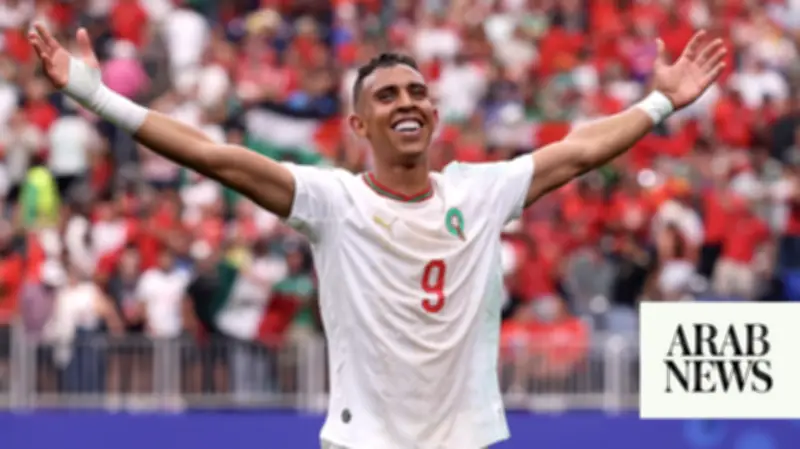
When Ismael Saibari clutched the back of his right thigh just 22 minutes into Morocco’s FIFA World Cup round of 16 clash against Canada, alarm bells started ringing. In a tournament where the Atlas Lions’ glaring weakness had been converting golden chances, losing their top scorer was the last thing they needed. Morocco’s biggest doubters emerged, knowing that Saibari’s absence would mean a weaker offensive display. His replacement was Soufiane Rahimi.
From bench to knockout star
The Al-Ain forward had racked up just 61 minutes of game time before the round of 16, operating as a key bench player for a nation he only truly broke into in early 2024. That gamble had already paid off once, with a late cameo against Haiti producing a goal and an assist in a 4-2 win. Whether he could deliver on the knockout stage was a different question, especially thrust on early through injury rather than as a planned introduction. Yet Soufiane Rahimi is no stranger to defying the odds.
“When I think of Soufiane Rahimi, the first word that comes to mind is hope,” said FIFA content producer and avid Atlas Lions fan Tim Argane. “He’s living proof that a kid growing up playing football in the streets — the ‘drouba’ — of Morocco can dream of playing for the national team and compete on the biggest stage in football.”

A pathway built in Morocco
Rahimi is one of seven players in Morocco’s 2026 squad born in the country. He has never played in Europe, splitting his career between Raja Casablanca and Al-Ain. For Argane, that pathway is central to what makes Morocco’s squad work. “I don’t see the idea that Morocco ‘recruits’ players from abroad as a substantial argument, because at the end of the day we’re all Moroccan,” Argane told Arab News. “What Morocco has done so well is create different pathways to the national team and scout players from all around the world who have Morocco at their heart. You have players like Rahimi who came through the Moroccan league, academy graduates and players who developed in Europe. They’ve all come together because they share the same identity and the same love for the Kingdom.”
Not part of the diaspora, and without the media attention that comes with European football, Rahimi had to build himself from the ground up. His story starts in the 1960s, through his father, Mohammed “Youari” Rahimi. Youari was an aspiring goalkeeper for his boyhood club, Raja Casablanca, until a car accident ended his playing career. Leaving Raja was never an option, though — he stayed within the club’s ranks, working as a baggage carrier and kit man for almost 50 years, even living at the club’s Oasis Sports Complex, where he raised his family.
Father’s dream, son’s destiny
“Youari is a self-made man who served Raja in every capacity, not just as a baggage handler,” said the then general manager of the club, Mohamed Naciri, in a 2015 interview. “He is an adviser, manager and psychologist who treats the most difficult cases we have at Raja with his characteristic sense of humor. He is a father figure to the players ... his loyalty and dedication to Raja have firmly etched his name in the club’s history.”
But Youari had one dream: to see one of his sons play for Raja. His eldest son, Amin, tried first, before stepping into his father’s role at the club when Youari retired in 2015. The onus then fell on Soufiane, who joined Raja’s youth ranks in 2006 at the age of 10 — though his path to the first team was anything but easy. “His journey is different, and that’s what makes it so special,” Argane said. “He was a ball boy at Raja Casablanca; he stayed patient, worked his way through the club, and followed in the footsteps of his father and brother, making his father’s dreams come true through him.”

Loan, breakthroughs, and continental glory
In 2017, when Soufiane was old enough for the senior team, Raja instead sent him out on loan to third-tier EJS Casablanca. He returned with 17 goals in 28 games and never looked back, winning back-to-back Botola Pro Player of the Season awards and helping Raja to their first continental silverware in decades, including the CAF Confederation Cup. His father’s dream was fulfilled. But Soufiane still had a career ahead of him. A move to Al-Ain in the UAE followed, where he continued breaking records, finishing as the 2023-24 AFC Champions League’s top scorer as the club won the title for the first time since 2003.
Olympic record and World Cup impact
A record-breaking 2024 Olympics campaign with Morocco’s U-23 side came next: he became the first player in Olympic history to score in six straight matches, the first since Carlos Tevez in 2004 to reach eight goals, and the first African and Arab player to finish as the tournament’s top scorer. Yet a place in the senior squad remained elusive, with Saibari’s rapid rise limiting Rahimi to 77 minutes across Morocco’s 2025 Africa Cup of Nations campaign. But at this World Cup, he built his form steadily, going from seven combined minutes across the first two group games to a match-winning cameo against Haiti. The real test came against Canada, when Saibari’s injury thrust him into the starting XI far earlier than planned — and he delivered again.
“It comes back to the belief inside this team. Every single player feels they can be the one to make the difference, and no one is made to feel less important than anyone else,” Argane said. “Before the tournament, Abde Ezzalzouli got injured, and he was having the season of his life, but the fans didn’t make El-Khannous feel like a replacement. I think that confidence comes from the whole environment — Walid Regragui built a group where everyone feels trusted, Fouzi Lekjaa has created a structure where every player feels they can make an impact, and coach Ouahbi and the technical staff know how to adapt to situations like this.”
Decisive performance against Canada
Against Canada, Rahimi’s long strides opened up the defense from the moment he came on. In the 48th minute, he forced Luc de Fougerolles into a foul on the right flank that led to Azzedine Ounahi’s opener. Later on, he almost added a third with a header that rattled the crossbar, before breaking into space behind the Canadian back line in the final moments to seal Morocco’s place in the quarterfinals for just the second time in their history.
“You saw it with Issa Diop replacing Aguerd and scoring against the Netherlands, and you saw it with Rahimi against Canada,” Argane said. “When their moment came, they were ready. That trust across the whole squad is one of Morocco’s biggest strengths.”
At one point in his career, Soufiane Rahimi doubted whether he would ever fulfill his father’s dream of playing for Raja Casablanca. Today, he has contributed to another historic run for the senior national team, into the final eight.