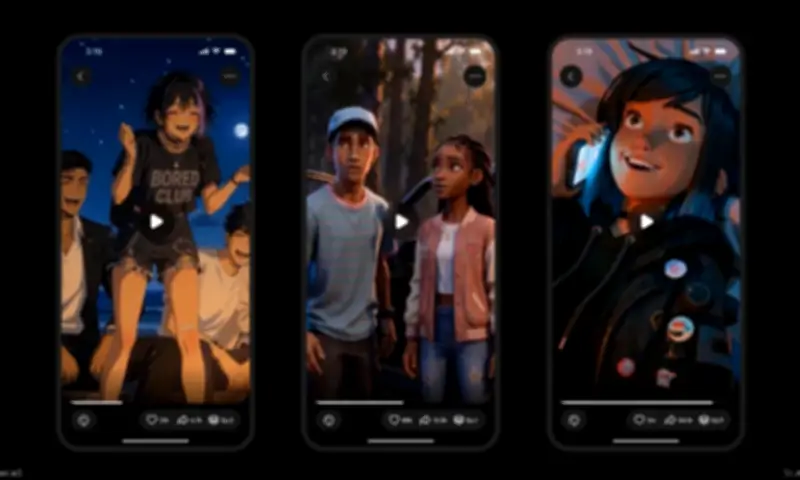
Character.AI has announced the launch of c.ai Series, short-form episodic videos designed to be watched and interacted with on mobile devices, marking a significant expansion beyond its core LLM-powered chatbot platform. The move positions the company in the rapidly growing microdrama industry, projected to reach $26 billion in the coming years.
What Sets c.ai Series Apart
Unlike traditional microdrama services that feature live-action shows with human performers, c.ai Series are animated and almost entirely generated using artificial intelligence. Each microdrama revolves around a set of characters thrust into adventures spanning popular genres like romance, horror, and sci-fi. While other apps like ReelShort and DramaBox offer similar content, c.ai Series distinguishes itself by allowing viewers to chat with characters after watching an episode.
Character.AI is launching three initial projects: Last Summer, a secret admirer story with an anime aesthetic; The Nighttime Game, focusing on friends playing a deadly card game, reminiscent of Netflix's Entergalactic; and Eden Fall, following elite MMO players into a Ready Player One-style virtual reality resembling Genshin Impact. Each series debuts with 10 episodes under two minutes each. The first eight episodes are free for all Character.AI users, while the final two are behind a paywall.

Production and Creative Process
According to Character.AI, the first batch of series was developed by a human-led, in-house studio team “using AI as part of the production workflow.” CEO Karandeep Anand emphasized that microdramas are a natural extension of the platform's evolution. “Microdramas are a continuation of that broader arc of becoming a broader storytelling and entertainment platform that we’ve been on,” Anand said. “This isn’t just a one-off thing we’re doing because microdramas are the next cool thing; it’s a very natural extension of what our users are already doing and it opens up another massive gateway into our community.”
Anand noted that while Character.AI could have launched Series “six months ago by hitting three buttons,” he chose not to rush the release to avoid “putting out video slop.” Instead, the company enlisted a “fantastic team of Hollywood screenwriters” to develop scripts, with a small group of creators penning extensive bibles detailing each story’s lore. These scripts were fed into Character.AI’s proprietary, agentic pipeline to generate visuals and audio, which were then edited with traditional post-production software. Development took a few weeks, on par with live-action microdrama platforms. Anand explained that keeping production in-house ensured visual consistency: “The amount of innovation that has happened with text-focused LLMs has been exceptional, but there haven’t been equivalent advancements in the multimodal image and models. Our models make it easier for us to ensure visual and tonal consistency for characters across different scenes.”
Interactive Features and Safety Measures
Viewers can roleplay or talk to characters from their favorite series, similar to Character.AI’s regular chatbots. Each episode is powered by a unique LLM designed to provide only information established on screen, preventing spoilers. Anand stated these bots are meant to be fun, which is why underage users are barred from interacting with them. Addressing past scandals involving children being encouraged to self-harm by chatbots, Anand insisted the company has implemented hard age verification to enhance safety. At launch, Series is available only to users over 18; younger viewers may eventually watch the shows but cannot chat with series-focused bots.
Market Context and Future Plans
Character.AI’s foray into microdramas follows TV networks like Fox, Bravo, and BET that have adopted vertical video. However, Anand views it as an organic step. In the future, the company plans to let creators produce original microdramas using its AI tools. While the animations are more polished than typical AI-generated content, occasional leaden dialogue and stiff facial expressions reveal the absence of human actors. Nonetheless, the interactive features may attract Character.AI’s user base, which is already accustomed to inserting themselves into fictional worlds.