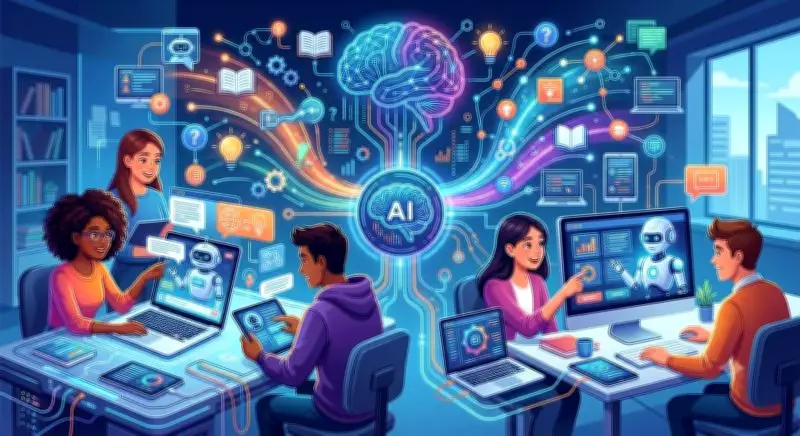
HEC Mandates AI Course for All Undergraduates
Pakistan's Higher Education Commission (HEC) has announced a mandatory three-credit-hour course on Artificial Intelligence for all undergraduate programs across universities in the country. Chairman HEC stated in an official press release that this policy is a timely step towards academic transformation, signalling that AI is no longer an optional addition to university curricula. The move aims to prepare graduates for an increasingly digital economy.
The Faculty Gap: Who Will Teach AI?
While the curriculum reform is ambitious, a critical question remains largely unaddressed: Who will teach AI? Most current faculty members belong to Generation X and Generation Y, having completed their education when deep disciplinary expertise—not AI—defined academic excellence. Linguists, management scholars, educationists, and historians built their expertise around their respective fields, not Artificial Intelligence. This is not a criticism but a reflection of the historical evolution of higher education. For much of the 1990s and early 2000s, AI remained a specialized field within Computer Science and advanced research labs. The rapid advances in deep learning in the early 2010s, followed by generative AI tools like ChatGPT in late 2022, transformed AI into a mainstream academic concern within just a few years. However, academic capacity has not evolved at the same pace.
Teaching AI vs. Using AI
Universities often assume that disciplinary competence automatically translates into AI expertise. Designing AI-integrated courses requires understanding AI concepts, research methodologies, ethical considerations, assessment frameworks, and responsible classroom integration—not just knowing how to use ChatGPT. Such expertise cannot be acquired through occasional webinars or short-term workshops; it requires sustained academic engagement, structured professional development, and interdisciplinary collaboration. Despite this, universities across disciplines—from languages to sociology, management, and education—are increasingly advertising faculty positions expecting AI expertise, exposing a widening gap between policy ambitions and institutional preparedness.

Opportunity, Not Willingness, Is the Real Challenge
The challenge is not a lack of faculty willingness to embrace AI, but a lack of opportunity for them to gain the necessary expertise. Just as a computer scientist cannot become a philosopher after one conference, a historian cannot become an AI curriculum designer overnight. Expertise develops through years of education, research, and practice. Therefore, the future of AI in higher education depends on equipping existing faculty for the AI era through comprehensive faculty development, interdisciplinary collaboration, industry partnerships, structured AI certification programmes, funded research opportunities, and continuous professional learning. Only then can AI become a meaningful educational reform rather than merely another curriculum requirement.