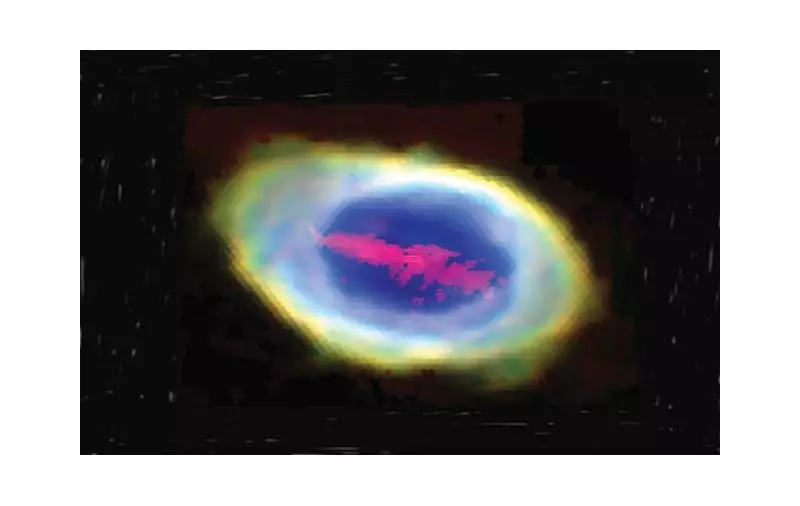
Even the most studied celestial objects can spring unexpected surprises, as astronomers have recently demonstrated with a groundbreaking discovery in the iconic Ring Nebula. According to a report from Space, this familiar cosmic structure, also known as Messier 57 (M57), harbors a mysterious "bar" composed of iron atoms, challenging previous understandings of planetary nebulae.
A Familiar Nebula with an Unfamiliar Feature
The Ring Nebula is a planetary nebula located approximately 2,000 light-years away in the constellation Lyra. Despite its misleading name, it contains no planets; instead, it represents the glowing remains of a sun-like star that exhausted its nuclear fuel. As the star's core collapsed into a white dwarf, it shed its outer layers, creating the nebula's distinctive oval shape, first observed by astronomer Charles Messier in 1779.
Revolutionary Technology Unveils Hidden Details
The discovery of the iron bar was made possible by the William Herschel Telescope (WHT) at the Observatorio del Roque de los Muchachos on La Palma island, Spain. Researchers utilized a new instrument called WEAVE (WHT Enhanced Area Velocity Explorer), specifically its Large Integral Field Unit (LIFU) mode equipped with hundreds of optical fibers. This advanced setup allowed the team to capture a spectrum covering all wavelengths of visible light across the entire face of the Ring Nebula, a feat previously unattainable.

"Even though the Ring Nebula has been studied using many different telescopes and instruments, WEAVE has allowed us to observe it in a new way, providing so much more detail than before," said team leader Roger Wesson of University College London (UCL) in a statement. "By obtaining a spectrum continuously across the whole nebula, we can create images of the nebula at any wavelength and determine its chemical composition at any position."
Characteristics of the Iron Bar
The rod-like cloud of iron atoms is situated within the inner layer of the nebula. It extends for about 1,000 times the distance between Pluto and the sun, with a mass roughly equivalent to that of Mars. Wesson noted that when processing the data, this previously unknown feature "popped out as clear as anything—this previously unknown 'bar' of ionized iron atoms, in the middle of the familiar and iconic ring."
Unraveling the Mystery of Formation
How this iron bar formed remains an enigma for scientists. One hypothesis suggests it may be linked to the process by which the star ejected its outer layers. Alternatively, the arc of iron plasma could result from the nebula's central star vaporizing an orbiting rocky planet as it expanded into a red giant phase.
If the latter theory holds, the Ring Nebula might offer a glimpse into Earth's distant future. In about 5 billion years, when the sun runs out of nuclear fuel and puffs out to become a red giant, a similar fate could befall our planet.
Future Research Directions
Team member and UCL astronomer Janet Drew emphasized the need for further investigation. "We definitely need to know more—particularly whether any other chemical elements co-exist with the newly-detected iron, as this would probably tell us the right class of model to pursue," she said. "Right now, we are missing this important information."
This discovery underscores the importance of innovative astronomical tools like WEAVE in revealing hidden aspects of the universe. As researchers continue to analyze the data, they hope to unlock more secrets about stellar evolution and the complex processes shaping nebulae.