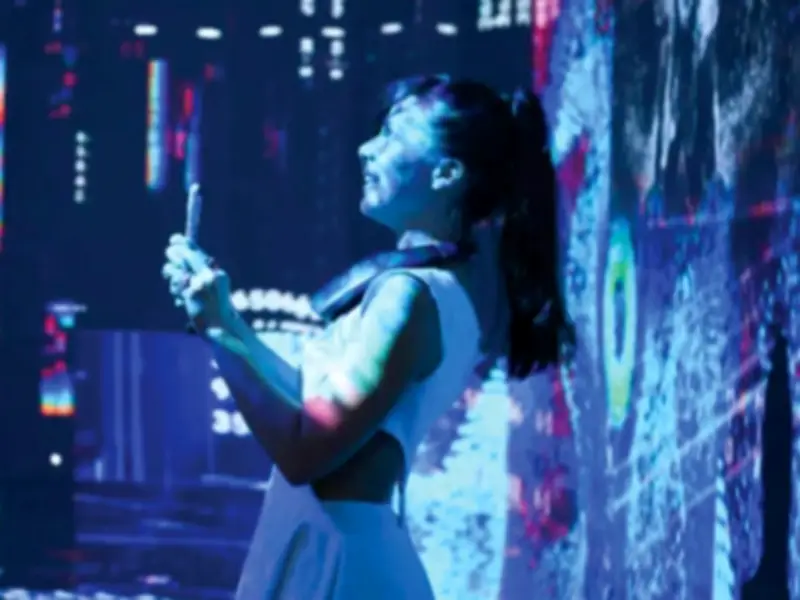
LOS ANGELES: Data collected from visitors—their movements, heartbeats, and even skin temperature—will feed the computer creating the immersive display at Dataland, a new museum in the heart of America's second-largest city. Using a network of sensors, including those on ticket-holders' wrists, the exhibition "Machine Dreams: Rainforest" marks the inaugural show at this innovative venue.
The Vision Behind Dataland
Dataland is the brainchild of Refik Anadol and Efsun Erkilic, whose 10 million lines of code power animations using 1.5 billion pixels. Anadol stated he was inspired by a visit to the Brazilian Amazon, a place he believes everyone should experience. "But I do not believe we should all go to the rainforest," he told AFP. "The question was: can the rainforest come to us? Can we still connect, feel special, respect and love nature, learn about it?"
How the Exhibit Works
Wall-mounted sensors track visitors' movements, while guests wear a medical-grade, watch-like device to monitor their emotions and heart rate. They also carry a portable scent diffuser throughout the experience. Using billions of images and data points, the model creates a constantly evolving display. It is as if the system were "dreaming," Erkilic explained. "It's moving all the time, because it's gathering data. As soon as it builds one structure, it also affects the overall storytelling. It's coming from a more poetic place instead of a scientific place. The machine itself is trying to recreate reality based on the data points; it's like bringing all the little bits and dots and trying to build reality itself."

Tangible Souvenirs
At the end of the experience, visitors can sample chocolates with flavors generated by the model or print T-shirts and paintings resulting from their interaction. These serve as tangible souvenirs of the ephemeral dream in Dataland. "The system forgets you; that is the beauty of it," says Anadol.
Museum Details
Dataland is a planned art museum dedicated to art created with the assistance of artificial intelligence, located in The Grand in Los Angeles. Originally slated to open in late 2025, it will now open on June 20, 2026, and is expected to be the first "museum of AI art." Its partnerships include the Cornell Lab of Ornithology and the Smithsonian. Dataland will be situated near the Museum of Contemporary Art, The Broad, and the home of the LA Philharmonic.
Turkish media artist Refik Anadol is a co-founder of the museum and has pledged that it will promote "ethical AI" and be powered by renewable energy. Anadol's studio has been recognized as a pioneer in using AI models to produce "AI data painting" and "data sculptures." Dataland has been designed in collaboration with architecture firm Gensler and consultancy Arup, spanning 20,000 square feet.
AI Context
Artificial intelligence was founded as an academic discipline in 1956 and has gone through multiple cycles of optimism and disappointment. Funding and interest increased substantially after 2012, when graphics processing units began accelerating neural networks, leading deep learning to outperform previous AI techniques. This growth accelerated further after 2017 with the transformer architecture. In the 2020s, an AI boom has coincided with advances in generative AI, enabling the creation and modification of media. Ethical concerns, AI safety, unintended consequences, long-term effects, and potential existential risks have prompted discussions of AI regulation.