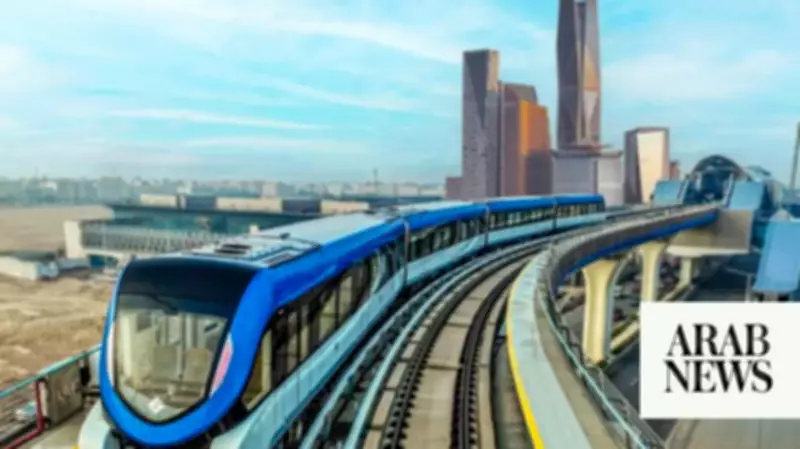
Saudi Arabia's Transport General Authority (TGA) reported that more than 45 million passengers traveled across the Kingdom's rail network in the first quarter of 2026. The urban rail sector alone recorded 42 million passengers, with the Riyadh Metro accounting for 31 million of that total.
Urban Rail and Automated Transport Systems
The TGA highlighted that the automated transport system at King Abdulaziz Airport served approximately 10 million passengers, while the system at Princess Nourah bint Abdulrahman University recorded 621,000 passengers. These figures underscore the growing demand for rail-based mobility, which helps ease urban congestion, improve traffic flow, enhance quality of life, and support environmental sustainability and economic development.
Intercity Rail Services
The Haramain High-Speed Railway, linking Makkah, Madinah, and Jeddah, transported two million passengers during the quarter. The Eastern Railway network, connecting Riyadh with the Eastern Province via Abqaiq, Al-Ahsa, Haradh, and Al Kharj, carried more than 349,000 passengers. The Northern Railway network, running from Riyadh northwest to Al-Haditha near the Jordanian border through Al-Majmaah, Qassim, Hail, Al-Jouf, and Qurayyat, served around 218,000 passengers.

The TGA emphasized that intercity rail transport enhances geographic connectivity as a safe and reliable travel mode, while also reducing environmental emissions, improving transport efficiency, and supporting quality of life.
Freight Transport Performance
In freight operations, the volume of goods transported by rail exceeded 4 million tonnes, including minerals and cargo. The Northern Railway network moved 3 million tonnes, while the Eastern Railway network transported over 448,000 tonnes and 197,000 standard containers. The TGA noted that rail freight improves supply chain efficiency and strengthens logistics connectivity between ports and economic zones.
For comparison, in the first quarter of 2025, Saudi Arabia's rail network carried more than 35 million passengers, with intercity services experiencing significant growth of over 3.4 million passengers.