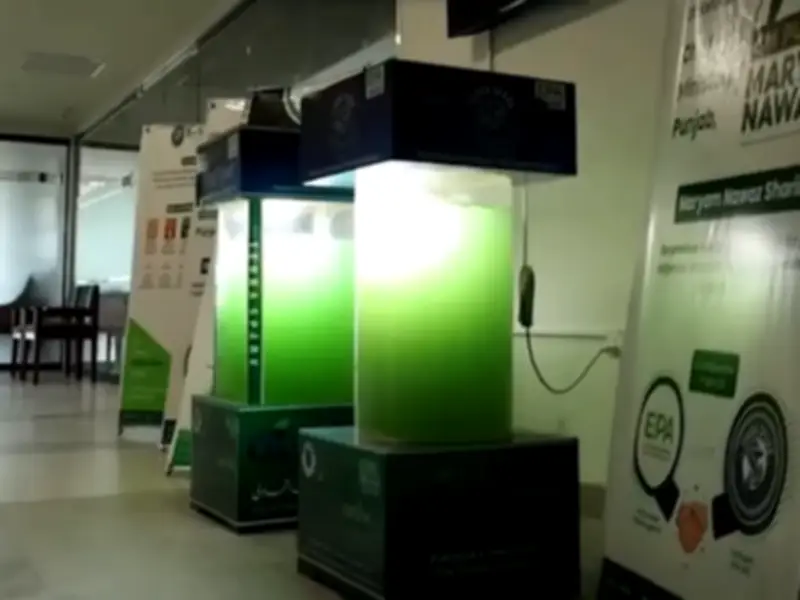
The Punjab government has decided to expand the 'Liquid Tree' project as part of its efforts to promote an eco-friendly province through modern scientific solutions. In a statement, Punjab Chief Minister Maryam Nawaz announced that Pakistan's first EPA-certified liquid tree would be relocated from Faisalabad to Lahore under the expansion plan.
Microalgae Collection and Initial Phase
She revealed that more than 100 species of microalgae have been collected from regions spanning Karachi to Khyber for the project. In the initial phase, liquid trees will be installed in major shopping malls as well as indoor and outdoor public spaces to help reduce urban air pollution.
Scientific Solution to Smog
The chief minister described the initiative as a “scientific and effective solution” to combat rising levels of carbon dioxide and smog in urban centres, adding that it could play a significant role in improving environmental conditions. She termed the project an important step towards environmental improvement, stating that artificial tree installations in commercial and public spaces would contribute to cleaner air.

Officials said the initiative reflects Punjab's broader strategy of adopting technology-driven approaches to address environmental challenges. The Punjab government has placed special emphasis on environment-friendly initiatives, with 2025 witnessing a significant reduction in smog and a marked improvement in air quality across the province.
Improvement in Air Quality
Lahore recorded a noticeable improvement in its Air Quality Index for the first time since the Covid-19 pandemic, while Punjab emerged as the country's top-performing province in environmental protection. According to official data, the average level of particulate matter in Pakistan declined by 8.7 per cent, with Punjab recording a 33.2 per cent reduction.
Last month, the provincial Environment Department ordered the establishment of environmental buffer zones around industrial areas across the province in a bid to curb pollution and improve public health.