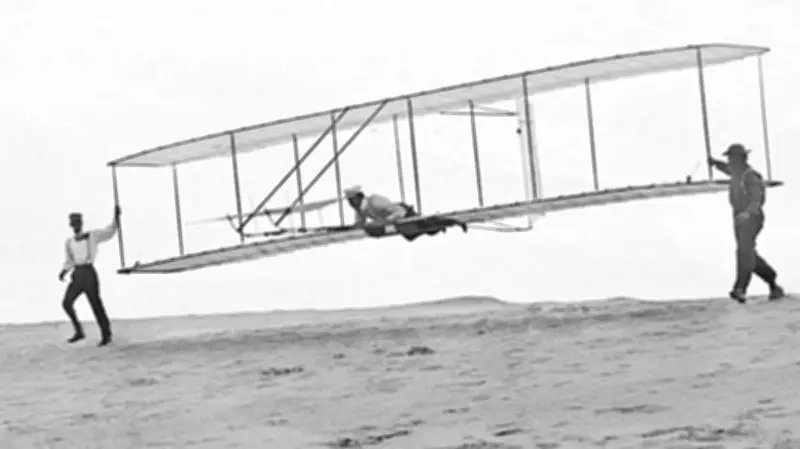
On December 17, 1903, Orville and Wilbur Wright made history by achieving the first controlled, sustained flight of a powered aircraft. Their invention, the Wright Flyer, lifted off from the windswept dunes of Kitty Hawk, North Carolina, flying for 12 seconds and covering a distance of 120 feet. This groundbreaking achievement marked the birth of modern aviation, demonstrating humanity's ability to conquer the skies.
The Historic Flight at Kitty Hawk
The Wright Brothers had been experimenting with gliders and flight mechanics for years before their historic powered flight. On that cold December morning, Orville piloted the Wright Flyer as it took off from a launching rail, with Wilbur running alongside to stabilize the wing. The flight lasted only 12 seconds, but it proved that controlled, sustained powered flight was possible.
According to the Wright Brothers' own records, the flight was witnessed by five local men: John T. Daniels, W.S. Dough, A.D. Etheridge, W.C. Brinkley, and Johnny Moore. Daniels captured the moment with a photograph that became iconic.

Impact and Legacy
The Wright Brothers' achievement laid the foundation for the aviation industry that would transform transportation, warfare, and global connectivity. Within a decade, aircraft design advanced rapidly, leading to the first commercial flights and military aviation. Orville and Wilbur Wright's indomitable spirit and innovative approach to problem-solving continue to inspire engineers and aviators worldwide.
Their success was not immediate; they faced skepticism and technical challenges. However, their systematic method of testing and refinement set a standard for engineering innovation.
Technical Details of the Wright Flyer
The Wright Flyer was a biplane with a wingspan of 40 feet 4 inches and weighed about 605 pounds. It was powered by a 12-horsepower engine designed and built by their mechanic, Charlie Taylor. The aircraft featured a unique wing-warping mechanism for lateral control, a precursor to modern ailerons. The pilot lay prone on the lower wing to reduce drag.
After the first flight, the Wright Brothers made three more flights that day, with the longest covering 852 feet in 59 seconds. The fourth flight ended when a gust of wind damaged the Flyer, but the brothers had already proven their concept.
Today, the Wright Flyer is displayed at the Smithsonian National Air and Space Museum in Washington, D.C., a testament to the dawn of aviation.