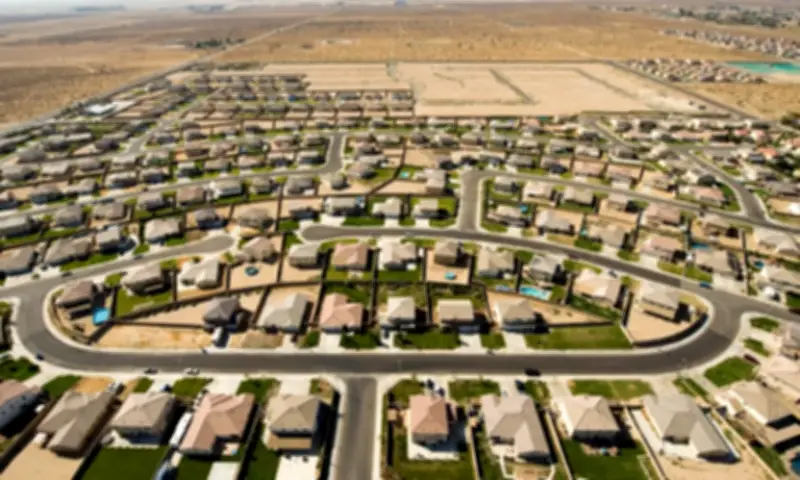
The housing abundance movement has achieved greater intellectual traction than many anticipated a decade ago. Across American politics, even in Zohran Mamdani's New York, it is now increasingly acceptable to acknowledge that excessive regulations hinder housing construction. However, this consensus does not resolve the politically challenging questions of where new housing should be built and what form it should take. Disagreement persists among housing reformers regarding the optimal approach: should efforts focus on adding homes in already vibrant urban and suburban areas, increasing density but facing zoning restrictions and community opposition, or should development occur at the urban fringe through sprawl, where land is cheaper and obstacles fewer?
Infill vs. Greenfield Development
These approaches, known as infill and greenfield development, are not mutually exclusive; with America millions of homes short, most experts advocate for both. However, there are compelling reasons to prioritize building within existing communities. Infill reduces environmental impact, shortens commute times, and fosters compact, walkable neighborhoods. A recent report from the Pew Charitable Trusts' housing policy initiative, the World Resources Institute, and ECOnorthwest highlights an additional advantage: infill can help maintain municipal fiscal health and potentially lower property taxes.
Infrastructure Savings
The researchers simulated future housing scenarios across ten diverse states, including fast-growing Arizona and Texas and slower-growing Pennsylvania. They compared public costs for essential services like roads and sewer lines for homes built within existing communities versus those at the urban fringe. Each home developed near jobs, shops, and transit required approximately $21,000 less in upfront infrastructure expenses, representing a one-third reduction. Ongoing maintenance costs averaged about 50 percent less for infill homes, while these communities generated roughly 13 percent more in property taxes per acre due to higher density.

Urban analysts have long noted this pattern, which largely stems from basic geometry: compact development reduces per-person infrastructure spending and spreads costs across more households. Yet American land-use policies often discourage such growth, favoring single-family homes in low-density areas. With rising interest rates, an aging population, and widespread property tax revolts, fiscal efficiency has become increasingly critical, potentially prompting a reassessment of the nation's outward expansion instinct.
Real-World Examples
Consider University Park, Illinois, a middle-class suburb with about 681 people per square mile, compared to Chicago, which is nearly 18 times denser. University Park serves fewer people per mile of road or piping, resulting in a thinner tax base to support infrastructure. The Pew report notes that home construction in established areas relies on existing infrastructure and includes denser housing types like apartments, duplexes, and accessory dwelling units, which require less infrastructure per unit than detached single-family homes.
While the report uses modeling, its findings align with empirical research. However, cheaper infrastructure does not guarantee overall lower costs. Arpit Gupta of NYU Stern points out that physical infrastructure constitutes only a small share of local government expenses; social spending on healthcare and education is more significant. This explains why dense blue cities like Chicago can still be costly due to higher public sector wages and stringent permitting processes.
Nevertheless, sprawling communities that rely on continuous growth face fiscal strain when growth stagnates. Memphis, Tennessee, exemplifies this. John Zeanah, the city's chief of development and infrastructure, noted that Memphis experienced significant costs from sprawl. By 2015, the city's land area had grown over 50 percent with virtually no population growth compared to 50 years prior, meaning 50 percent more infrastructure to maintain with a stagnant tax base. Memphis is now concentrating investment in existing neighborhoods to reverse these mistakes.

Barriers to Density
American cities and suburbs aiming to shift toward infill face regulatory and cultural hurdles, including zoning codes, parking minimums, NIMBY opposition, and structural incentives favoring outward growth. Tushar Kansal of Pew explained that local jurisdictions can more easily secure funding for new infrastructure than for maintenance, making greenfield development appear attractive in the short term. While fiscal sustainability is a relevant argument amid the cost-of-living crisis, the stronger case for infill rests on human freedom, quality of life, and economic benefits. Legalizing housing where people want to live should be sufficient justification.