On casual days, I find immense joy in the simplest things. A karak cup of tea or a perfectly brewed mug of coffee can have magical effects on my heart and mind. My father is often concerned about my overconsumption of these beverages and says at least once a day, "Mister, I remember quite clearly that I started taking tea long after completing my graduation, let alone coffee". He simply advises me to practise moderation. Every time he witnesses the third or fourth cup of tea being delivered to our study before noon, he lets out a long sigh and walks over to where I sit. The rest that follows is quite predictable. I acknowledge that all his concerns are valid and well-founded. Be that as it may, the heart continues to yearn for such things and one is bound to give in sooner or later. Furthermore, it has now become an everyday affair and I cherish it, for he is someone who is more knowledgeable than I am, cares about me more than I can imagine and thinks of me most selflessly. In Punjabi households like ours, we frequently hear the timeless words of Mian Muhammad Baksh. The Sufi poet's verse, "Baap Siraan De Taj Muhammad" (Fathers are like crowns on our heads, Muhammad), is often repeated by elders and sometimes relevant anecdotes are told to drive the point home.
The Arrival of the King of Fruits
If things were limited to these two beverages, he would probably put up with me. But as soon as the summer season sets in, the king of fruits, the mango, makes its appearance and a new obsession takes root. During the unbearable heat of Lahore, prolonged arguments may succeed in convincing me to reduce one or two cups of tea or coffee a day, especially when those cups are to be replaced with two or more perfectly ripe, juicy and firm mangoes. Although I have always been an ardent lover of fruits, I do not remember exactly when I developed a craze for this seasonal delicacy. Much of the credit goes to my father, whose passion for a healthy lifestyle compels him to keep our fruit stock replenished. All seasonal fruits are sure to be found at our home, except watermelon. Reports of deaths caused by contaminated watermelons in India have made him develop an aversion to the fruit.
The Parsi Lord Of Murree Who Ended Up Pouring Tea In Lahore
From Babur to Akbar and from Shah Jahan to Aurangzeb, all the powerful Mughal emperors had a great fondness for this fruit. Every summer, without fail, we receive large quantities of mangoes through friends and relatives. According to some estimates, Pakistan grows nearly three to four hundred varieties of mangoes. Among the varieties that remain popular and easily accessible are Chaunsa, Sindhri, Anwar Ratol, Langra and Dasehri. Others may disagree, but Chaunsa tops the list for me because of its unique sweetness, exotic aroma and melt-in-the-mouth texture. The firmer it is, the better. For many, it also serves as a cheat meal at night. Cutting a chilled, smooth and unwrinkled mango into slices and eating the pulp off its skin before hitting the hay sweetens one's dreams.


Ghalib and the Imperial Orchard
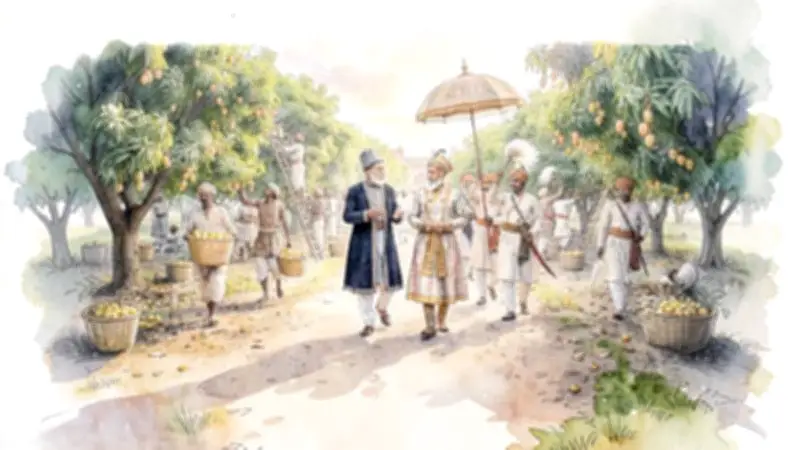
From Babur to Akbar and from Shah Jahan to Aurangzeb, all the powerful Mughal emperors had a great fondness for this fruit. The anecdote involving the last Mughal emperor, Bahadur Shah Zafar, and Mirza Asadullah Khan Ghalib is quite famous. While strolling through the royal garden, Bagh e Hayat, Zafar noticed Ghalib staring at the mango trees. When the emperor asked why he was looking at the mangoes so intently, Ghalib replied with folded hands, as Rana Safvi writes, "My Lord and Guide, some poet once said that every fruit has the name of the person and his ancestors destined to eat it written on it. I am looking for the names of my grandfather, my father, and myself!" At this, the emperor smiled and ordered that a basket full of the finest mangoes be sent to the bard's house that very day. On another occasion, Mirza Ghalib and his friends were savouring mangoes while indulging in lively banter. One of their friends, Hakim Razi ud Din Khan, disliked mangoes and therefore sat at a distance, keeping quiet. When he could no longer bear hearing the praise of mangoes, he picked one up and threw it towards a donkey standing nearby. Much to his delight, the donkey grunted and moved a few paces backwards, apparently indicating its dislike for the fruit. He thought he had finally found a perfect opportunity to mock his friends. Beaming with delight, he said, "Mirza Nousha, see, even donkeys do not like mangoes!" Mirza Ghalib, who was famous for composing exquisite spontaneous couplets and, at times, even complete poems, continued savouring the mango he was holding in his hands. After a brief pause, he came up with a remarkable repartee that continues to be relished to this day. Ghalib Sahib replied, "Mian, it is only the donkeys that do not like mangoes." Everyone sitting around Mirza Sahib burst into peels of laughter at this immortal response, while their friend, burning with embarrassment, walked away without saying another word.
Between Virtuous City And Bare Life: Al-Farabi, Agamben And The Crisis of Human Becoming In The Slum
The rich, dreamy flavour of this fruit continues to reign over the hearts, palette knives, brushes and pens of countless artists and writers. There are some fruits that one eats with a guilty conscience because they remain beyond the reach of the majority of one's fellow countrymen. But this king of fruits is available at affordable prices and, like a just ruler, extends its generosity to all and sundry.