Discovery of Kufic Inscriptions at Al-Sidriya
Early Islamic inscriptions in Kufic script recently discovered at the Al-Sidriya site in Al-Dawadmi, Riyadh region, represent a significant historical treasure. These inscriptions provide insight into the documentation processes of centuries ago and the nature of the script itself. Prof. Salma Mohammed Hosawi, professor of ancient history at King Saud University and a cultural heritage expert, explained the findings.
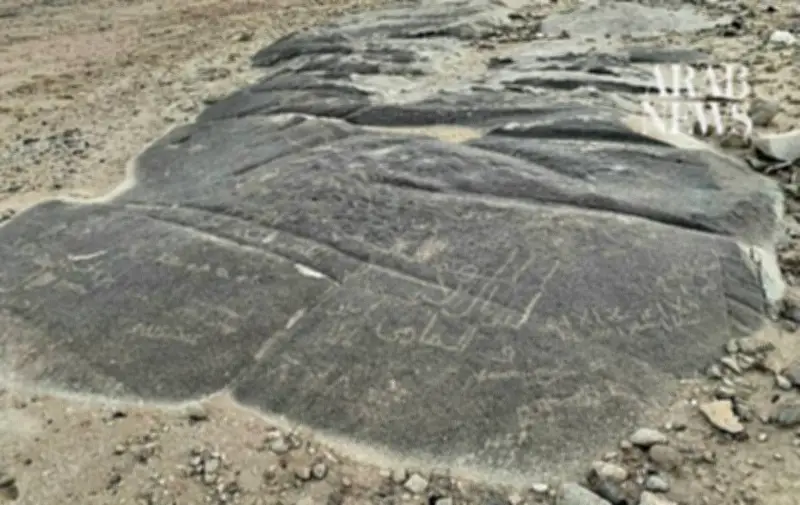
The inscription consists of three lines carved onto a rock face measuring approximately 115 by 60 centimeters. It bears a supplication: “O Allah, forgive Nazzal ibn Husayn and the reader, Amen.” Hosawi noted that the inscription begins with the invocation “O Allah,” a form reserved for prayer and supplication, asking forgiveness for both the writer and his father while inviting readers to join the prayer. “This reflects the values of compassion and mutual solidarity that characterized early Islamic society,” she said.
Dating and Significance of the Inscription
Hosawi confirmed that the inscription dates to the second Islamic century (the 8th century A.D.) and is classified as a personal commemorative inscription. Its author recorded both his own name and his father’s, reflecting the importance Arabs placed on preserving genealogy and identifying individuals through paternal lineage. It also provides evidence of names commonly used during that historical period.

Hosawi suggested that the author may have been a worker at the site, a traveler, or a merchant passing through, particularly since central Arabia was one of the region’s principal caravan routes, explaining the widespread presence of such inscriptions along historic travel corridors. She stated, “Arabic inscriptions are considered more reliable sources for documenting everyday life as their authors personally recorded their own experiences, beliefs, and names, unlike some ancient civilizations that focused primarily on major political and military events.”
Evolution of Arabic Script
Hosawi explained that Arabic script evolved through three major stages. The first was the stage of birth and emergence during the 1st and 2nd centuries A.D., followed by a period of formation and development from the 3rd to the 5th centuries A.D. The final stage was one of independence and stability, during which Arabic script became a clearly defined writing system with its own distinctive characteristics as a uniquely Arabic script.
Researchers have used several methods to date early Arabic inscriptions, including linking them to known historical events, recording dates in Arabic phrases, combining multiple dating methods within a single inscription, and using Nabataean symbols with specific numerical values. These approaches have enabled scholars to determine chronological periods with considerable accuracy.
Dots and Vowel Marks in Early Script
Hosawi noted that “early Arabic script was written without dots or vowel marks, making prior knowledge of the language essential for correct reading.” She added that Abu Al-Aswad Al-Du’ali is credited with introducing the first system of vowel notation. He used colored dots to represent the short vowels “fatha,” “kasra,” “damma,” and “tanween,” distinguishing them from the original text to facilitate accurate reading without errors.
Arabic calligraphy is one of the prominent cultural and civilizational elements that has shaped the identity of the Arab and Islamic world throughout the centuries. It has transcended its role as a means of writing to become a visual art form that reflects religious, aesthetic, and historical values.
Kufic Script as Cultural Heritage
Hosawi emphasized that “Arabic calligraphy—especially Kufic script—is one of the most important elements of Islamic cultural heritage because of its close association with writing the Holy Qur’an and with Islamic ornamentation.” She added that the use of Arabic calligraphy extended far beyond recording texts. It became an important decorative element in mosques, buildings, and homes, both inside and out, as well as on furniture, coins, clothing, and wall murals, evolving into an artistic and cultural expression that reflected the richness of Islamic civilization.

Kufic script is one of the oldest Arabic-Islamic scripts. It originated in the city of Kufa in present-day Iraq during the first Islamic century, after the city was founded in 638 A.D. by Sa’d ibn Abi Waqqas during the caliphate of Umar Ibn Al-Khattab. The script developed significantly as Islamic civilization flourished and spread throughout the Islamic world. It remains in use today in various forms, including foliated Kufic, inspired by plant motifs, and square Kufic, known for its geometric design.
Saudi Arabia’s Commitment to Calligraphy
Saudi Arabia’s designation of 2021 as the “Year of Arabic Calligraphy” reflects the leadership’s commitment to preserving this cultural heritage and supporting efforts to safeguard it and pass it on to future generations, ensuring that Arabic calligraphy remains a symbol of cultural identity and artistic excellence in the face of rapidly evolving technological change.