The tradition of astrolabe making in Mughal Lahore represents a unique but often overlooked achievement in the city's cultural history. While Lahore is widely celebrated for its monuments, miniature paintings, calligraphy, gardens, and decorative arts, it also emerged as one of South Asia's most important centres for scientific instrument production. Between the sixteenth and seventeenth centuries, a remarkable family of craftsmen contributed significantly to Lahore's rise as a hub where astronomical knowledge and skilled metal craftsmanship developed together. Their instruments travelled across Asia, Europe, and the Middle East, preserving the memory of a period when scientific knowledge, artistic skill, and courtly patronage existed in close relationship. The surviving astrolabes and celestial globes produced by this family reveal an important but neglected dimension of Lahore's intellectual heritage.
The Astrolabe: A Medieval Scientific Marvel
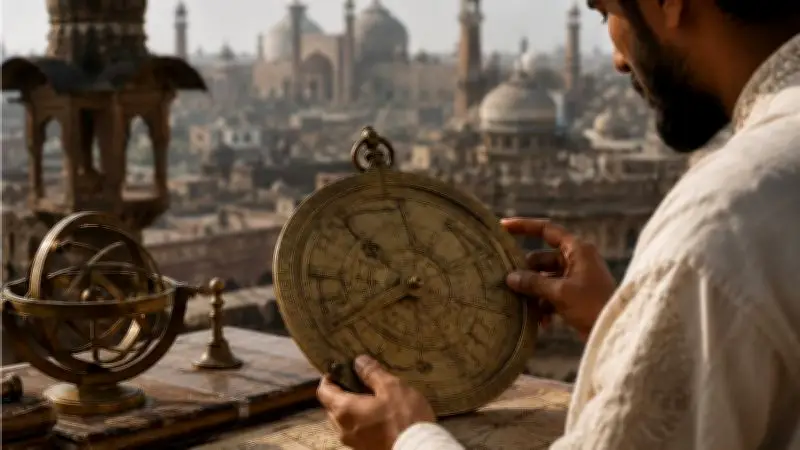
An astrolabe was one of the most important astronomical instruments of the medieval world. Although its origins lie in ancient Greek astronomy, it was greatly developed in the Islamic world, where scholars refined its design and expanded its applications. In simple terms, it was a portable instrument used to observe and calculate the positions of celestial bodies. It helped users measure the altitude of the Sun and stars, determine time, assist navigation, and solve certain mathematical problems. In Islamic societies, it also served practical religious purposes, particularly in calculating prayer times. According to Mubashir-ul-Haq Abbasi and Sreeramula Rajeswara Sarma, the astrolabe was used by astronomers, surveyors, geographers, mosque timekeepers, and other learned communities, making it both a scientific device and a practical instrument of everyday life.
Lahore's Rise as a Centre of Astrolabe Production
The rise of Lahore as a centre of astrolabe production was closely connected with the wider cultural environment of the Mughal Empire. During this period, Lahore developed into a major centre of skilled production, supported by imperial patronage and a sophisticated artisan economy. Although the exact beginnings of astrolabe making in Lahore remain uncertain, available evidence shows that the craft was firmly established by the sixteenth century and continued for several centuries. Saifur Rahman Dar notes that Lahore became one of the most celebrated centres of astrolabe manufacture, producing fine instruments from the sixteenth century until the nineteenth century. He places astrolabe making within Lahore's broader tradition of excellence in crafts such as painting, book binding, carpet weaving, and decorative arts.

The Allah Dad Family: A Hereditary Tradition
The most famous group associated with this tradition was the family of Allah Dad, the astrolabist known as Asturlabi Humayuni Lahori. Their workshop became the foundation of one of the most remarkable hereditary traditions in the history of scientific instrument making. Early research by Syed Sulaiman Nadvi brought attention to this family when he identified astrolabes and celestial globes made by its members. Later studies expanded this knowledge and established a genealogy extending over several generations. Sarma records that more than one hundred signed instruments by members of this family are known today, belonging to seven makers across four successive generations. About 120 astrolabes and 25 celestial globes attributed to this family are known to survive in museums and private collections across India, Pakistan, the Middle East, Europe, and the United States.
The earliest well-documented figure of this family was Sheikh Allah Dad, followed by his son Mulla Isa, his grandsons Muhammad Muqim and Qaim Muhammad, and later descendants including Diya al-Din Muhammad. Their inscriptions on surviving instruments often recorded their names and ancestry, allowing historians to reconstruct their lineage. Allah Dad's importance lies not only in establishing a recognised workshop tradition but also in creating the foundations of what later became known as the Lahore style of astrolabe making. His surviving instruments display early features that were refined by later generations, particularly delicate openwork designs and artistic patterns that became associated with Lahore-made astrolabes.

The Humayuni Title and Its Significance
The title "Humayuni" associated with the family has attracted considerable scholarly discussion. Earlier interpretations connected it directly with Emperor Humayun, suggesting that the family produced a special type of astrolabe linked with the emperor. However, Sarma argues that the term should be understood in the sense of royal association rather than as evidence of a separate type of astrolabe invented for Humayun. The title nevertheless reflects the prestige enjoyed by the family and their relationship with the Mughal courtly world. Their instruments became recognised not only for their accuracy but also for their refined appearance, and the designation "Asturlab Lahori" became associated with precision and aesthetic quality.
Muhammad Muqim: Master of the Lahore Tradition
Among the greatest makers of this family was Muhammad Muqim, grandson of Allah Dad, whose works represent the maturity of the Lahore tradition. His surviving instruments demonstrate the combination of mathematical precision and artistic craftsmanship that made Lahore astrolabes famous. Abbasi and Sarma note that the known astrolabes made by Muqim date between 1609 and 1659, showing his long and productive career. His achievements included both extremely small and highly elaborate instruments. One of his most remarkable accomplishments was the creation of the world's smallest astrolabe, measuring only 43 millimetres in diameter. Such examples demonstrate that Lahore makers were not simply reproducing standard designs but were experimenting with scale, complexity, and artistic expression.
Celestial Globes and Technical Innovations
The achievements of the Lahore family extended beyond astrolabes to the production of celestial globes. These globes represented the heavens in three-dimensional form and served important educational and astronomical purposes. The Lahore makers introduced significant developments in their manufacture, particularly the technique of casting hollow globes as a single piece through the lost-wax method. Sarma attributes the development of this technique to Qaim Muhammad, while his son Diya al-Din Muhammad further excelled in producing refined examples. Their celestial globes demonstrate that the family's contribution extended beyond practical instruments to the artistic representation of astronomical knowledge itself.
Surviving Examples in Museums
A particularly important surviving example of Muhammad Muqim's craftsmanship is the astrolabe dated 1047 AH (1637–38 CE), now preserved in the Islamabad Museum. Its inscription identifies Muqim as the son of Isa and grandson of Allah Dad, confirming his place within this famous lineage. Another undated astrolabe by Muqim remains in the Lahore Museum. These surviving instruments provide direct evidence of the quality of Mughal scientific craftsmanship and demonstrate how Lahore artisans produced objects valued far beyond their immediate surroundings.
Astrolabes as Repositories of Geographical Knowledge
The Lahore astrolabes also reveal the close relationship between astronomy and geography during the Mughal period. Several instruments produced by the family contained geographical information, including lists of cities with their latitudes and longitudes. Allah Dad's astrolabes, for example, included geographical tables containing information about various cities, while later members of the family continued this practice. Such features show that astrolabes were not merely tools for observing the heavens but also repositories of geographical knowledge. The inclusion of geographical information connected these instruments with the wider intellectual interests of their makers and users.
Prestige and Patronage
By the seventeenth century, Lahore astrolabes had become more than practical scientific instruments. Their detailed craftsmanship, rarity, and association with learned culture meant that some elaborate examples were valued not only for practical use but also as objects of prestige among elite patrons. Their combination of scientific precision and artistic beauty gave them a special place within Mughal culture.
Global Reach and Legacy
The reputation of Lahore's astrolabe makers extended far beyond the Mughal Empire. Their instruments are now preserved in important collections around the world, including museums and libraries in India, Europe, and the United States. Sarma notes that Lahore-made astrolabes are found in institutions such as the Ashmolean Museum in Oxford, the British Museum in London, museums in Jaipur, and other collections. Their survival across continents reflects the international appreciation of Lahore's scientific craftsmanship.
Continuation of the Tradition
Although the greatest fame of Lahore's astrolabe tradition belongs to the Mughal period, the city's specialised instrument-making tradition continued beyond the seventeenth century. Later makers in Lahore, including Lala Sahu Mal and Ustad Pir Bakhsh, demonstrate that the city retained its reputation as a centre of astronomical craftsmanship into the nineteenth century, even though they belonged to a wider tradition rather than the Allah Dad family lineage.
A Forgotten Chapter in Intellectual History
The history of Lahore's astrolabe makers represents a forgotten chapter in the intellectual and artistic history of South Asia. Their achievements challenge the idea that scientific history belongs only to scholars and court astronomers. In reality, craftsmen played a crucial role in transforming knowledge into physical objects. The makers of Lahore united astronomy, mathematics, metalwork, and artistic design, creating instruments that were both functional and beautiful. Today, the astrolabes and celestial globes created by the Allah Dad family and other Lahore craftsmen remain powerful reminders of the city's wider historical identity. They show that Lahore was not only a centre of imperial architecture and artistic expression but also a place where scientific knowledge was preserved, developed, and transformed into objects of lasting cultural value. The legacy of the Lahore astrolabists therefore deserves recognition as an important contribution to the global history of science, craftsmanship, and intellectual exchange.