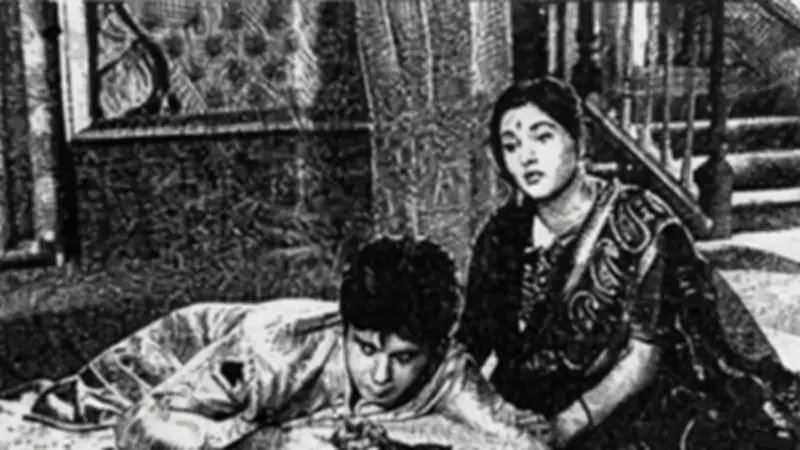
When asked about his greatest role, Dilip Kumar softly and slowly answered, 'Devdas.' He explained why playing the title character in Devdas was so significant. Based on a popular classic, the story captured a central conundrum of Indian society. Set in turn-of-the-century rural Bengal, it was the tragic tale of two lovers trapped by caste laws. Devdas moves inexorably to his self-inflicted doom but keeps his promise to visit his beloved before dying. She is married to a man of similar caste. Fatally ill from alcoholism, he barely arrives to take his last breaths outside her home. Their love was doomed from the start, and Dilip's role as the tragic lover became a highlight of Indian cinema.
Personal Impact of Devdas
There was a personal reason Dilip mentioned Devdas. He prepared for roles by inhabiting the character, and for Devdas, he became the doomed lover. The film released in 1955, winning him the Filmfare Award for Best Actor, the Indian equivalent of the Oscars. After filming, the pessimism of the character lingered, affecting his personality. He sought physicians' advice, who recommended lighter, jovial roles. A string of hits followed, including Kohinoor, Ram Aur Shyam, and Leader.
Encounter in Quetta
In 1988, as Commissioner in Quetta, Balochistan, I was asked to escort Dilip Kumar and his wife Saira Bano during their visit to Pakistan. Despite tensions between India and Pakistan, their visit was noteworthy. I received them at the airport, accompanied them to the local hospital, lunch at Governor's House, and rest at the VIP resthouse before seeing them off. We were alone in the car, giving me a chance to talk with Dilip. He engaged like a practiced diplomat or polished artist, making me feel like an old friend.

At the airport, a crowd gathered to bid farewell. I witnessed his genuine star power, recalling how his film Aan was so popular in Pakistan that it played in Karachi for years. At my boarding school in Abbottabad, a boy named Chu replaced Dilip's face with his own in a poster, causing outrage among classmates. Later, in East Pakistan, I saw a large portrait of Dilip Kumar in a cinema lobby as a stand-alone tribute. In London, I watched Devdas again, marveling at his performance. His dialogue, 'Which unfortunate drinks to cope with life? I drink so that I can breathe,' remains iconic.
Reunion in London
Over a decade later, we met again in London. I had left my post as High Commissioner for Pakistan to the UK, and he was visiting. At a farewell dinner at Mohsin Akhtar's farm, Dilip and Saira Bano were guests of honor. He seemed aged but spoke eloquently and gracefully. SS Pirzada, advisor to the President of Pakistan, testified to my integrity and character. The evening was widely reported in Urdu press.
Life and Legacy
Dilip Kumar's personal life had the quality of a film script. He was destined to marry Madhubala, but they fell out during Naya Daur, ending in a court case. In 1966, he married Saira Bano, 22 years younger and an ardent fan. He later married Asma Rahman in 1981, but it didn't last. He had no children with Saira, who cared for him devotedly, elevating her to legendary status.
Born Muhammad Yusuf Khan in Peshawar, he debuted in 1944 as Dilip Kumar. The 1950s, the golden era of Indian cinema, saw him dominate. He died in 2021 at 98, with a career spanning 57 films. He won the most Filmfare awards for best actor, and in 2013, Filmfare declared him 'the biggest superstar of all time.' His name became synonymous with heroic tragedy.
Early in his career, he established himself as a serious actor playing doomed lovers, with sad, soulful songs. Classics like Uran Khatola, Babul, Daag, Devdas, Deedar, and Andaz earned him the title 'king of tragedy.' He won best actor awards consecutively, making the award meaningless. He received eight Filmfare awards and 19 nominations. In 2011, he was voted 'The Greatest Indian actor of all time' in a Rediff poll, and he holds the Guinness world record for most awards by an Indian actor. Mughal-e-Azam is considered the greatest film of all time.
Later, he played mature roles. He was appointed Sheriff of Mumbai and received civil awards from India and Pakistan, including the Nishan-i-Imtiaz in 1988. His old house in Peshawar was declared a national monument in 2014.

Cultural Bridge
Dilip Kumar's name was greater than the sum of its parts. He was acknowledged by presidents and prime ministers of several countries. Generations of actors copied his style, including Amitabh Bachchan and Shah Rukh Khan. In Pakistan, Santosh Kumar and Nadeem imitated him. His name evoked romance and tragedy, confronting the beauty of humanity. Men wanted to be him, women yearned for his devotion. He had a commanding presence, contrasting with flamboyant contemporaries like Raj Kapoor and Dev Anand.
His stature as possibly the greatest movie star in India is unchallenged, symbolizing a pluralist and tolerant society. Viral videos testify to his iconic position. In one, he stands with Dharmendra, who adored him. Dilip says, 'I asked God why did you not make me as handsome as Dharmendra?' Dharmendra's joy is priceless as he bows to touch Dilip's feet. Saira Bano and Dharmendra argued over who loved Dilip more.
Dilip's relationship with Nehru was widely known. Another viral video shows Dilip recounting censor board issues with Ganga Jamuna, the only film he produced. He spoke in the local dialect Poorbi, method acting at its finest. The censor board demanded cuts, but Dilip met Nehru, who passed the film without a single cut.
David Lean offered Dilip the role of Sharif Ali in Lawrence of Arabia, but he declined. The role went to Omar Sharif, whom Dilip felt played it better. It's a 'what if' question: had he accepted, would he have played roles like Dr Zhivago?
Dilip was never a stage actor but brought a stage-like style: slow, measured speech, minimal movement, and gravitas. South Asian society has deep structures, including religious identity. To many Muslims, Dilip Kumar is the ultimate screen hero, and his Muslim identity adds to his halo. For non-Muslims, questions of loyalty arise, but he never abandoned his faith. During the 1965 war, authorities invaded his home, confiscating a radio. He was criticized for accepting Pakistan's civil award. Yet, Hindu comments often express affection, citing blessings from Bhagwan. Dilip became an immutable cultural bridge between nations and communities, an icon of peace.