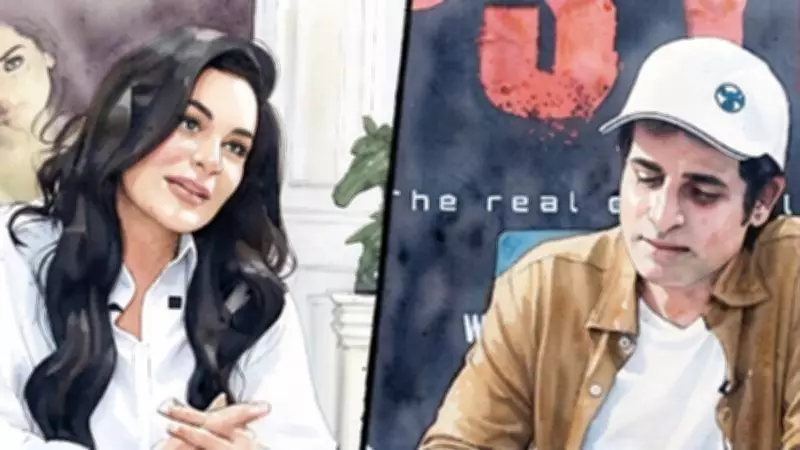
The recent interview of film actress Meera by Irshad Bhatti has not merely sparked a controversy; it has ripped open an old and festering wound in our media culture. For some viewers, this interview was a serious violation of professional and parliamentary decency—a relentless excavation into a woman's personal life, presented as journalism but, in reality, an act of brutality. For others, and this is far more disturbing, the interview became a source of satisfaction—a chance to watch a powerful woman made uncomfortable, symbolically stripped naked under the studio lights.
This divide in public reaction—some recoil, others take pleasure—is no minor disagreement of taste. It is irony upon irony: we claim to be shocked that a journalist can dig so deep into a woman's private affairs, yet a large segment of the audience consumes this discomfort as entertainment. And the double irony is that the journalist himself, and many like him, genuinely believe they possess an absolute right to ask anything, their professional ethics and human compassion disappearing like a wolf in the jungle hunting a weaker animal.
The Question of Media Psychology
The question is not merely about one interview or one actress. The question is about the psychological makeup of our media persons who operate not on gender sensitivity but on the shallow currents of personal likes and dislikes, and it is necessary to ask: is this a matter of a lack of training, a lack of exposure, an ego problem, male dominance, or something far deeper embedded in our cultural and philosophical foundations? And is this sickness confined only to film actresses, or does it extend to women in show business, women in politics, and women as a whole?

To understand what happened in that studio, one must first abandon the comforting illusion that this was an isolated lapse in judgement. Rather, it was a terrifying storm of institutional failure and individual entitlement, and its roots lie deep in the psychological structure of a particular kind of journalist—one who sees his profession not as a service to truth but as a vehicle for his ego. Such a journalist mistakes aggression for courage, intrusion for depth, and the discomfort of the interviewee for the authenticity of the question.
He operates under a male epistemological framework: the belief that his own curiosity, his own likes and dislikes, are sufficient justification for any question, no matter how invasive. In this worldview, the woman across the table is not an autonomous human being with dignity, agency, and boundaries; she is an object, a text to be read against her will, a puzzle to be solved even if solving it causes her pain. This is not journalism. It is a performance of dominance dressed in the garb of a profession. And it thrives because the newsroom, still largely male-dominated and rigidly hierarchical, rewards such behaviour with ratings, clicks, and the silent admiration of colleagues who mistake cruelty for fearlessness.
The Male Gaze in Media
From a literary perspective, Laura Mulvey's concept of the 'male gaze' is highly useful in illuminating this phenomenon. In cinema and literature, women have long been portrayed as spectacles—passive objects to be looked at, dissected, and judged by an active male viewer. Bhatti's interview fully borrowed this grammar. Meera was not engaged in dialogue; she was placed under a microscope. The questions were not designed for insight or understanding but to provoke a reaction, preferably one of pain or humiliation.
Here we catch a glimpse of the literary 'grotesque,' in which human beings are reduced to their most vulnerable, often shameful aspects and paraded for public consumption. But where satirists like Swift or Rabelais used the grotesque to expose social hypocrisy, the aggressive journalist uses it only to feed his own ego and the audience's voyeurism. The result is neither art nor serious inquiry; it is a ritual of public undressing, carried out under the banner of press freedom.

Political Dimensions: Beyond Film Actresses
Politically, this issue extends far beyond film actresses. Ask any woman in public life—whether a politician, a corporate leader, or a journalist herself—about her experience with media interrogation, and she will describe a familiar pattern. Her work will come after her clothing, her policies after her marital status, her achievements after her alleged moral failings. A male politician is asked about his governance. A female politician is asked why she does not marry, or why she wears a particular kind of clothing, or how she balances home and career. This is not critique. This is surveillance, rooted in the patriarchal system.
It is necessary to recall three famous incidents that illustrate the absurdity and pervasive nature of this behaviour. The first is that of former German Chancellor Angela Merkel, counted among the most powerful politicians in the world. During an interview, she was asked about her clothing. The journalist pointed out that she often wears similar suits, as if this were significant news. Merkel replied with great composure, confidence, and boldness. She said: 'I am not a model girl. I am a politician.' Her words shattered the premise—she challenged the very foundation of the question. Her argument was that the question of clothing, whether its quantity or style, has no relevance to the foundations of politics. Furthermore, she demonstrated that asking such questions is against media ethics, because they neither serve the public's right to information nor relate to any notable policy or performance.
Benazir Bhutto and Hina Rabbani Khar
The second incident is from our own society, and perhaps even more painful because it is associated with one of our great leaders. Benazir Bhutto, the first woman prime minister of the Muslim world, was a personality whose political insight, sacrifices, and connection with the people are part of history. But during her tenure and afterward, certain circles of the media targeted her simple and modest clothing for criticism. She was accused of being allegedly careless about her dress—as if this carelessness were a political crime. Benazir Bhutto spent her entire life in public service, endured the darkness of prisons, suffered the hardships of exile, and ultimately sacrificed her life. Rarely was there as deep a discussion of her political decisions, her democratic struggle, or her visionary leadership as there was of her dupatta, or the colour and fabric of her shalwar kameez and Tasbeh. It was not only inappropriate but tragic that a woman prime minister had to be endured for her outward simplicity rather than her capabilities.
The issue is that when a male leader wears simple clothing, it is interpreted as humility and approachability, but when a woman does the same, it is seen as carelessness or deficiency. Benazir Bhutto's case is the worst example of this double standard.
The third incident further reinforces this same absurdity. When Pakistan's former foreign minister Hina Rabbani Khar visited India, at a time when relations between two nuclear powers were extremely delicate and important negotiations were underway, the media's focus, instead of being on her diplomatic skills or her stance, centred on her clothing and her handbag. A beautiful and confident woman foreign minister, representing her nation, was subjected not to serious questions but to hearing how much her bag cost and why she wore a dupatta of a particular colour. These questions were not only a violation of professional ethics but also ignored the fact that Hina Rabbani Khar was on a highly important diplomatic mission. Her clothing and bag were no measure of her diplomatic capabilities, yet the media turned these very things into news. Perhaps even more painful was that such attention conveyed the message that to understand a woman's capability, one must first scrutinise her physical appearance—as if a woman cannot be serious until she dresses according to male standards.
Common Thread: Scrutiny of Appearance
These three examples—Merkel, Benazir Bhutto, and Hina Rabbani Khar—share a common thread: all of them faced a line of questioning that had no relation to their political capabilities or public role. Merkel immediately rejected it and proved her mettle. Benazir Bhutto faced a criticism that never ended, even though she never changed her simple lifestyle. And Hina Rabbani Khar became part of a conversation in which the price of her handbag was discussed more than her diplomatic performance. These three incidents indicate that the problem is not confined to any single country or media house—it is a universal attitude in which women are first judged by their physical appearance, and only then by their work.
These incidents of Merkel, Benazir Bhutto, and Hina Rabbani Khar are very close to Meera's interview. In both cases, women were asked about their bodies, their choices, or their physical appearance—not about their work or their ideas. The only difference is that a global leader like Merkel had enough power and dignity to immediately ethically reject the question, while Benazir Bhutto faced such criticism throughout her political life, and Hina Rabbani Khar had to endure it during an important diplomatic visit. Meera, being a film actress, perhaps suffered from a lack of that same power, which made the interview more painful and imbalanced. But the principle is the same: to ask any woman—whether chancellor, prime minister, foreign minister, or actress—questions about her appearance as if it were part of her qualification is, in fact, professionally and ethically unjustified.
Meera's interview is not an anomaly but a symbol. When a journalist asks personal questions without any public interest, he is not exercising a professional right but enforcing a social hierarchy under which women's bodies, choices, and vulnerabilities are considered public property. For every woman, the political message is this: you are never safe from interrogation, because your self was never your own.
Ethical and Philosophical Dimensions
Ethically, the matter is clear. The fundamental principles of journalism—dignity, informed consent, relevance, and minimising harm—have all been violated. The question is: what public interest was served by making Meera uncomfortable? None. The audience's prurient curiosity is not public interest. The journalist's ego cannot erase the dignity of the interviewee. Such a question is not ethical inquiry; it is an attack on personhood.
Philosophically, this is 'egoistic epistemology'—the belief that one's own curiosity justifies every question. The journalist becomes a god. This is the same failure that Levinas called ethical violence: in the face-to-face encounter, seeing an opportunity for domination rather than responsibility. The interviewee exists only to serve the journalist's desires.
From the woman's perspective, this message is uniform across all professions. The actress is asked about her relationships rather than her art; the politician about her sari rather than her legislation—just as happened with Benazir Bhutto and Hina Rabbani Khar, and just as Merkel bravely rejected. The woman journalist is asked about fashion rather than foreign policy. The ordinary woman understands that her public presence will always be subject to the kind of interrogation that her male counterpart never has to endure. Meera's discomfort was shared by every woman who has ever been asked, in a professional environment, something that had no relation to her profession.
Systemic Solutions
Then what can be done? The solution must be systemic, not symbolic. First, mandatory gender-sensitivity training must not only be a requirement for every journalist, editor, and producer, but also part of continuous ethical formation, rather than a one-time workshop. Second, every media house should establish an independent internal ombudsman—a body with real authority to review complaints about invasive questioning and impose consequences for violations. Third, professional press councils must move beyond weak statements to actual sanctions, including public censure and suspension of credentials for repeat offenders. Fourth, media literacy campaigns should be launched to educate the public about why certain questions are harmful, so that public demand shifts from sensationalism to substance. Fifth, newsroom leadership must be held accountable: editors and producers who greenlight or praise interviews that cross ethical lines should face equal scrutiny, because they create the culture in which individual journalists feel empowered to act like wolves. Sixth, safe reporting mechanisms must be created so that those harassed during interviews can complain without fear of professional retaliation. And finally, and most fundamentally, media organisations must actively promote women to leadership positions—not as tokens but as decision-makers who shape editorial policy, because diverse newsrooms make better ethical decisions, and representation at the top changes incentives all the way down.
Conclusion
Meera's interview is a mirror. The problem is not limited to film actresses. Until we train our media to see women as human beings rather than spectacles, and until audiences stop considering spectacle as legitimate journalism, this cycle will continue. The wolf still roams the jungle—just a man with a microphone in his hand. Now it is time to build fences—not around women, who have already been fenced in enough—but around the ethics of those who claim the right to question.