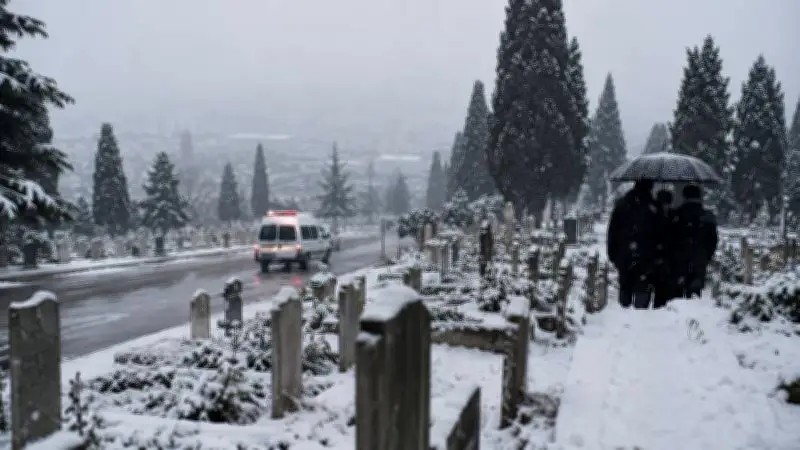
The first snow of the season had fallen over Istanbul overnight. Quietly, without warning. In the hush of that dull January morning, we followed the small white ambulance as it moved slowly through the outer suburbs of the city, its red hazard lights blinking faintly through the grey air. Beside me sat his widow, Rafat, wrapped in silence, her face turned toward the window where snowflakes gathered briefly before melting away. Istanbul, usually restless and impatient, seemed subdued beneath the snowfall. Minarets receded into the mist. Rooftops disappeared under a thin whitening veil. Only the low hum of the engine and the crunch of tyres over slush disturbed the stillness.
I found myself wondering whether he would have preferred Beethoven’s Fifth or Ninth Symphony, or perhaps the haunting soundtrack of Wong Kar-wai’s In the Mood for Love, as the music accompanying his funeral. We were driving toward a graveyard on the edge of the city. A quiet place far from the crowds and noise, where rows of dark cypress trees stood against the winter sky. The sloping hill where his grave had been dug was slippery with fresh snow, and at one point I almost slipped into the grave myself. Adeel Khan’s long journey was ending there, far from home. He had seen only fifty-seven springs in his life. Only five people attended his funeral.
The circumstances of his death seemed almost unreal. For nearly two weeks, we searched for him, trying to trace the solitary traveller who had disappeared somewhere between Turkey and Morocco. His phone remained switched off. Embassies, police stations, hotels — everyone drew a blank. It was as if he had vanished into thin air. Then, without warning, a sealed envelope arrived by ordinary post at the Australian Embassy. Inside was a brief notice stating that an unclaimed body carrying an Australian passport had been found in a hotel room in Istanbul. He passed away peacefully in his sleep due to a silent heart attack. He had once told Rafat that wherever in the world death found him, he should be buried there. Perhaps that had always been his secret wish: to disappear quietly into the dusk of life. Rafat honoured that wish.

Early Life and Journalism
I first came to know him during his years at Dawn. He was a handsome young Pashtun who walked with a slight limp, a reminder of childhood polio. In those days, he was known as Liaquat Adeel Khan. Later, out of an aversion to his namesake, Liaquat Ali Khan, he quietly discarded “Liaquat” and became simply Adeel Khan. Before joining Dawn, he had worked for Frontier Post, The Nation and The Muslim. I was already familiar with his interviews with Dr Najibullah, Wali Khan and Altaf Hussain.
Adeel was born in Mardan, where his father served in the police. He was the youngest child in the family — deeply loved, pampered and, by his own admission, somewhat spoilt. He completed his Master’s degrees in Philosophy and International Relations from Peshawar University. He was a great connoisseur of Western classical music and tried, albeit unsuccessfully, to initiate me into the fine art of listening to symphonic music. His favourite composers were Mozart, Beethoven, Chopin and Strauss. Once, perhaps naively, I asked him how one could enjoy opera so deeply without understanding the language. He replied that music could be understood and felt in any language, regardless of whether one knew its words or rules.
A few years before his death, while I was telling him about Dmitri Shostakovich’s Leningrad Symphony — performed during the siege of the city in the Second World War as an act of defiance against fascism — I noticed tears in his eyes. For him, it affirmed his conviction that music was among the highest forms of human expression, and perhaps also of resistance. An Andy Warhol portrait of Beethoven was a permanent fixture on the wall of his Karachi apartment.

Marriage and Move to Australia
In the early 1990s, he became a frequent visitor to our home. He would jokingly complain that Hoori and I were doing very little to help him find a wife. One day, while browsing through our wedding album, he became captivated by a photograph of one of my cousins. I flatly refused to introduce him to her, telling him that she was an accomplished young woman and that, given his ethnic background and political views, her parents would probably never agree to the match. But he did not give up. He kept enquiring about her. A few months later, I discovered that he had somehow managed to find his way to her office and introduce himself. It was an extraordinary story. After an initial rejection, he persisted with remarkable patience and sincerity and eventually married her with the full consent of her parents. Not only that, they grew really fond of him in subsequent years.
Adeel’s family travelled from Mardan to attend the wedding. When I arrived at the venue, I was startled to see him stepping out of his car alone. With my embarrassingly backward social instincts, it had never occurred to me that it was my responsibility to bring him to the venue as part of a proper baraat. Fortunately, this seemed the least of his concerns, as his favourite music from Chopin, Strauss and Tchaikovsky played in the background throughout the evening. Soon after the marriage, he and Rafat left for Australia.
Academic Work and Intellectual Contributions
Our correspondence continued over the years, and he kept me informed about the progress of his studies and academic work. He undertook another Master’s degree and his thesis was titled The Politics of Islam in a Post-Colonial Society. From a journalistic background, he evolved into a sociologist and political thinker associated with the University of New England in Australia, where he taught sociology and health-related social sciences.
Adeel’s intellectual work revolved around questions of identity, nationalism and the uneasy relationship between the state and its diverse peoples. His doctoral thesis, later published as Politics of Identity: Ethnic Nationalism and the State in Pakistan, examined how Pakistan inherited the highly centralised structures of the colonial state and how this, in turn, generated recurring ethnic tensions among Sindhis, Baloch, Pashtuns and Mohajirs. Rejecting simplistic explanations of “ancient ethnic rivalries,” he argued that ethnic nationalism in Pakistan was rooted in political exclusion, uneven access to power, and the state’s attempt to impose a singular national identity through bureaucracy, language and ideology. He viewed Pakistan not as a complete break from colonial rule but, in many ways, as a continuation of its administrative logic under new rulers.
One of the more original aspects of his work was its emphasis on what he described as varying “distance from and proximity to the state.” Groups benefiting from access to state institutions behaved differently from those excluded from them. He also argued that many European theories of nationalism could not adequately explain ethnic politics in postcolonial states like Pakistan because colonialism had produced a very different form of state formation in South Asia. Another major theme in his work was the continuity between the colonial and postcolonial state. In one chapter, he described Pakistan as the “nationalisation of the colonial state.” In other words, independence changed the rulers but preserved much of the centralised machinery of colonial governance.
What made Adeel’s work distinctive was not only the depth of its scholarship, but also its morally charged, philosophical and reflective tone. He wrote less like a detached academic and more like someone wrestling with the human consequences of power, alienation and exclusion. Even in his most theoretical passages, one sensed the presence of exile and the search for dignity within fractured societies. His work engaged critically with Eric Hobsbawm, Marxist approaches, and postcolonial theories of nationalism. Scholars such as Dipesh Chakrabarty and Partha Chatterjee praised his work for offering a provocative reinterpretation of ethnic politics in Pakistan.
Personal Interests and Legacy
Among fiction writers, he admired Shakespeare, Dickens, Steinbeck and the great Russian novelists. The last book he gifted me was on comparative religion, a subject he was teaching at the time. During a visit to Pakistan in the mid-1990s, he brought me more than a dozen films from the world of alternative cinema — works by Akira Kurosawa, Wong Kar-wai, Federico Fellini, François Truffaut and Abbas Kiarostami. From then onward, cinema became one of our favourite subjects of conversation, a dialogue that continued until his death. It was he who introduced me to the richness of alternative cinema, after which Hollywood films became difficult to endure, with the occasional exception of Woody Allen, whom he greatly admired.
A couple of years before his passing, he suffered a knee fracture that left him depressed for a long time. A few months after his death, I received a large consignment of his books and films, sent to me by Rafat. It remains one of the greatest gifts I have ever received — second only to the library my father left behind for me. Most of the books are heavily underlined and carry his notes in the margins. I know Adeel would have smiled approvingly at Rafat’s gesture. Even today, whenever I watch a remarkable film, my thoughts instinctively return to him, as though I still need to hear his opinion, to discuss a scene, an ending, a line of dialogue. Some friendships continue like that long after death — quietly, persistently — through books, music, films and memory.