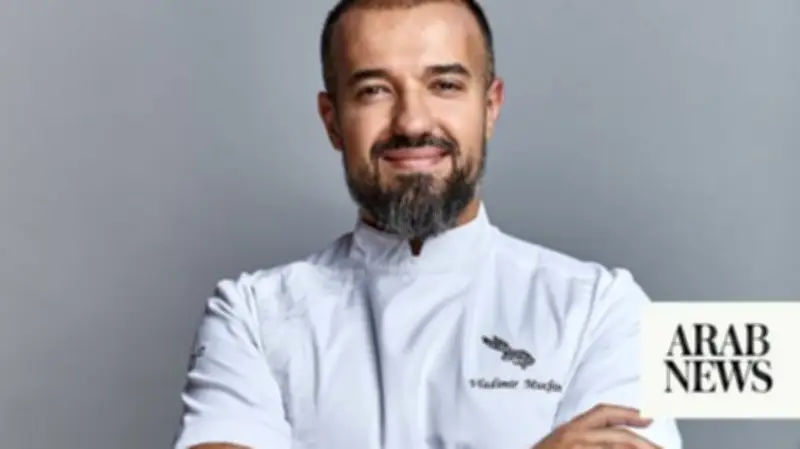
Vladimir Mukhin, a fifth-generation chef who has earned global recognition for reinterpreting Russian cuisine, shared his philosophy on discipline, disrespect for ingredients, and the influence of Salvador Dali in an interview with Arab News. Born in Essentuki, Russia, Mukhin began his kitchen career at age 12 in his father’s restaurant and later studied catering technology at the Plekhanov Russian University of Economics. He completed internships in restaurants across France, Spain, and Japan.
Accolades and Achievements
Mukhin has amassed numerous accolades over the years. He led White Rabbit, a Moscow restaurant that earned a Michelin star in 2021, appeared in Netflix’s “Chef’s Table” in 2016, and was recognized as the ninth-best chef in the world by The Best Chef Awards in 2019. He is currently the brand chef and co-founder of Sakhalin Dubai, where he crafts a menu blending Mediterranean and Asian influences with Russian regional traditions.
Early Mistakes and Lessons
Reflecting on his early career, Mukhin said, “I started working in the kitchen aged 12 and my first mistake was one that every young chef makes: I thought that cooking a dish was the whole profession. Put a plate in front of the guest and you’re done. But the process goes so much deeper than that. It starts with finding the product, communicating with the farmer, understanding where an ingredient comes from. The moment I grasped that, my cooking changed completely.”

Tips for Home Cooks
Mukhin advised home cooks to never think about the cost of a dish. “The moment you start counting pennies, the best ideas disappear. My father told me that, and I believe it absolutely. The second thing is to respect the ingredients. Buy one great seasonal product and don’t overwhelm it. The best dishes are the ones where nothing gets in the product’s way.”
Key Ingredients and Critiques
When asked about one ingredient that can instantly improve any dish, Mukhin responded, “Happiness hormones. I’m not joking: the mood you’re in when cooking comes through in the food. But if we’re talking about a specific product, then good butter and the right salt go a very long way. But, honestly, the main thing is always a quality central product. No spice in the world can fix bad meat.”
Mukhin admitted that he critiques food when dining out. “It’s an occupational hazard. I always notice details in other restaurants. But I also welcome criticism of my own work.” He identified common mistakes in restaurants: “When a restaurant doesn’t understand who its guests are. My rule is simple: either do it brilliantly — ‘Wow!’ — or don’t do it at all. Restaurants that do things ‘just fine’ are the most dangerous places to be. Another thing that always bothers me is disrespect for the ingredient — when a great product gets buried under layers of sauces and techniques.”
Favorite Cuisines and Dishes
Mukhin expressed his love for Asian food: “It’s honest, precise, and there’s a deep respect for flavor in it. But traditional Russian cooking is my favorite. Lamb neck with prunes — my grandmother Fedosya Kireyevna’s recipe — that’s my benchmark. When I find something in a restaurant that has that same depth of flavor and meaning, I’m a happy man.”
For quick home cooking, Mukhin said, “I go to the market, pick up something seasonal and fresh, and by the time I’m walking home, I already know what I’m making. I remember every flavor I’ve ever tasted; I can reproduce something I tried on my last trip note for note. So, at home, I usually cook whatever inspired me most recently. It could be something incredibly simple — eggs, good bread, the right fat. The key is to stay unhurried on the inside, even when you’re rushing on the outside.”
Guest Behavior and Pet Peeves
Mukhin expressed frustration with guests who come for status rather than food. “When a guest comes not for the food, but for the status. When they’re staring at their phone instead of actually tasting the dish. We’ve put a story into that plate — a product from some village in Siberia, a technique that took months to develop — and the person photographs it and pushes it aside. The other thing is when guests modify a dish beyond recognition. It’s like asking Dali to remove the elephants from his painting.”

Favorite Dish to Cook
Mukhin’s favorite dish to cook is borscht with fried crucian carp. “It’s a reworking of my grandmother’s recipe, and it’s personal to me. Everything about Russian cuisine is in that dish — roots, memory, and a certain boldness. These are exactly the kinds of dishes I want to show the world; not ‘beautiful plates,’ but living stories.”
Most Difficult Dishes
He noted that simple dishes are the most challenging. “When there are only three components on the plate, there’s nowhere to hide. That’s the real challenge. The hardest thing is to make something delicious that everyone already knows: borscht, pelmeni, kasha… Everyone’s tried them, everyone has an opinion, everyone has a grandmother with her own version.”
Leadership Style
Mukhin described his leadership as disciplined. “Discipline is the foundation of everything… Early mornings, late nights, willpower, total commitment. From childhood I knew that more was expected of me than of others — my father showed me no special treatment, even when I was a trainee. That shaped in me a deep understanding: you always do what you’re capable of, regardless of circumstances. I welcome criticism and I give it — for me it’s an opportunity to improve, not a blow to the ego. Shouting is unproductive, but there’s no room for complacency in my kitchen.”
Recipe: Sakhalin Salad
Chef Vladimir’s Sakhalin Salad includes: 45g skinless tomatoes, 45g avocado, 30g iceberg lettuce, 45g Kamchatka crab meat, 35g tobiko caviar, 25g mayonnaise, and 10g sweet chili sauce. Method: Dice tomatoes and avocado into small cubes. Finely shred iceberg lettuce and break crab meat into bite-sized pieces. Mix mayonnaise and sweet chili sauce. Using a ring mold, layer ingredients in order: tomatoes, avocado, lettuce, crab meat, spreading sauce between layers. Top with tobiko caviar and serve immediately.