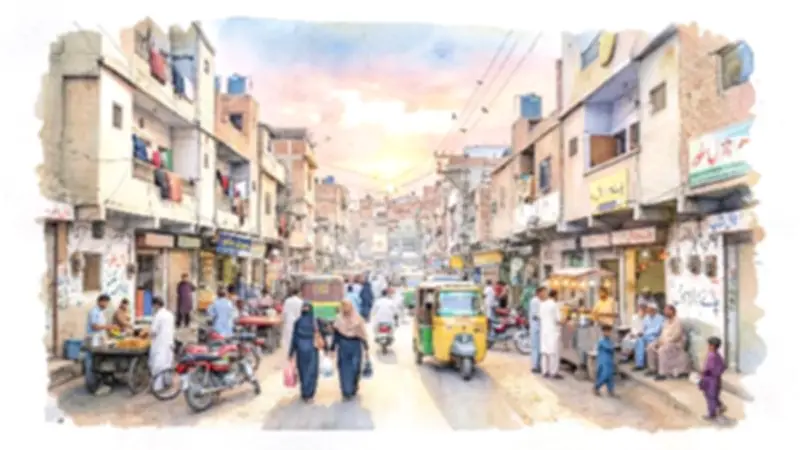
Khurshid Hasnain's recently published novel Manzar Aik Bulandi Se is a significant, refreshing, and thought-provoking addition to contemporary Urdu fiction. It is not merely a story; rather, it presents, through the language of fiction, a complex social landscape where the city, informal settlements, land, class conflict, political violence, the land mafia, religious sentiment, art, nature, local wisdom, and human hope are all interwoven. In this sense, the novel becomes a literary document of an age in which, in the name of development, the land and its inhabitants are under threat; indeed, their connections to their collective memory are often threatened.
The Author's Background
Khurshid Hasnain's own intellectual and creative background is important for understanding the novel. He has a history of association with progressive political and literary organisations and activism. As a student leader, he was the General Secretary of the Karachi University Students Union in the mid-1970s. During the same period, he was a founding Secretary of the Young Writers Forum, an organisation under the mentorship of stalwarts like Syed Sibte Hasan, Mirza Zafrul Hasan, Fehmida Riaz, and many other progressive intellectuals of that period. However, he chose a career as a physicist and academic and later, as a science diplomat in an international organisation. To this variety in his personal background, he added his activities as a short story writer and a poet with a published volume of poetry. Science and literature are often treated as two separate worlds, but in reality, both are rooted in observation, curiosity, creativity, and discovery. Science seeks to understand the structure of the universe; literature seeks to understand the inner world of human beings and society. In Khurshid Hasnain's work, these two attitudes meet: on one side, the precision of scientific observation; on the other, the literary command of language and narrative.
The Novel's Structure and Themes
A novel is not simply a long story. A short story depends on unity, concentration, and a single dominant effect, whereas a novel allows plurality, diversity, contradiction, and the full unfolding of characters within the wider movement of life. One of the major strengths of this novel is that it does not remain limited to one incident or one central character. It brings many characters, many classes, many interests, and many social forces into a single artistic frame. There are several stories in the novel, but they are not scattered. They connect with one another and finally move toward a central social conflict.

The setting of the novel is Karachi and its surrounding settlements. This is a world where the big city, with all its power, greed, fear, and possibilities, advances toward informal and semi-urban areas. In this landscape, there is a hill, a stream, foliage, rocks, local people, Hakim Sahib's small medical practice, and alongside all this, a development project that sees land not as land but as raw material for profit. This is the basic conflict of the novel: nature versus capital, land versus occupation, human beings versus systems, and memory versus a ruthless idea of development. The informal settlement is not outside the city; it is the hidden conscience of the city, and Manzar Aik Bulandi Se brings this hidden conscience into view.
Key Characters and Their Significance
Hakim Sahib is a highly significant character in the novel. He treats people using local herbs and fruits. From a mysterious local fruit, Yamla, there emerge juice, jelly, and eventually the possibility of pharmaceutical development, culminating in the conception of a medicine called Shifa-es-saelein. At first glance, this may appear to be an interesting plot device, but it carries several layers of meaning. On one level, it symbolises indigenous knowledge, traditional wisdom, natural resources, and a form of understanding deeply rooted in the land. On another level, it reflects the fear that governments, corporate interests, or powerful institutions might one day take control of this local secret. In this way, Hakim Sahib's modest enterprise comes into conflict with larger economic and political systems.

Prince, or Shahjahan, is another central character. His past is tied to political violence, student politics, party affiliation, forced tasks, extortion, kidnapping plans, and the bloody history of the city. He is not a born criminal. He is a young man from a lower-middle or modest background who becomes trapped in political organisations, power games, and the violent machinery of the city. Through this character, the novel shows how political groups use young people as fuel for their own agendas in the name of rights and struggle. Prince's life becomes an example of how a person may enter a river by choice, but once inside, he no longer controls the current.
Khawaja Sahib, the land developer, with a history of successful housing projects behind him, represents another level of class transformation, capitalist power, and cultural hollowness. He rises from a simple lower-class background and becomes a wealthy and influential builder. But the novel raises an important question: does wealth automatically give a person cultural refinement? Does economic progress transform the inner structure of personality? The answer offered by the novel is largely negative. Childhood, upbringing, social environment, class deprivation, and early experiences leave deep marks on a person's character. Khawaja Sahib's wealth gives him power, but it does not give him inner refinement. Through him, the novel exposes the contradictions within capitalist development.
Land and Identity
One of the most important intellectual concerns of the novel is the human relationship with land. In a society like Pakistan, this question has always been complicated: what is our real relationship with our land? Do we love it, or do we merely exploit it? Do we value our local culture, environment, plants, soil, and memory, or are we ready to erase them in the name of progress? In the novel, people may, however unwillingly, abandon their ancient abodes, but they resist the destruction of a hill with which they have a spiritual connection. This contradiction reveals a deep psychological complexity in Pakistani society, where practical attachment to land may be weak, but symbolic and spiritual attachment can remain extremely powerful. The novel does not merely speak of geography; it opens up social psychology. The hill, stream, bushes, Yamla, shrine, rocks, and spiritual associations are not merely scenic details. They are parts of a collective subconscious. For the land mafia, these are obstacles to their development schemes. For the local people, on the other hand, they are part of identity, belief, habit, memory, and belonging. This is why the title Manzar Aik Bulandi Se becomes not only a physical view from a height, but also an intellectual elevation from which the city, settlement, land, power, and human relationships can be visualised together.
Art, Nature, and Power
Sofia, the photojournalist, represents a modern form of observation, record, and expression. She brings gardens, fruits, rocks, and natural structures resembling human forms into public view. The idea of a famous artist turning these rocks into sculptures introduces the relationship between art and nature. But as soon as art, nature, and public interest come together, religious forces, criminal elements, spectators, capitalist interests, and political fears all become active. In this way, the novel shows that in our society, even an apparently innocuous thing (art, nature, medicine, land, a shrine, a rock, or a road) can quickly become part of a larger game of power.
The relationship between the city and the informal settlement is also very important in the novel. The big city looks down upon the informal settlement, yet it depends on it for labour, service, cheap land, political crowds, and economic advantages. The informal settlement is not outside the city; it is the hidden conscience of the city. Manzar Aik Bulandi Se brings this hidden conscience into view. The novel reminds us that a city is not only made of high-rise buildings, roads, projects, and investment. It is also made of those people who live on its margins, work for it, and yet are denied an equal place on its map.
Language and Style
In terms of language, one of the novel's great strengths is its fluency and its close relation to the social background of the characters. The language of different classes and characters is not identical. In the dialogues, one can feel differences of social position, environment, profession, upbringing, and mental level. This prevents the novel from becoming artificial. Khurshid Hasnain's style is graceful, sharp, and flowing. He does not merely narrate events; he creates atmosphere. His work may be linked with the tradition of external realism, but he gives that tradition new meaning in the context of Karachi, its surrounding settlements, land mafia, and environmental crisis.
Plot and Structure
The plot of the novel is quite well-organised. Several streams flow together: Prince's past that continues to haunt his present, the artist Azar's obsession to carve statues from the rocks on the threatened hillock, Hakim Sahib's family and the mysterious fruit and the medicine derived from it, Sofia's journalistic intervention and her probing of Azar's past, Khawaja Sahib's building project, and the concerns of the local population and their attachment to the hillock. While these elements are interesting individually, the success of the novel lies in the way they are tied together within a common tension. One does not feel that the writer has merely placed four or five separate stories side by side. Each story connects with the other and pushes the central conflict forward.
Another important quality of the novel is that while it does not elaborate on the political violence of the past, its echo remains present throughout the narrative. In Karachi's recent history, the atmosphere of political organisations, student politics, clean-up operations, extortions, kidnappings, disappearances, and consequent terror has been deeply felt. The novel gestures towards that history without turning itself into a journalistic report. This is the strength of fiction: it captures structures more than names, effects more than events, and human wounds more than historical headlines.
Female Empowerment
An important aspect of the novel that deserves attention is its subtle but meaningful portrayal of female empowerment. This dimension is part of the narrative, though it can easily be overlooked in a review focused mainly on land, class, and urban transformation. Hakim Sahib, although he belongs to an older social world, does not confine his daughter to a conventional domestic role. He gives her an important place in his work and does not object to her friendship with Shahjahan (Prince), even though there is a palpable emotional current between them. This suggests a changing attitude toward women in urban society.
Similarly, Khawaja Sahib's family presents another significant example. His uncle, later to be his father-in-law, does not bequeath the entire business to him alone; he also gives his daughter a dominant role in the business he leaves behind. Gradually, she moves from the position of a silent partner to an equal participant. The final lines of the novel, spoken through her voice, are especially meaningful. They suggest that when women are given equality, respect, and a genuine share in decision-making, marital relationships do not become weaker. On the contrary, they become stronger, healthier, and more balanced. In this sense, the novel presents female empowerment not as a threat to family life, but as a source of greater maturity and stability within human relationships.
Critical Reservations
Now, if one turns toward critical reservations, the first question concerns the psychological complexity of the characters. The characters are interesting, active, and socially meaningful, but at certain points, they appear to represent a class, force, or attitude, more than fully independent individuals. Prince, Khawaja Sahib, Hakim Sahib, Sofia, and others are important within their own domains, but if their inner conflicts, fears, regrets, confusions, and psychological fractures had been opened further, the human dimension of the novel would have become even deeper.
A second reservation concerns some symbolic elements. The hill, rocks, sculptures, Yamla fruit, and Shifa-es-sailene are rich in meaning, but at times their symbolic significance becomes somewhat too visible. They variously represent nature, spirituality, local knowledge, capitalist occupation, and social spectacle, but in some places, the reader may feel that the writer is pushing these symbols forward consciously rather than allowing them to merge more silently into the flow of the narrative. Had these symbols been absorbed more quietly, their artistic effect might have been even stronger.
The third point concerns the multiplicity of the plot. The various elements, such as the bid to acquire a path for the new colony and the tussle between various interests on this issue, Hakim Sahib's medical experiment, Sofia's journalism, the artistic treatment of rocks, the local community's concerns, Prince's violent past, and the spiritual relationship with land—all move together. This multiplicity gives the novel breadth, but for some readers, it may also create a sense of spread. If some events had been treated with greater artistic economy or deeper internal connection, the overall effect might have become more concentrated.
One may also raise a question about Prince's end. His fate is meaningful because he cannot fully free himself from his past. Yet this ending could have been made more layered. Had his inner state—his past, regret, fear, desire for redemption, and sense of failure—been expanded further, his tragedy could have become even more powerful. Nevertheless, this does not weaken the overall effect of the novel. Rather, it opens the novel for serious critical discussion.
Broader Context
Beyond these reservations, Manzar Aik Bulandi Se must also be viewed within the broader landscape of contemporary Urdu fiction. In the last two decades, translations of world literature into Urdu have created new readers, new styles, and new expectations. Translations from Latin America, Europe, South Asia, Kafka, Thomas Mann, and modern world fiction have opened new possibilities for the Urdu novel. In such an environment, Khurshid Hasnain's novel proves that the Urdu novel in the tradition of social realism has not ended. It remains alive with new themes, new crises, and new artistic concerns.
Manzar Aik Bulandi Se is a novel that offers not only aesthetic pleasure but also social awareness. It is a novel of those who live on the margins of the city, those who are dispossessed of land, those who are used by politics, those who become victims of capitalist greed, those who try to protect nature, those who give meaning to art, and those who flee from the past while searching for a future.
The novel's greatest strengths are its social insight, language, command over plot, class consciousness, relationship with nature and land, and external realism. Its weaknesses relate to the psychological complexity of characters, the somewhat noticeable presence of certain symbolic elements, and the spread of the plot. But these weaknesses do not reduce its importance. Rather, they prove that this is a novel worthy of serious critical engagement.
Khurshid Hasnain has created in Manzar Aik Bulandi Se a world that is not unfamiliar; it exists all around us. We see its characters every day on roads, in informal settlements, offices, construction projects, political circles, shrines, schools, clinics, and newspaper reports. The difference is that the novelist has seen them from a height—from such a height where the scene becomes clearer, more painful, more complex, and more meaningful. For this reason, Manzar Aik Bulandi Se may be described as a fresh current in the present landscape of the Urdu novel. It reminds us that fiction is not merely entertainment; it can also be a way of looking at society with all its contradictions, more deeply. Sometimes a novelist, especially one who is also, inwardly, a physicist, can see what the city itself fails to see in the dust, noise, and bustle of everyday life.