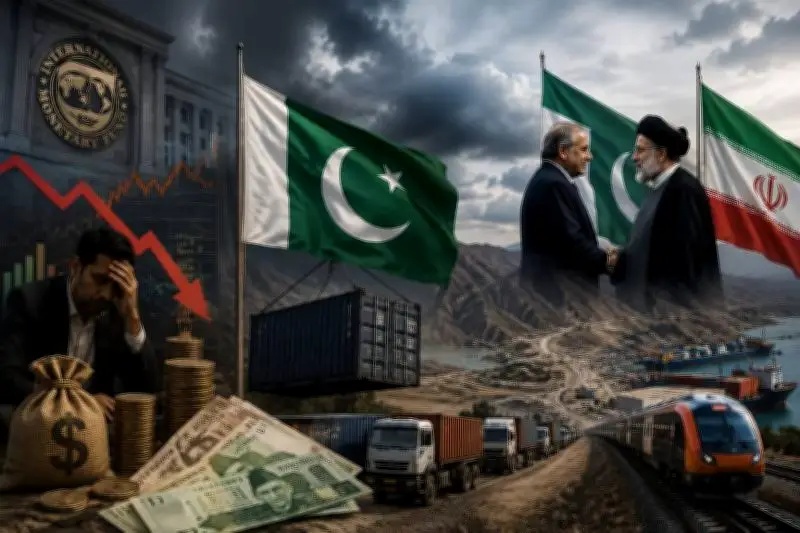
Pakistan's role in helping calm one of the Middle East's most dangerous confrontations has generated a wave of optimism in Islamabad. Donald Trump has praised Pakistan's leadership. Relations with Saudi Arabia are warm. Iran is once again discussing trade and connectivity. Gulf capitals are paying attention. Commentators speak of a regional peace dividend. Ministers talk of investment, trade corridors and a new era of economic opportunity. The mood is understandable. The conclusion is not.
Diplomatic Success vs. Economic Reality
Brokering peace may be good diplomacy. It may improve Pakistan's standing abroad. It may create opportunities for trade, investment and regional cooperation. But it is not a development strategy. Pakistan's history suggests that confusing the two has been one of the country's most persistent and costly mistakes. Every decade, Pakistan's elite discover a new reason why prosperity is finally around the corner. In the 1960s, it was alliance with the West. In the 1980s, it was the anti-Soviet jihad. After 9/11, it was Pakistan's status as a frontline state in the War on Terror. During the last decade, it was CPEC. Today, it is Pakistan's role as a regional mediator, a beneficiary of improving Gulf ties, and—perhaps most importantly—the belief that Pakistan has once again become strategically valuable to the United States. The names change. The story does not.
The Familiar Pattern of Overpromising
Listen carefully to the current debate and a familiar pattern emerges. Pakistan's geography is finally about to pay off. Regional tensions are easing. Trade routes are reopening. Gulf money is returning. Washington is paying attention again. Economic transformation, we are assured, is only a matter of time. Pakistan's future has spent so long being 'just around the corner' that it is beginning to look less like a destination and more like a permanent address. The enthusiasm surrounding Donald Trump's recent praise for Pakistan is particularly revealing. In some quarters, Trump's warmer tone has been treated almost as an economic indicator. A successful diplomatic intervention, a few encouraging statements from Washington, renewed attention from Gulf capitals, and suddenly an old conviction reappears: Pakistan matters again. One might have thought the country had already conducted enough experiments with this theory.

Historical Lessons Ignored
Pakistan mattered enormously during the Cold War. Pakistan mattered enormously during the Afghan jihad. Pakistan mattered enormously after September 11. Strategic importance, it turns out, is not the same thing as development. Yet Pakistan's governing class remains strangely susceptible to the idea that geopolitical relevance can somehow be converted directly into prosperity. One of the expressions of this optimism came from former State Bank governor Ishrat Husain, whose recent Dawn column argued that a changing regional environment creates significant economic opportunities for Pakistan. Husain is hardly alone. Across television studios, newspaper columns and official statements, one finds variations of the same argument. Regional tensions are easing. Diplomatic opportunities are expanding. Trade and investment may increase. Therefore, Pakistan's economic prospects are improving. The opportunities undoubtedly exist. The question is why Pakistan has repeatedly failed to convert similar opportunities into lasting growth.
Devastating Historical Record
On that point, the historical record is devastating. Politicians celebrate possibilities. Investors price probabilities. And probabilities are precisely where Pakistan's current sales pitch becomes less convincing. Pakistan has enjoyed geopolitical openings before. It enjoyed them during the Cold War. It enjoyed them after the Soviet invasion of Afghanistan. It enjoyed them after 9/11. It enjoyed them during the launch of CPEC. Every one of these moments generated predictions about connectivity, investment, trade and transformation. Every one of these moments was supposed to be different. None was. The problem is not that opportunities fail to appear. The problem is that Pakistan consistently mistakes opportunities for achievements.

Structural Weaknesses Persist
A trade corridor is treated as though it were trade. An investment pledge is treated as though it were investment. A diplomatic opening is treated as though it were development. A favourable statement from a foreign leader is treated as though it were economic policy. The economy, unfortunately, remains stubbornly unimpressed. Pakistan remains under an IMF programme because it lacks the domestic capacity to finance itself sustainably. Tax collection remains among the lowest levels of comparable economies. Public debt remains elevated. Circular debt in the power and gas sectors continues to swell despite years of promised reforms. Most revealingly, these are not historical problems. They are contemporary realities.
Growth Forecast Downgraded
As ministers celebrate the transformative possibilities of regional connectivity, Pakistan is simultaneously struggling to meet reform benchmarks it has already agreed to undertake. While speeches extol investment and trade, fiscal and energy-sector weaknesses continue to undermine the foundations upon which any investment boom would actually depend. The two stories are unfolding at the same time. One is told through speeches. The other is told through numbers. The numbers are considerably less enthusiastic. Indeed, while officials and commentators celebrate the economic possibilities supposedly unlocked by Pakistan's diplomatic successes, the Asian Development Bank recently revised its growth forecast for Pakistan downward to 3.7 percent. The downgrade was a useful reminder that international investors assess economies through productivity, investment, fiscal sustainability and reform progress—not diplomatic momentum. Whatever opportunities may emerge from a more favourable regional environment, they have yet to alter the fundamentals driving Pakistan's growth outlook.
Iran Trade Target Remains Elusive
Consider the government's ambitions for trade with Iran. Officials now routinely invoke a $10 billion bilateral trade target. The figure has been repeated so often that it has acquired the status of revealed truth. Actual trade remains a fraction of that target. Banking mechanisms remain constrained. Infrastructure bottlenecks remain unresolved. Cross-border transport has been disrupted repeatedly. The Rimdan-Gabd economic zone, frequently presented as a symbol of future integration, remains unfinished on the Pakistani side. At some point, a target repeated often enough ceases to be a plan and becomes a ritual.
Security Risks Undermine Gwadar Vision
Then there is Gwadar. Nearly every grand vision currently being marketed to investors ultimately depends on stability in Balochistan and along the Makran coast. Refineries, ports, transit corridors and special economic zones all rely upon one basic condition: security. Yet the security trajectory has been moving in the opposite direction. Recent months have witnessed major insurgent attacks across Balochistan, including incidents affecting Gwadar itself. The emergence of a maritime dimension to the insurgency introduces new risks precisely in the waters through which future trade and energy projects are expected to flow. This matters because investors do not evaluate projects the way politicians evaluate press conferences. Politicians hear announcements. Investors hear risk. Politicians see memoranda of understanding. Investors see balance sheets. Politicians celebrate possibilities. Investors price probabilities. And probabilities are precisely where Pakistan's current sales pitch becomes less convincing.
Changing Global Landscape
The uncomfortable reality is that the world has changed. Saudi Arabia is no longer acting like the patron it once was. Vision 2030 has transformed Riyadh's approach to overseas investment. Gulf sovereign wealth funds increasingly behave like disciplined commercial investors rather than geopolitical benefactors. China is now more creditor than patron, with a corresponding focus on repayment and project viability. Neither Iran nor Türkiye possesses the financial capacity to underwrite Pakistan's economy even if they wished to. Yet much of Pakistan's establishment still appears trapped in the assumptions of an earlier era. The old model was simple. Strategic relevance generated external support. External support reduced pressure for domestic reform. The cycle repeated itself.
Diplomacy Cannot Substitute for Reform
The danger today is that diplomatic success is once again being interpreted as a substitute for economic strategy. It is not. Peace can create opportunities. It cannot collect taxes. Diplomatic relevance can attract attention. It cannot eliminate circular debt. Regional connectivity can open doors. It cannot secure investors against insurgency. A compliment from Washington cannot reform Pakistan's energy sector. And brokering peace cannot solve the structural weaknesses that have repeatedly brought the country back to the IMF. This is not an argument against diplomacy. Pakistan should seek better relations with every country it can. It should encourage trade, attract investment and reduce regional tensions wherever possible. But it should also stop pretending that foreign policy can do the work of domestic state-building.
The Real Question for Pakistan
The real question facing Pakistan is not whether another summit will be held, another trade target announced, another memorandum signed or another foreign leader will offer flattering words. The real question is whether the country can finally address the institutional weaknesses that have survived every geopolitical cycle of the last half-century. Until that happens, the latest promises of a peace dividend will join a long list of previous promises: celebrated at the time, forgotten in retrospect, and revived only when the next wave of geopolitical optimism arrives. Pakistan does not lack opportunities. It lacks the institutions required to turn opportunities into prosperity. That problem cannot be solved in Washington, Riyadh, Ankara or Tehran. It can only be solved at home.