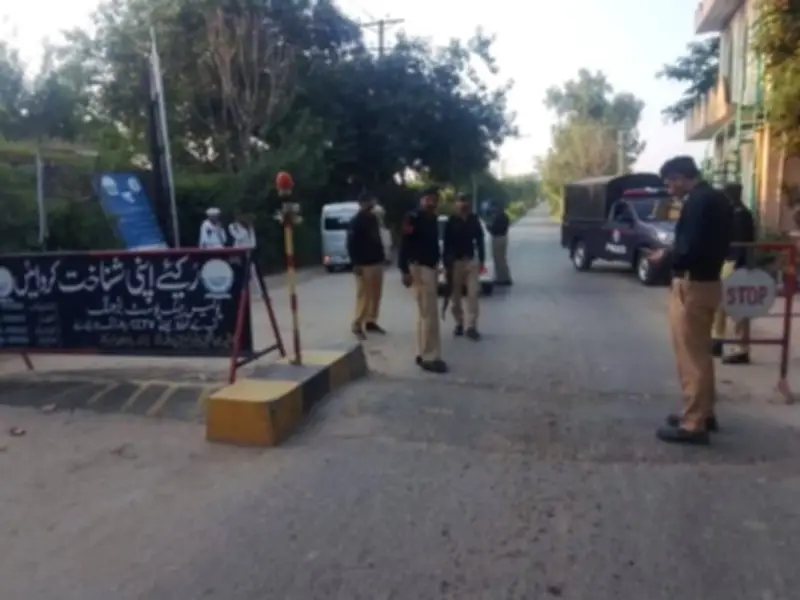
RAWALAKOT: Four law enforcement agencies' (LEA) personnel were martyred and over 20 were injured after elements allegedly associated with the banned Joint Awami Action Committee (Jaac) opened fire on them in the Rawalakot area of Azad Jammu and Kashmir (AJK) on Sunday.
According to a statement issued by a spokesperson of the AJK Inspector General of Police (IGP), the incident occurred when armed members of the banned organisation gathered under the guise of a protest and allegedly targeted law-enforcement personnel deployed on duty. The police claimed the firing was carried out under a pre-planned strategy by the leadership of the banned Jaac, accusing the group of attempting to sabotage law and order and attack the Combined Military Hospital (CMH) Rawalakot.
According to the statement, four law-enforcement personnel embraced martyrdom in the firing, while more than 20 police and security officials sustained injuries. The injured were shifted to medical facilities for treatment. Police said the wounds sustained by the martyred and injured personnel were caused by firearms and gunshots.

The IGP condemned the incident, describing it as a "planned, armed and terrorist act" rather than a peaceful political protest. He said the alleged attack targeted state authority, public peace, law-enforcement institutions and a medical facility. The police chief stated that the attack on CMH Rawalakot constituted a serious violation of the law and directly endangered patients, medical staff, injured personnel and civilians present at the facility.
"Direct firing on law-enforcement personnel, the resulting martyrdoms and gunshot injuries, and the subsequent attack on CMH Rawalakot clearly constitute terrorism," the statement quoted the IGP as saying. He added that legal action against those involved would be unavoidable and would proceed in accordance with evidence, the Constitution and the law. "No armed group will be allowed to hold the peace of AJK, the safety of its citizens and the state's administrative order hostage," he said.
The AJK police paid tribute to the martyred personnel, saying their sacrifice was made in the service of peace, public safety and the rule of law in the region. The police department said it stood with the families of the martyrs and that all necessary measures were being taken to ensure proper medical treatment for the injured officials. The statement also reiterated that the AJK Police and civil administration would not compromise on the writ of the state, public peace and the protection of citizens. "The law will take its course," it added.
Separately, the AJK police on Sunday sealed the central office of Jaac in Muzaffarabad over alleged anti-state activities. The AJK government proscribed the group on June 5. During a search operation at the premises, police recovered a sub-machine gun, a 12-bore rifle, and a pistol. Despite the presence of a large number of people outside the office at the time of the raid, no protest or slogan-chanting was reported. Later, the district administration, along with police, sealed the central office located in the AJK's capital. Officials and analysts said the weapon recovery during the raid indicates the group was allegedly attempting to incite unrest under the pretext of public rights advocacy.
Supreme Court ruling on refugee seats
Meanwhile, the AJK Supreme Court on Sunday ruled that the 12 seats reserved for refugees in the Legislative Assembly are constitutionally protected and cannot be altered through administrative measures, political agreements, or public pressure, according to a detailed advisory opinion issued on a presidential reference. The 53-member AJK Legislative Assembly includes 12 seats reserved for Kashmiri refugees who migrated from Indian Illegally Occupied Jammu and Kashmir (IIOJK) during the conflicts of 1947 and 1965 and are now settled across Pakistan. Six seats represent refugees from the Jammu division, estimated at around 434,000 people, while six represent refugees from the Kashmir Valley, whose population is estimated at about 30,000.

The issue of refugee representation has long been a key demand of the now-banned Jaac, which led a series of protests last year that turned violent and resulted in several deaths. In its opinion, the court reaffirmed that the refugee seats are guaranteed under Article 22 of the AJK Constitution and are rooted in a long legislative history dating back to electoral arrangements introduced in 1960 and subsequent constitutional reforms in 1964 and 1970. The court described the seats as a "constitutional expression of a profound historical and juridical truth" arising from the displacement of Kashmiris following the 1947 partition and subsequent conflict. It noted that the arrangement was further strengthened through successive legal instruments before being explicitly incorporated into the Constitution through the 13th Amendment.
Emphasising constitutional supremacy, the court held that any change to the composition of the Assembly can only be made through the amendment procedure laid down in Article 33. "The provisions of the Constitution may be amended in accordance with Article 33," the opinion stated, adding that the amendment process is "exhaustive and exclusive" and that no authority other than the legislature can lawfully alter constitutional provisions. The court said executive orders, political agreements, and public agitation have no legal effect in changing the Constitution, stressing that constitutional change must occur through "public mandate, parliamentary debate and constitutional procedure".
A significant portion of the opinion addressed the use of protests and blockades to press political demands. While affirming that peaceful assembly is a fundamental right, the court said the right is "neither absolute nor unrestricted" and must be exercised in a manner consistent with public order and the rights of others. The court warned that road blockades, forced business closures and disruptions to supply routes fall outside constitutional protection. "The exercise of one Fundamental Right cannot be permitted in a manner that substantially impairs or destroys the Fundamental Rights guaranteed to others," it said. It further observed that attempts to secure constitutional change through coercive means are "legally unenforceable" and incompatible with the rule of law. "The Constitution protects peaceful dissent; it does not protect conduct that undermines public order," the opinion added.
The court also underscored the constitutional requirement to hold timely elections, referring to Article 22(4), which mandates that general elections be conducted within the prescribed period. Describing the obligation as mandatory and non-negotiable, the court said constitutional timelines "admit of no exception" and cannot be delayed due to political uncertainty or public agitation. It directed the Election Commission and relevant executive authorities to ensure that free, fair and transparent elections are conducted within the constitutionally mandated timeframe, while maintaining conditions necessary for polling.
Tracing the historical evolution of refugee representation, the court noted that refugee seats have existed in various forms since 1960 and have been consistently retained through successive constitutional and legal frameworks. It described the arrangement as a "continuously affirmed constitutional principle" reflecting the political status of displaced Kashmiris and said its uninterrupted continuation demonstrates that refugee representation is a "deep-rooted constitutional commitment" rather than a temporary administrative measure. The court reiterated that its opinion is advisory in nature and does not create enforceable orders between parties. It said the purpose of the reference was to assist constitutional authorities rather than adjudicate a dispute in the conventional sense.
Political reactions
The ruling comes two days after the AJK government declared Jaac a proscribed organisation, accusing it of involvement in terrorism, promoting hatred and creating anarchy ahead of the group's planned protest on June 9. The move also came hours after the AJK Election Commission announced that general elections for the Legislative Assembly will be held on July 27. The commission said preparations were under way to ensure transparent, orderly and impartial elections under judicial supervision.
Meanwhile, the PTI criticised the government's decision to ban Jaac. "If Jaac was truly a terrorist organisation, why did the government spend months negotiating with it, signing agreements with it, implementing its demands, holding meetings with its leadership and treating it as a legitimate stakeholder until yesterday?" the party said in a statement.