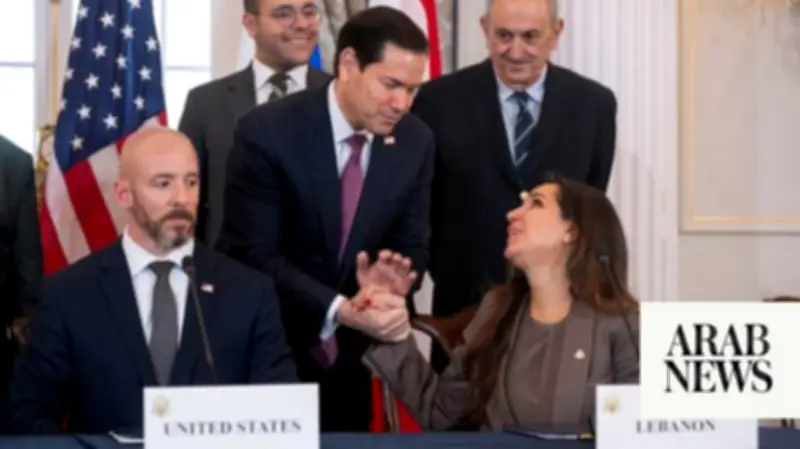
A senior Lebanese official clarified on Saturday that the newly signed US-brokered framework with Israel is not a peace treaty but a process to end hostilities between the two countries. Speaking to Arab News after Lebanese and Israeli delegations signed the trilateral framework in Washington on Friday, the official, who closely followed the negotiations, described the document as a non-aggression agreement.
“It can be regarded as a non-aggression agreement,” the official said, emphasizing that the framework does not alter Lebanon’s longstanding position on normalization with Israel. Lebanon remains committed to the Arab Peace Initiative, launched by Saudi Arabia and adopted by the Arab League at the 2002 Beirut Summit, which conditions full normalization with Israel on the establishment of an independent Palestinian state based on 1967 borders and a just solution for Palestinian refugees.
Framework Details and Reactions
The trilateral framework was signed after four days of direct negotiations under US mediation. According to the US State Department, the framework lays the groundwork for future agreements to end the conflict, ensure sovereignty and security, and establish peaceful neighborly relations. However, reactions in Lebanon were mixed, with Hezbollah opposing the agreement.

Hezbollah MP Hussein Al-Hajj Hassan avoided a definitive stance, saying, “Our future steps depend on the deliberations and consultations we are holding within the party and with our allies.” Prime Minister Nawaf Salam presented the framework as consistent with Lebanon’s commitments under the Taif Accord and UN Security Council Resolution 1701, noting that the November 2024 ceasefire agreement limits arms to legitimate security forces.
Hezbollah Protests and Political Divisions
Hezbollah MP Hassan Fadlallah warned that the Lebanese authorities “will not be able to enforce the agreement signed in Washington unless they proceed, with US backing, toward a civil war.” Hundreds of Hezbollah supporters protested on Friday night, blocking roads with burning tires. The Lebanese army used tear gas to disperse protests near the government headquarters and the airport road.
The official source said the protests were expected: “Those who accuse the state of having served US and Israeli interests through this framework agreement are right. Lebanon has no leverage. We are in a weak position and have nothing to negotiate with. We want to put an end to the state of hostility.”
Framework Implementation and Pilot Zones
The framework agreement will be submitted to the Cabinet for approval. Hezbollah’s two ministers are expected to boycott the session, but the source said the process would proceed through political compromise. Lebanese Forces MP Ziad Hawat called the agreement “a new step in the right direction,” urging Hezbollah to hand over weapons. Democratic Gathering MP Bilal Abdallah asked, “Do we leave our country as a card in Iran’s hands, or do we seize the opportunity?”
The 14-point framework affirms the right of each state to exist in peace and establishes a US-supported military coordination group. The Lebanese Armed Forces will restore authority over all territory, pending verified disarmament of non-state armed groups. As the LAF assumes control, the IDF will progressively withdraw. Two initial pilot zones have been identified: one outside the Yellow Line, west of the Saluki Valley and south of the Litani River, and another north of the Litani River. A Lebanese military source told Arab News that Zawtar al-Sharqiyah and Zawtar al-Gharbiyah are likely pilot zones.