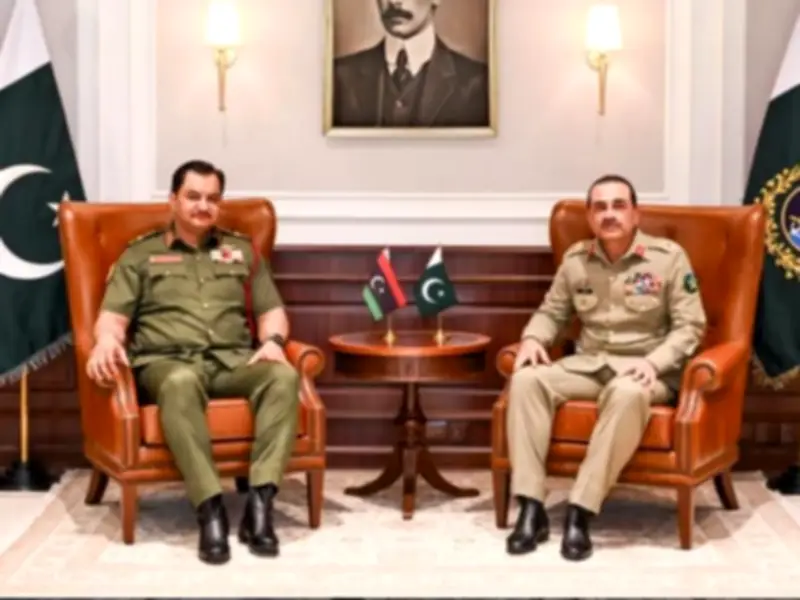
Chief of Defence Forces (CDF) and Chief of Army Staff Field Marshal Asim Munir held a meeting with Libyan Arab Armed Forces Deputy Commander-in-Chief Lt Gen Haftar at the General Headquarters (GHQ) in Rawalpindi on Wednesday, focusing on bilateral defence cooperation and regional security.
Guard of Honour and Discussions
Upon arrival, Lt Gen Haftar was presented with a guard of honour. During the meeting, both sides underscored the importance of strengthening bilateral defence ties and expanding cooperation in military training and security, according to a statement issued by the Inter-Services Public Relations (ISPR).
The two leaders discussed matters of mutual interest, regional security dynamics, defence cooperation, and avenues for enhanced military-to-military collaboration. CDF Munir highlighted the Pakistan Army’s commitment to promoting peace, stability, and constructive engagement with friendly countries.

Professionalism Praised
The ISPR added that the visiting dignitary appreciated the professionalism of the Pakistan Armed Forces and acknowledged their contributions towards regional peace and security.
This was the second meeting between the two military leaders this year. They previously met in February, when they also discussed regional security dynamics. During that meeting, Field Marshal Munir reaffirmed Pakistan’s commitment to strengthening bilateral relations with Libya and underscored renewed momentum in defence collaboration.
Historical Ties and Arms Deal
Pakistan and Libya enjoy longstanding diplomatic and military ties. A notable example is a multi-billion-dollar conventional arms deal signed in December last year, described as one of Pakistan’s largest-ever weapons sales. The agreement was finalised following an earlier meeting between Field Marshal Munir and Lt Gen Haftar in Benghazi.
However, any such agreement with the Libyan National Army is expected to attract international scrutiny given Libya’s prolonged instability since the 2011 NATO-backed uprising that toppled Muammar Gaddafi, plunging the country into years of conflict between rival authorities in the east and west.
UN Arms Embargo Context
Libya has technically remained under a UN arms embargo since February 2011, imposed through United Nations Security Council Resolution (UNSCR) 1970 and later reinforced by subsequent resolutions, including UNSCR 1973. The embargo prohibits all states from supplying, selling, or transferring arms and related materiel to Libya. Despite this legal framework, arms flows into Libya have continued largely unabated over the past decade, fuelling proxy conflicts and deepening divisions between rival factions.