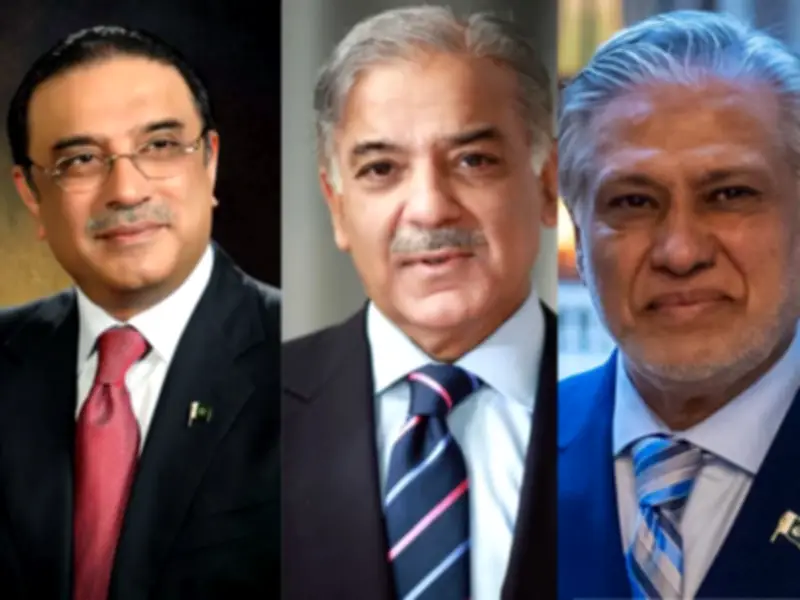
Political leadership, including President Asif Ali Zardari, Prime Minister Shehbaz Sharif, Deputy Prime Minister and Foreign Minister Ishaq Dar, and Finance Minister Muhammad Aurangzeb, on Monday welcomed the US–Iran peace agreement, describing it as a positive development for regional stability and a potential boost to global economic and diplomatic conditions.
President Zardari Welcomes Memorandum of Understanding
President Asif Ali Zardari welcomed the announcement of a Memorandum of Understanding between the United States and Iran, expressing hope that it will lead to a final agreement and help secure lasting peace in the region. In a statement shared on X, President Zardari said the agreement would "hopefully pave the way for a final agreement" and "lay the foundation for durable and comprehensive peace in the region." He emphasized that Pakistan had consistently supported dialogue and diplomacy throughout the period of tensions, describing the development as "an important step towards strengthening multilateralism and the peaceful resolution of disputes through engagement and mutual respect." The president also expressed hope that the diplomatic efforts would "usher in greater peace, stability and prosperity for the region and the world."
Prime Minister Shehbaz Sharif Announces Peace Deal
Prime Minister Shehbaz Sharif announced early Monday that the US and Iran had reached an agreement following intensive negotiations, with both sides declaring an immediate and permanent end to military operations across all fronts, including in Lebanon. In a post on X, he stated, "Following intensive talks, we are pleased to announce that the Peace Deal between the United States of America and Islamic Republic of Iran has been REACHED. Both sides have declared the immediate and permanent termination of military operations on all fronts, including in Lebanon."

Foreign Minister Ishaq Dar Praises Diplomatic Breakthrough
Deputy Prime Minister and Foreign Minister Ishaq Dar also took to X to welcome the agreement. He said, "This significant breakthrough reflects the power of sustained diplomatic engagement and the collective resolve of friendly nations to choose dialogue over confrontation." Dar noted that the much-awaited development sends a "reassuring" message to the international community and provides much-needed confidence and stability to global markets and the world economy, particularly for developing countries that are most vulnerable to regional instability. He added that Pakistan remained actively engaged with all concerned parties and consistently advocated restraint and constructive engagement. Dar thanked Saudi Arabia, Qatar, Türkiye, and Egypt, as well as the UN and international partners, for their support. He said, "We look forward to the formal signing ceremony on June 19 in Geneva and remain confident that this positive development will pave the way for enduring peace, stability and shared prosperity for the region and beyond."
Finance Minister Aurangzeb Highlights Economic Implications
Finance Minister Muhammad Aurangzeb welcomed the peace agreement and said it could have positive implications for the global economy and Pakistan’s economic outlook. In remarks shared by the Ministry of Finance on X, he described the development as a significant moment for international stability, calling it "a proud moment for the global economy." Speaking at a Pakistan Stock Exchange ceremony, Aurangzeb said Pakistan’s leadership had played a role in supporting dialogue and de-escalation efforts. He said PM Shehbaz Sharif and Field Marshal Asim Munir were being acknowledged internationally for their efforts. The minister said the agreement could help ease economic uncertainty linked to recent regional tensions and suggested that Pakistan had "effectively navigated" the initial economic impact of the conflict. He noted that while energy sector disruptions would take time to stabilize, the overall economic outlook had improved with "encouraging upside potential" for the next fiscal year.

Details of the Agreement
Pakistan has repeatedly called for dialogue and diplomatic engagement to address regional disputes and tensions. US and Iranian officials said they had agreed on a framework to end their war, halt the US blockade of Iran, and reopen the Strait of Hormuz, a preliminary pact that sent oil prices falling but leaves the fate of Iran's nuclear program to further negotiations. The memorandum of understanding is scheduled to be officially signed on Friday in Switzerland. The precise terms were not immediately known. Sharif said in a post on X that the pact called for "the immediate and permanent termination of military operations on all fronts, including in Lebanon." Iranian media published details Monday of a 14-point draft memorandum of understanding between Iran and the US laying out a proposed framework to end the war and move toward a final agreement. The draft provides for the full lifting of the US naval blockade against Iran within 30 days and calls for reopening the Strait of Hormuz within 30 days under Iranian arrangements. Since mid-March, Trump has repeatedly claimed a deal with Iran to end the war was close. The two sides have traded strikes this week, straining a ceasefire announced in April. The region has been on edge since the US and Israel launched airstrikes on Iran in late February, triggering Iranian retaliation on Israel and other regional countries hosting US assets. A temporary ceasefire was reached on April 8, but negotiations later stalled amid disputes over its implementation and subsequent regional developments, even as Trump extended the truce indefinitely.