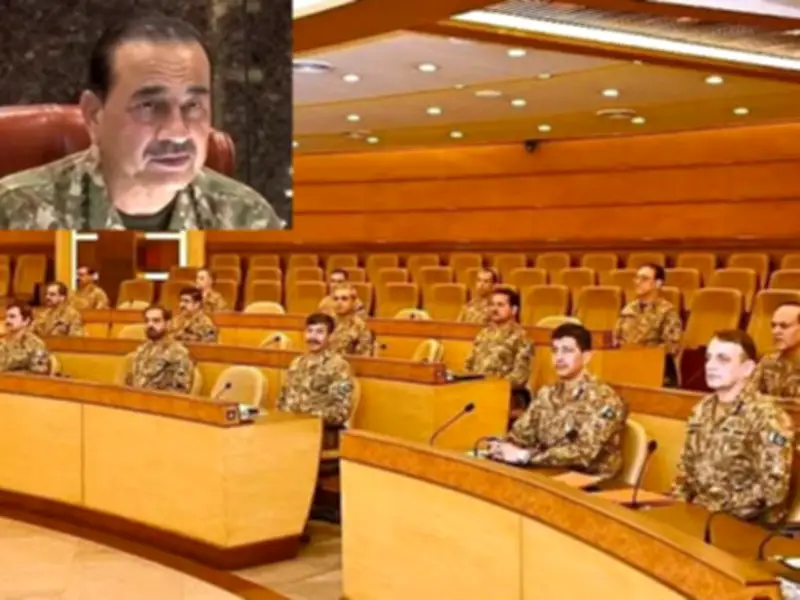
The top military leadership of Pakistan on Monday declared that counterterrorism operations against terrorist groups operating from territory under the control of the Afghan Taliban regime will continue, signaling Islamabad's readiness to take the war against terrorism deep inside Afghanistan if necessary. The announcement came during the 276th Corps Commanders' Conference (CCC), chaired by Field Marshal Syed Asim Munir, Chief of Army Staff and Chief of Defence Forces, at the General Headquarters (GHQ) in Rawalpindi.
Serious Concerns Over Afghan Soil Used by Terrorists
According to the Inter-Services Public Relations (ISPR), the forum expressed serious concerns over the continued use of Afghan Taliban-controlled territory by Indian-sponsored terrorist groups, including Fitna al Khawarij (FAK) and Fitna al Hindustan (FAH), to orchestrate attacks inside Pakistan. The official ISPR statement affirmed that "lasting peace and stability in the region is contingent upon preventing use of Afghan Taliban-controlled territory by Indian terrorist proxies for which the Afghan Taliban regime is directly responsible."
The statement added that Pakistan has an unequivocal right to defend its people from terrorism and that the armed forces will continue intelligence-based operations (IBOs) against terrorism emanating from Afghan Taliban-controlled territory under Operation Ghazab-Lil-Haq. These remarks are among the clearest public declarations by Pakistan's military leadership that it is prepared to pursue anti-terror operations against groups using Afghan territory as a sanctuary.

Recurring Accusations and Denials
Pakistan has repeatedly accused the Afghan Taliban of failing to curb the activities of the banned Tehreek-e-Taliban Pakistan (TTP) and other terrorist groups operating from across the border. However, Kabul has consistently denied allowing its soil to be used against Pakistan. The Corps Commanders' Conference took place against a backdrop of a recent surge in terrorist attacks, many of which Pakistani authorities believe were planned and directed from sanctuaries in Afghanistan with external support.
The forum also underscored that military action alone would not be sufficient to address the challenge. In addition to kinetic operations, it stressed the immediate need to establish robust governance structures in restive areas focused on public service and welfare, and to dismantle a "terror-crime nexus" thriving under vested political patronage.
Hybrid Warfare and Disinformation Campaigns
The military leadership noted that following the comprehensive defeat inflicted in Marka-e-Haq, hostile actors have increasingly shifted towards externally supported hybrid warfare and disinformation campaigns aimed at creating unrest inside Pakistan. The forum condemned all forms of state-sponsored financing, facilitation, and sponsorship of proxies, and warned that any attempt to destabilize Pakistan through hybrid means will be countered with strategic clarity and firm resolve.
The conference also reviewed the prevailing security environment and expressed satisfaction over the operational preparedness, professionalism, and combat readiness of the armed forces. Participants offered Fateha for the martyrs of the armed forces, law-enforcement agencies, and innocent civilians, reaffirming that their sacrifices remain the foundation of Pakistan's security, unity, and resilience.
Regional Stability and Indus Waters Treaty
Reviewing the evolving regional landscape, the forum appreciated Pakistan's constructive role in promoting dialogue, de-escalation, and regional stability. It reaffirmed the country's commitment to peaceful conflict resolution, respect for international law, and enhanced regional cooperation to address shared security challenges. The military leadership also took note of India's rhetoric surrounding the Indus Waters Treaty (IWT) and reaffirmed the guidance provided in the National Security Committee's directive of April 24, 2025.
"The forum expressed resolute commitment to undertake all measures necessary to ensure availability of Pakistan's rightful share of water as per the directives of the government and inspirations of the people of Pakistan," the ISPR statement said.

Kashmir and Self-Determination
On Kashmir, the forum strongly condemned what it described as ongoing human rights violations and unilateral demographic engineering in Indian Illegally Occupied Jammu and Kashmir (IIOJK), reiterating that Kashmir remains Pakistan's jugular vein. Reaffirming Pakistan's diplomatic, political, and moral support for the Kashmiri cause, the military leadership emphasized that lasting regional stability depends on granting the people of Kashmir their inalienable right to self-determination in accordance with United Nations Security Council resolutions.
Directives for Multi-Domain Transformation
In his concluding remarks, Field Marshal Asim Munir directed commanders to expedite the implementation of the military's multi-domain transformation plan in line with the evolving character of warfare. He also called upon commanders to maintain the highest standards of vigilance, operational readiness, and professional excellence, emphasizing integrated responses to conventional, sub-conventional, and hybrid threats while safeguarding Pakistan's sovereignty and national interests at all costs.