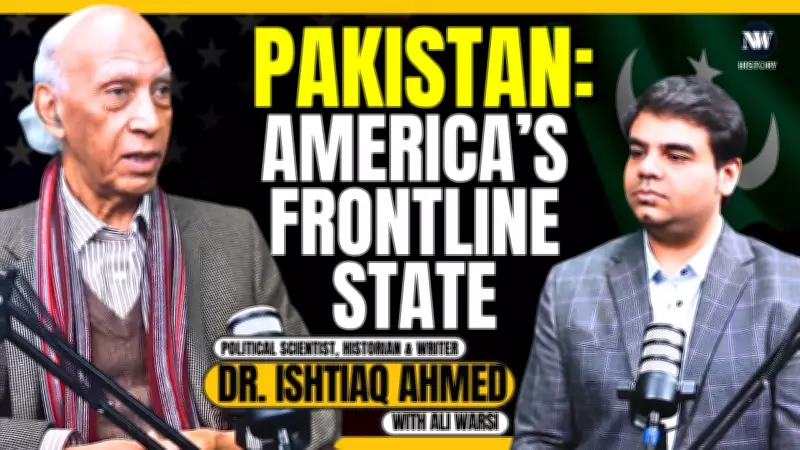
Was Pakistan created as a Cold War frontline state? This question is explored in a detailed discussion that delves into the geopolitical origins of Pakistan, the British Empire's anti-Soviet strategy, America's shifting priorities in South Asia, and why Pakistan became central to Western security alliances during the Cold War.
The Geopolitical Origins of Pakistan
The podcast examines the multifaceted reasons behind Pakistan's creation, moving beyond the conventional Hindu-Muslim narrative. It highlights how British imperial thinking, anti-communism, and global power politics played significant roles. The discussion references key figures such as Muhammad Ali Jinnah, Jawaharlal Nehru, and Muhammad Iqbal, as well as major events like the Korean War, the Soviet-Afghan War, and the broader Cold War order.
British Empire's Anti-Soviet Strategy
The British Empire's strategic interests in containing Soviet expansion heavily influenced the creation of Pakistan. The region's proximity to the Soviet Union made it a valuable buffer zone. This anti-Soviet stance was later inherited by the United States, which saw Pakistan as a key ally in the Cold War.

US Military Aid and Alliances
Pakistan became a cornerstone of Western security alliances, joining the Central Treaty Organization (CENTO) and the Southeast Asia Treaty Organization (SEATO). The United States provided substantial military aid to Pakistan, viewing it as a frontline state against Soviet influence. The Afghan Jihad further cemented this relationship, with Pakistan playing a crucial role in supporting Mujahideen fighters against the Soviet occupation of Afghanistan.
Shifting Priorities and the India Factor
Despite Pakistan's strategic importance, Washington ultimately prioritized India due to its larger market, democratic system, and non-aligned stance. This shift in priorities created tensions in US-Pakistan relations, which continue to this day. The discussion also explores the fears of Soviet expansion that drove Western policies in the region.
Challenging Conventional Understandings
This episode challenges conventional understandings of Partition and Pakistan's creation by highlighting the Cold War context. It argues that the creation of Pakistan cannot be fully understood without considering the global power dynamics of the time. The podcast encourages listeners to rethink the historical narratives surrounding Pakistan's origins.