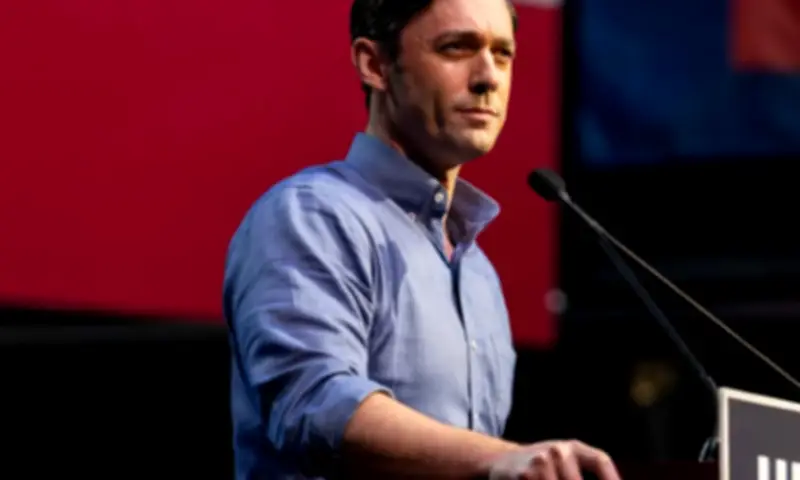
For the past month, Georgia Senator Jon Ossoff has dominated discussions of the 2028 Democratic primary, with his consistent polling lead prompting national observers to leapfrog all the way to the next presidential election. Features in both the New York Times and Politico have touted him as a leading candidate, and his odds on the Polymarket prediction site have more than doubled since late May, giving him a better chance than Vice President Kamala Harris, who currently leads in nearly all national polls.
Why Ossoff Excites Democrats
Ossoff is a repeat winner in one of the most important presidential battlegrounds—Georgia—and appeals to everyone from Never Trumpers at the Bulwark to leftist streamer Hasan Piker. His rhetorical focus on Donald Trump's corruption elevates a theme that energizes Democrats of all stripes. His background as a filmmaker makes him almost uniquely well-suited to the short-form video age.
“I have been jokingly calling him…the Lisan al-Gaib, which is a Dune reference to the Timothée Chalamet figure — essentially, the chosen one,” Chris Hayes, the MSNBC host, said on a recent episode of The Ezra Klein Show. “I think he has figured out a way, in a broadly palatable ideological fashion, to leverage a populist moral critique of the rot of Trump that can appeal across the different Democratic factions.”

The Unity Candidate Archetype
Yet there is reason to think this hype is getting over its skis. Ossoff fits the archetype of the mythical “unity candidate”—broadly appealing elected officials without a defined base, who correct for the party's previous failures and have yet to alienate anybody important. However, the unity candidate has a mixed record in recent contests, often looking perfect on paper but struggling in practice.
Ossoff's ability to straddle the party's internal divides without making enemies is impressive. His vote to block military aid to Israel in 2024 endeared him to the left, while his vote for the Laken Riley Act—imposing harsher punishments on undocumented immigrants who commit crimes—won centrist approval. He avoided hardline stances on social issues that left Kamala Harris with a trail of quotes for Republicans to attack in 2024.
“He not only refused to join along with the craziness of 2017 to 2020, but actively explicitly rejected it without becoming defined by the negative,” said Liam Kerr, co-founder of the centrist WelcomePAC.
The Weaknesses of Current Frontrunners
The emerging field shows Harris on top, followed by California Gov. Gavin Newsom, Rep. Alexandria Ocasio-Cortez, and former Transportation Secretary Pete Buttigieg. Each has a major strike against them: Buttigieg is unpopular with the socialist left and polls poorly with Black voters; AOC is hated by centrists; Newsom is seen as insincere; and Harris carries baggage from Biden’s presidency and her own failed runs.
In a party looking to move beyond its Trump-era doldrums, many see these choices as uninspiring or divisive. Ossoff, less weighed down by prior party debates, fills that need. He communicates primarily through slickly produced clips of speeches—at rallies or Sunday services at Black churches—which work well in the TikTok age. This strategy allows tight message control and reduces the risk of slip-ups that could infuriate party subfactions.
The Risks of the Unity Candidate Strategy
But the something-for-everyone strategy can leave a candidate without a base. In 2016, Marco Rubio had a similar profile—young, insurgent, but establishment-friendly—yet got squeezed between Ted Cruz on the right, John Kasich in the center, and Trump as the populist outsider. In 2020, Kamala Harris looked like a unifying bet but flamed out before the first primary vote, suspending her campaign in December 2019.
Currently, Ossoff polls at 2.3 percent in the RealClearPolitics average, dead last among all included candidates. “We’re seeing that play out in the Michigan Senate race,” Democratic pollster Adam Carlson said, referring to Mallory McMorrow, a state legislator who dropped out after getting trapped on Israel. “McMorrow was kind of in the middle… trying to be a little something to everybody.”

Ossoff has yet to face sustained scrutiny on Israel, and it’s an open question whether left-wing influencers will celebrate his partial support if a rival like Ocasio-Cortez goes further. His media strategy, while effective, may mask challenges in a crowded primary—he eschews longform interviews and off-the-cuff content, which are necessary for building authentic connections.
“He doesn’t do longform, he doesn’t do off-the-cuff, he doesn’t do the omnipresent attention,” one Democratic strategist told me. “He’s gotta get the reps in, because he’s going to need that skill set to run for president.”
Could Ossoff Succeed Like Obama?
Ossoff’s strategy isn’t doomed to fail. Barack Obama managed to be everything-to-everyone in 2008, appealing to the left on the Iraq war while attacking Hillary Clinton’s healthcare plan from the right. Some suggest Ossoff’s early criticism of Israel might play a similar role, reassuring the left on a key litmus test while courting the middle on substantive policy.
“He seems like someone who plays to win — not someone who plays not to lose,” Kerr said.
Ossoff may or may not emerge as a 2028 force, but the hype surrounding his campaign exposes that the Democratic primary is unsettled: the current polling frontrunners are weak, and both voters and the party elite are actively searching for alternatives. It mirrors the GOP in 2016—plenty of credible contenders, but no consensus favorite—and that race ended with a nominee who seemed impossible at the outset.