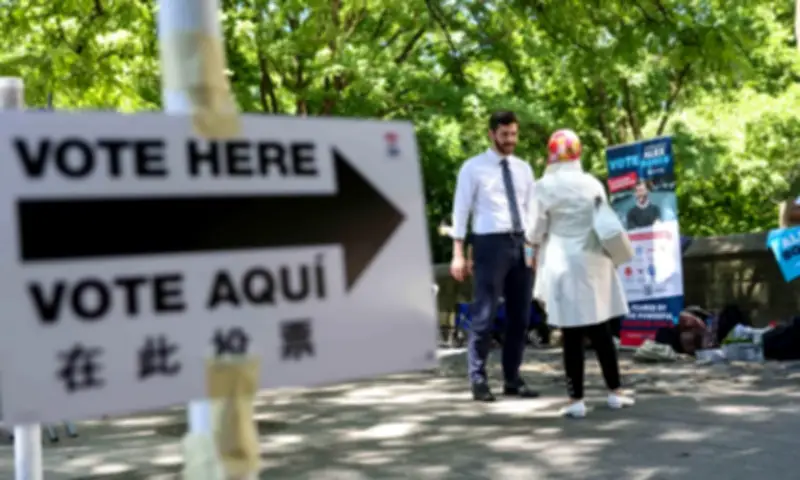
Tuesday's primary elections in New York will serve as a major test of the anti-establishment wave within the Democratic Party, one year after Zohran Mamdani won the Democratic nomination for mayor of New York City and became a partywide icon. The state has become a live read on the rift between the party's left flank and its centrist establishment, with races that could reverberate nationally.
AI Regulation on the Ballot
Alex Bores, an assembly member running in New York's 12th District in Manhattan, authored what he calls the strongest AI safety law in the country, the RAISE Act. However, Governor Kathy Hochul intervened, forcing lawmakers to water it down before signing it into law. The final version stripped the provision barring companies from releasing models that fail safety tests and scaled back penalties.
Bores, running in a crowded field that includes Kennedy scion Jack Schlossberg and Never-Trump lawyer George Conway, expressed frustration with the lack of robust AI legislation nationally. According to Bores, “There’s a lot of fear among elected officials that if they try to regulate this technology, it will be the end of their political careers. ... We’ve even seen leadership within the Democratic Party tell candidates in frontline races, ‘Hey, maybe stay away from AI.’”

He added, “Every time I introduce a new AI policy, I get texts from Congress members: ‘Hey, this is great, love this.’ And I always respond, ‘Introduce it.’ ... And then it’s crickets. They know it’s the right thing to do. They’re just so scared of the money on the other side.” Bores believes that 70 percent to 80 percent of voters want AI regulated, a stance backed by some polls. The gap between voter sentiment and Washington's action is the central issue of his campaign.
Mamdani's Endorsements Under Scrutiny
Mayor Mamdani has endorsed a slate of insurgent candidates, and Tuesday's results will reveal whether his coattails are real or if he is spending political capital he does not have. For the broader Democratic Party, these races will indicate how far socialism and explicitly leftist politics have taken root in urban centers and working-class neighborhoods with large racial minority populations.
In New York's 13th District, covering parts of Manhattan and the Bronx, Darializa Avila Chevalier, a Democratic Socialists of America-aligned public defender who canvassed for Mamdani when he was at 1 percent in the polls, is challenging Rep. Adriano Espaillat, the first Dominican American in Congress and chair of the Hispanic Caucus. Avila Chevalier frames her challenge as values over identity: “It’s not enough to share identity. We also have to share our values and share our fight and share a commitment to winning for our people.”
In New York's 7th District, Mamdani's backing of DSA candidate Claire Valdez over Brooklyn Borough President Antonio Reynoso has drawn criticism from Rep. Nydia Velázquez, who currently represents the district but is not running for reelection at age 73. Velázquez, a close Mamdani ally during the mayoral race who now supports Reynoso, warned the mayor earlier this year, telling the New York Times, “Honeymoons are short, and people need to pay attention to the work at hand.”
Channeling Dissatisfaction with the Establishment
What unites Bores, Avila Chevalier, and Valdez is not a single issue but the bet that Democratic voters are fed up with their own party's establishment and want candidates who will say so. Avila Chevalier's clearest contrast with Espaillat is his record of voting to keep arming Israel. She argues that this issue appeals to voters worried about kitchen-table issues, stating, “Budgets are moral documents. They tell us exactly what we prioritize.”
In a district where she says 26 percent of residents live below the poverty line, her argument is that money for “endless war” is money not coming home. When called an America First argument from the left, she pushed back: “It’s an argument about life.” Espaillat has been a reliable recipient of support from the pro-Israel lobby. The Espaillat campaign did not respond to a request for comment.

Whether such arguments actually move voters or just generate social media buzz is what Tuesday's primaries will begin to answer. The results could signal the strength of the anti-establishment wave and the viability of leftist platforms in key urban districts.