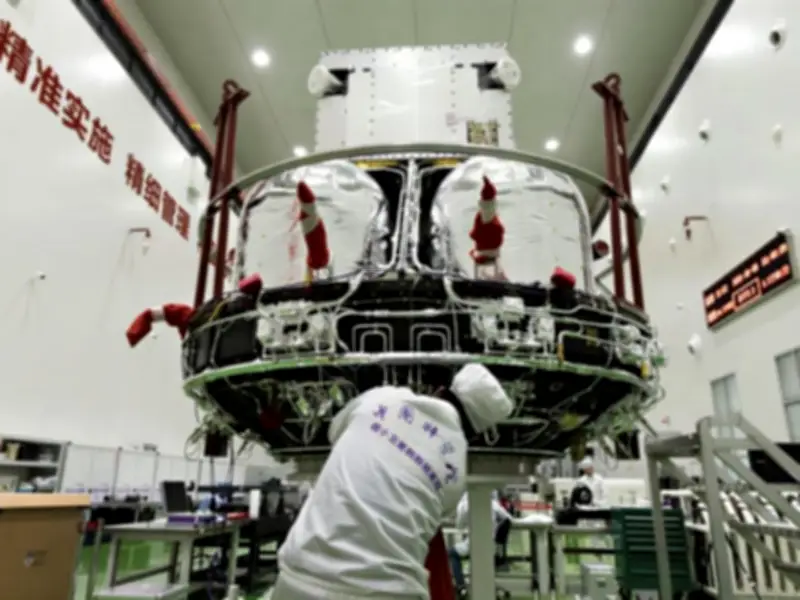
The European Space Agency (ESA) has highlighted the growing complementarity between Chinese and European Earth observation capabilities, emphasizing the potential of combining satellite data and scientific expertise for global benefit. Rune Floberghagen, head of ESA's Department of Climate Action, Sustainability and Science, stated in an exclusive interview with Xinhua in Dublin that both sides have developed strong space assets and a shared ambition to use their data for planetary challenges.
Dragon Program: 22 Years of Cooperation
Floberghagen was in Dublin for the 2026 Dragon 6 Mid-term Symposium. The Dragon Program, launched in 2004 by China's Ministry of Science and Technology and ESA, supports joint Earth observation research using Chinese, European, and third-party satellite data. Over the past 22 years, the program has generated hundreds of collaborative scientific projects, fostering trust and long-term professional relationships between researchers.
"Trust is really the key word here," Floberghagen said, noting that scientists share data, methods, and approaches. "We are, as we say, in the same boat, in a rough ocean. The planet's challenges do not really know borders."

China's Rapid Progress in Earth Observation
Floberghagen acknowledged China's "tremendous" progress in Earth observation, spanning optical cameras, radar, atmospheric composition, sea level, vegetation, and agricultural conditions. Europe initially shared expertise in technologies and data processing, but the relationship has become increasingly reciprocal. "You give your part, Europe gives its part, and together that is actually quite a wonderful thing," he said.
He also praised China's ability to implement decisions quickly, noting that when a decision is made, it happens according to plan. This efficiency impressed him during his visits to China.
Shift Towards Practical Applications
While the Dragon Program has focused on scientific research and data quality, Floberghagen noted an evolution into practical applications. Satellite and remote-sensing data can aid firefighters, flood responders, and other frontline personnel, but space specialists and emergency responders need to better understand each other's needs. "You need to bring these two worlds together," he said, expecting practical applications to become a bigger part of Dragon in the future.
Future Technologies and Young Scientists
Looking ahead, Floberghagen anticipates collaboration on new observation technologies and measurements, such as atmospheric carbon dioxide changes, plant health, photosynthesis, and biosphere evolution. The two sides will compare data from new instruments and explore applications supporting environmental protection and the green transition.
Young scientists remain central to the program. "Young scientists are overall very focused on preservation of the planet, on green values," Floberghagen said. ESA aims to create more exchange opportunities for researchers between Europe and China.