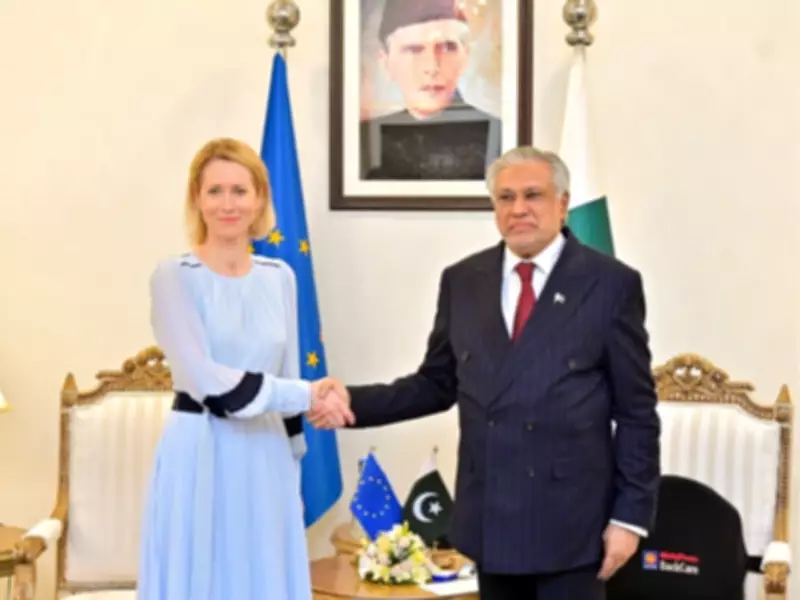
The European Union High Representative for Foreign Affairs and Security Policy, Kaja Kallas, on Monday called for deeper and more forward-looking relations with Pakistan, describing Islamabad as a key regional partner during a press briefing following the 8th Pakistan–EU Strategic Dialogue.
Key Highlights from the Dialogue
Speaking alongside Deputy Prime Minister and Foreign Minister Ishaq Dar, Kallas said her visit came at an important moment amid global and regional changes, noting that both sides had reaffirmed their commitment to strengthening cooperation. She stated, “Pakistan is a major regional power and an important partner for the European Union,” adding that the strategic dialogue had underlined a shared resolve to deepen ties further.
Trade Relations and GSP+
Kallas highlighted that the EU and Pakistan had seen “strong momentum” in trade relations, stressing that the EU remains Pakistan’s largest export destination, “larger than China and the US combined.” She also noted Pakistan’s position as the world’s leading beneficiary of the EU’s GSP+ scheme, while emphasising that continued access depends on progress in implementing international conventions, including governance standards, environmental protection, and labour and human rights commitments.

Expanding Cooperation Areas
Beyond trade, both sides were expanding cooperation in “climate resilience, digital infrastructure, clean energy, migration and mobility,” alongside stronger people-to-people links. Kallas pointed to education ties as well, noting she was “impressed that Pakistan tops the EU’s global Erasmus Mundus scholarship rankings again, the fifth year in a row.”
Regional Developments and Mediation
On regional developments, Kallas said both sides had discussed “pressing global developments, including in the Middle East,” and praised Pakistan’s diplomatic role in US–Iran engagement. She said, “Pakistan has been the main mediator between the United States and Iran,” adding that these efforts “have helped to prevent a return to full-blown war on several occasions” and were “much recognised and appreciated across Europe.”
Kallas said there was now “a tenuous diplomatic opening to extend the ceasefire and reopen the Strait of Hormuz,” but stressed that any temporary understanding must be followed by broader negotiations on Iran’s nuclear programme and other key issues, adding that “lasting stability will require more encompassing solutions.” She also said the European Union was ready to contribute to a long-term settlement, citing its “economic leverage, hard-won nuclear expertise, long-standing relationships across the Gulf and direct engagement with Iran itself.”
Security Concerns
Turning to regional security, she said Pakistan had been “locked in a conflict with Afghanistan,” warning that recent fighting had “grave humanitarian consequences” and could fuel instability and radicalisation. She said the EU had “constantly called on both sides to exercise restraint and de-escalation,” while acknowledging that “Pakistan has the right to defend itself and its people in line with international law.”
Pakistan's Perspective
In his remarks, Dar called for deeper and more structured engagement between Pakistan and the European Union, saying both sides remain closely coordinated on key regional and global developments. Dar said he had “remained in constant touch” with EU leadership, including during the Pakistan–India tensions last year and the ongoing US–Iran situation. He added that this regular engagement reflected “candour and trust between Pakistan and the EU,” adding that both sides remain committed to constructive cooperation with the European Union and its member states.
Dar noted that the brief gap between the 7th review in Brussels and the current round reflected the growing pace of engagement, describing it as possibly the shortest interval in the history of such dialogues. He said both sides were reviewing progress under the Pakistan–EU Strategic Engagement Plan 2019, covering “trade, investment and development, human rights and rule of law, migration and mobility, and security and counter-terrorism.”

Economic Ties and Trade
Highlighting economic ties, he said EU–Pakistan trade stands at around €12 billion and described cooperation under the GSP+ framework as a “win-win template.” Dar said discussions focused on enhancing trade and investment ties, including the Pakistan–EU Business Forum held in Islamabad earlier this year, which he called a “welcome development” that both sides hope to make a regular feature.
Regional Issues and Kashmir
On regional issues, he said both sides held an “in-depth exchange of views” on the US–Iran conflict, South Asia, Afghanistan, Europe and the Middle East. The foreign minister said, “I thanked Her Excellency for the EU’s appreciation and supportive role for Pakistan’s mediation efforts in the US-Iran conflict.” He added, “We are humbled by the recognition of our efforts and will continue to work towards finding a comprehensive and lasting solution to the conflict.”
Dar also raised concerns over regional security, referring to what he described as “unprovoked Indian aggression” and reiterating Pakistan’s position on Kashmir, advocating a settlement “in line with UN Security Council resolutions” and the wishes of the Kashmiri people. He said Pakistan’s stance on the Indus Waters Treaty had been “vindicated” by recent arbitration findings, which confirmed limits on India’s control over western rivers. Referring to security concerns, he highlighted militant activity from Afghan territory, saying such attacks remain a “top concern” for Pakistan.
Commitment to Multilateralism
Dar stressed the need for strengthening multilateralism and adherence to the UN Charter to address global challenges in an “effective and credible manner.” The minister described the EU visit as a “significant milestone” in bilateral relations, stating that, “Today we reaffirm our resolve to transform these relations into a comprehensive and mutually beneficial partnership.” He expressed hope it would lead to more frequent high-level exchanges between the two sides, saying he looked forward to “many visits” from his European counterpart in the future.
Delegation-Level Meeting
Earlier at the delegation-level meeting, Kallas thanked Pakistan for the invitation and said she was pleased to finally visit the country, noting that the visit had been repeatedly discussed during earlier conversations with Pakistani officials. Praising Pakistan, she said, “I really want to commend you on facilitating the talks between the US and Iran.” Referring to global economic pressures, Kallas said instability has wider consequences, adding that it affects “energy prices” and “the prices of fertilisers,” and stressed the importance of maintaining a ceasefire and continuing diplomatic engagement.
Kallas said the European Union and Pakistan should work towards strengthening ties in the coming year, stating that, “The momentum of 2026 is to develop EU-Pakistan relations into a more forward-looking footing.” She highlighted growing geopolitical tensions and stressed shared principles, saying both sides support “a rules-based international order” and aim to promote “global and regional stability.”
She said Pakistan continues to benefit from the EU’s GSP+ scheme, calling it a key driver of growth and trade relations. Beyond trade, she said there is scope to expand cooperation in areas such as climate resilience, digital infrastructure, migration, and mobility, describing these as “investments in long-term partnership.” Kallas added that both sides should continue discussions on regional and global developments, saying she looked forward to strengthening the relationship further.
Dar, when addressing the delegations, emphasised the importance of maintaining a six-month interval between strategic dialogues, noting that this pace had been followed between the current and previous round of talks. He expressed appreciation for EU leadership and its continued engagement, saying Pakistan values the interaction at the highest level. “We keep exchanging notes,” he said, adding that the continued interaction was “very welcome.” He also referred to the EU’s broader strategic vision aimed at strengthening long-term cooperation and guiding future partnership between the two sides.
Dar further expressed hope that European Commission President Ursula von der Leyen would visit Pakistan in the future, noting that a standing invitation had already been extended by the prime minister. He said, “We have a great relationship with the EU; there is a great history. Pakistan sees considerable untapped potential in our cooperation.” Dar added that both sides could work together in several areas, particularly trade and other key sectors aimed at strengthening economic engagement.
Restricted Meeting
Earlier, the EU foreign policy chief arrived in Islamabad and held talks in a restricted meeting with Dar at the Foreign Office. According to the FO, both sides “acknowledged the positive trajectory of Pakistan-EU ties and agreed to further strengthen the mutually beneficial partnership.” The two leaders also exchanged views on regional and global developments ahead of the 8th Pakistan–EU Strategic Dialogue, which is scheduled to take place subsequently.
The meeting underscored ongoing engagement between Pakistan and the European Union, with both sides expressing commitment to continued dialogue and cooperation on areas of shared interest. According to a statement issued by the EU on May 30, the foreign affairs representative is in Pakistan for high-level discussions on bilateral relations and cooperation between the European Union and Pakistan. Kallas will also take part as a co-chair in the 8th EU-Pakistan Strategic Dialogue alongside Dar.
Kallas - also the European Commission's vice president - will hold meetings with President Asif Ali Zardari, Prime Minister Shehbaz Sharif, and Chief of Defence Forces and Chief of Army Staff Field Marshal Asim Munir. The EU is Pakistan's second-largest trading partner, with the GSP+ status allowing the country to enjoy duty-free or minimum duty on European exports. The status was granted by the EU in 2014, resulting in a 108 per cent increase in Pakistani textile exports to the EU due to concessional tariffs.