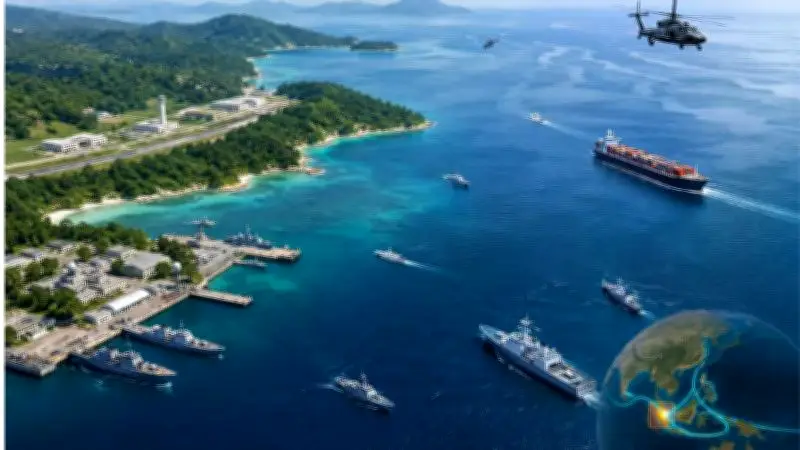
Great Nicobar Island: A Strategic Outpost in the Indian Ocean
The Great Nicobar Island (GNI), located approximately 40 nautical miles west of the Malacca Strait, holds immense geostrategic significance for India. The Malacca Strait, a critical chokepoint, handles roughly 25% of global maritime trade, including about 80% of China's oil imports. As the primary shipping channel between the Pacific and Indian Oceans, any disruption could raise consumer goods prices worldwide. India's Andaman and Nicobar archipelago, closer to Myanmar and Thailand than to mainland India, provides access to Southeast Asia and the Asia-Pacific region. India, a dialogue partner of ASEAN and a member of the Quad (with USA, Japan, Australia), seeks a more influential role in these waters.
The Great Nicobar Island Development Project (GNIDP)
The Indian government, under Prime Minister Modi, has proposed a three-phase plan for holistic development, described as of "strategic, defensive and national importance." The project aims to transform GNI into a "major hub of maritime and air connectivity." Spearheaded by NITI Aayog and reportedly involving the Adani group, the plan includes building an international transshipment hub (entrepôt), a greenfield airport for civil and military use, a power and desalination plant, a township, a coastal expressway, electric mass transit rail, and a river dam. The project could cause a 4000% population increase, with a target completion date of 2047.
Strategic Benefits and Geopolitical Implications
Currently, a significant portion of India's container cargo is shipped via Sri Lanka, Malaysia, and Singapore, adding logistical steps. The proposed transshipment hub aims to reduce foreign dependence, capture economic value, create jobs, and strengthen supply chain resilience. It will provide more logistic options during wars, droughts, or blockades. With its proximity to the Malacca Strait, India can improve maritime domain awareness, support naval logistics, strengthen surveillance, and enable swift response. While some see value in sea denial rather than sea control, the project is viewed as a strategic observatory and a geopolitical signal of India's goal to gain influence in the Asia-Pacific and Indian Ocean Region.

Comparison with Other Indian Maritime Projects
GNIDP joins other initiatives like the Vizhinjam deep-water transshipment port in Kerala, India's first, aiming to attract global trade and boost the blue economy. The India-Middle East-Europe Economic Corridor (IMEC) connects three regions and is seen as a counter to China's Belt and Road Initiative (BRI). Together, these projects ensure India's influence in global east-west trade, alongside its Act East policy and Quad membership.
Environmental and Transparency Concerns
Critics, including Congress leader Rahul Gandhi and former environment minister Jairam Ramesh, have raised concerns. The Great Nicobar Biosphere Reserve, covering over 80% of the island, hosts rainforests, mangrove forests, giant leatherback turtle breeding sites, and homes of the Nicobarese and Shompen people. Ramesh highlighted a lack of transparency, with no environment monitoring report published since March 2024, and key studies incomplete. He called it an "extraordinary level of non-transparency." Others label the project as commercial, pitched as national security to avoid pushback. Viability questions arise due to earthquake and tsunami risks, and critics argue strategic benefits are inflated, as India cannot actually block the Malacca Strait but only monitor it.
Regional Dynamics and Pakistan's Response
India's enhanced port-led developments are seen as rivals to Gwadar and the BRI. The GNIDP has prompted other regional states to reassess their foreign policies. Pakistan is advised to focus on making the BRI operational, upgrade its navy, develop its blue economy, and strengthen ties with Southeast Asia to maintain balance in South Asia and relevance in the Indian Ocean region.