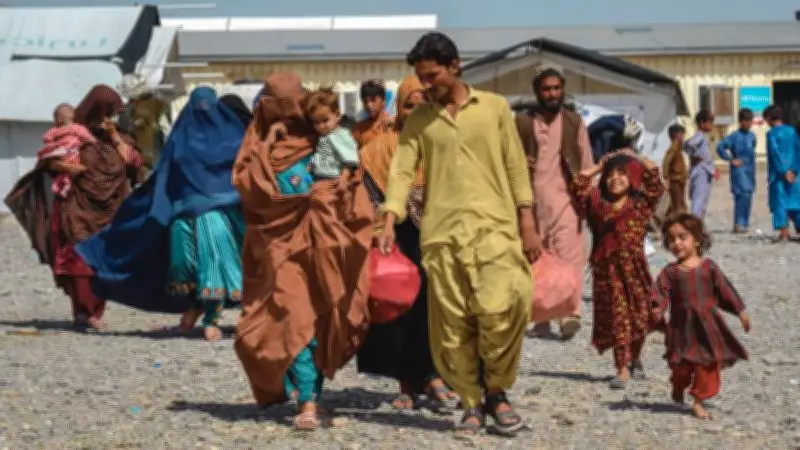
Pakistani authorities have intensified operations against undocumented Afghan nationals following a federal directive to begin their repatriation, leaving refugees and asylum seekers fearful of arrest and forced return to Afghanistan. The Ministry of Interior issued instructions on June 28 directing provincial authorities to prepare for the repatriation of Afghan nationals living in Pakistan without valid visas, according to a copy of the directive obtained by The Friday Times.
Raids and Detentions Under Repatriation Plan
Police and other law enforcement agencies have since launched raids and search operations in several parts of the country. The crackdown has intensified following a deadly militant attack on a paramilitary Rangers facility in Karachi’s Gulistan-e-Johar area, where one of the detained suspects was reportedly identified as an Afghan national. Jamaat-ul-Ahrar, a splinter group of the Tehreek-e-Taliban Pakistan, claimed responsibility for the attack.
The operations are being conducted under Pakistan’s Illegal Foreigners Repatriation Plan, a government policy aimed at removing undocumented foreign nationals from the country. Although the policy formally applies to all undocumented foreigners, Afghan nationals have been affected most heavily. Following the Interior Ministry’s directive, police and law enforcement agencies across the provinces have begun questioning, detaining and deporting Afghans who are unable to produce valid documentation.

Refugees Express Fear and Desperation
For Afghan refugees already living in uncertainty, the latest operations have created a renewed atmosphere of fear. “This current crackdown has left me completely terrified,” said Ayesha, an Afghan refugee living in Islamabad, while speaking to The Friday Times. “Women are already living through hell in Afghanistan. I came to Pakistan for one reason: to continue my education. I want to become an artist. Art is my voice and how I express myself, but you simply cannot do that in Afghanistan anymore.”
Ayesha said she now felt trapped between the threat of detention in Pakistan and the prospect of returning to a country where women and girls have been denied many basic rights. “I am stuck in this awful limbo, and the new deadline has brought all that fear back,” she said. “I do not want to return, but it feels as though I have no choice. Does everyone not deserve to be treated like a human being? The police do not care whether you are registered or unregistered. To them, we are all treated like criminals.”
Legal and Human Rights Concerns
Human rights lawyers have warned that national security concerns cannot be used to justify indiscriminate arrests or the collective punishment of an entire community. “Every state has the sovereign right to protect national security and enforce its immigration laws,” lawyer Moniza Kakar told The Friday Times. “However, those powers must be exercised in accordance with the Constitution, the rule of law and international human rights standards.”
Kakar, a co-founder of the Joint Action Committee and a prominent legal advocate challenging the forced deportation of Afghan refugees, said a single security incident could not legally justify targeting people solely on the basis of their nationality. “Law enforcement measures must be based on individual conduct and credible evidence, not nationality alone,” she said. She added that undocumented Afghan nationals were also entitled to due process. “They should be informed of the reasons for their detention, have access to legal representation and be given a meaningful opportunity to challenge their detention or deportation, particularly where they may face persecution or other serious human rights violations if returned to Afghanistan.”
Mass Arrests in Karachi
According to Karachi police, more than 5,000 undocumented Afghan nationals have been arrested and transported to the border for deportation over the past 10 to 12 days. Police officials said search operations were continuing daily in neighbourhoods where undocumented Afghan nationals were believed to be residing.

The scale and speed of the crackdown have alarmed the United Nations refugee agency, which has urged Pakistan to halt forced returns and ensure that refugees are not sent back to situations in which their lives or freedoms may be endangered. “UNHCR is deeply concerned about the Government of Pakistan’s decision to forcibly return Afghan refugees and asylum seekers,” Qaiser Khan Afridi, spokesperson for UNHCR Pakistan, told The Friday Times.
Afridi acknowledged Pakistan’s role in hosting millions of Afghan refugees over more than four decades, often amid considerable economic and security challenges. “Refugees must not be returned to a country where their life or freedom is threatened,” he said. UNHCR is particularly concerned about the forced return of women and girls to Afghanistan, where the Taliban authorities have imposed sweeping restrictions on education, employment and public life. “We remain particularly concerned about women and girls forced to return to a country where their human rights are at risk, as well as other groups who might be endangered,” Afridi said. “We call on the authorities to ensure that any return of Afghans to Afghanistan is voluntary, safe and dignified.”
Potential Expansion to Balochistan
Sources have indicated that a large-scale operation against undocumented Afghan nationals may also be launched in Balochistan after July 11. The repatriation of Afghan refugees was reportedly discussed in detail during a recent meeting of the Balochistan Apex Committee chaired by Prime Minister Shehbaz Sharif. The meeting also reviewed the province’s law-and-order situation and recent incidents of terrorism.
UNHCR has appealed to the Pakistani government to adopt a phased and protection-sensitive approach and to provide refugees with a sufficient grace period to prepare for any return. The agency has also urged the government to permit continued legal residence for particularly vulnerable Afghans, including those requiring medical treatment, students pursuing higher education and people in mixed-nationality marriages.
For refugees such as Ayesha, however, the legal arguments and diplomatic appeals offer little immediate reassurance. As raids continue and deportations accelerate, many Afghans fear they will be judged not by their individual circumstances, legal status or reasons for seeking refuge, but by their nationality alone.