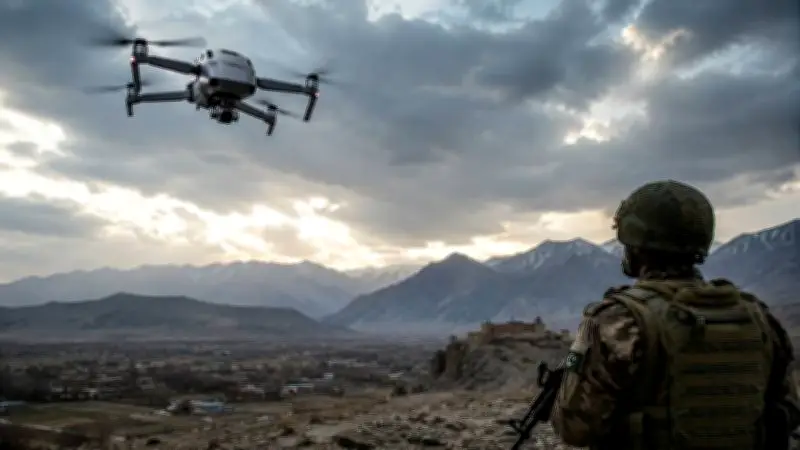
Pakistan's Multi-Front Drone Dilemma
Cinematically, the phrase 'Enter the Dragon' conjures images of lethal precision, calculated strikes, and a singular martial discipline. Decades ago, Bruce Lee brought that philosophy to the silver screen. Today, a vastly different, mechanical beast has entered the theatre of modern warfare: the unmanned aerial vehicle (UAV). In the regional context of Pakistan and Afghanistan, the drone did not enter with a cinematic flourish, but rather with the distant hum of a propeller over the Hindu Kush, forever altering the landscape of national sovereignty and public safety.
What began decades ago as a monopolised tool for high-tech surveillance has evolved into an asymmetric equaliser. Today, Pakistan faces a multi-front drone dilemma. On the geopolitical frontier, non-state actors and cross-border adversaries utilise rudimentary and commercial drones to bypass traditional air defences. Domestically, the unchecked proliferation of consumer quadcopters poses an asymmetric security threat to urban centres and public spaces. To protect its sovereignty and citizens, Pakistan must urgently overhaul its airspace strategy. It must follow global precedents to establish a dedicated Anti-Drone Command, arm local law enforcement with tactical electronic countermeasures, and rigidly enforce a domestic drone licensing framework akin to firearms regulations.
The AfPak Genesis: From Monitors to Munitions
The history of drones in the AfPak region is deeply rooted in the post-9/11 security paradigm. Originally, unmanned platforms in these rugged borderlands were the exclusive domain of the United States military and the Central Intelligence Agency (CIA).

The Scouting Phase: In the early 2000s, unarmed drones like the RQ-1 Predator were deployed primarily for intelligence, surveillance, and reconnaissance (ISR) missions along the porous Pak-Afghan border. Their purpose was tracking Al-Qaeda and Taliban leadership fleeing operations in Afghanistan.
The Lethal Transition: The nature of the conflict changed fundamentally on 13 May 2004, when the first-ever reported United States drone strike inside Pakistan killed Nek Muhammad Wazir, a prominent local militant commander in South Waziristan.
The Escalation Years: Between 2008 and 2012, United States drone strikes peaked sharply, totalling exactly 340 strikes. The year 2010 stood as the absolute zenith of the aerial campaign, averaging a strike every three days. This heavy usage eventually entered a permanent decline, leading to the notable elimination of Afghan Taliban chief Mullah Akhtar Mansour in Balochistan on 21 May 2016.
While these strikes were highly controversial and fiercely debated on the grounds of state sovereignty and civilian casualties, they fundamentally reshaped the tactics of regional militancy. Non-state actors studied the efficacy of aerial asymmetric warfare from the receiving end. They quickly realised that whoever controls the low-altitude sky dictates the terms of the engagement.
The Modern Threat: Democratisation of Aerial Terror
Fast forward to the present day, and the monopoly on unmanned technology has entirely collapsed. The technology has democratised, giving rise to an era where low-cost, readily available commercial platforms are easily weaponised. Pakistan now faces a direct, cross-border aerial challenge. Groups like the Tehreek-e-Taliban Pakistan (TTP) and the Afghan Taliban have actively incorporated drone warfare into their operational playbooks. Armed wings of these groups have advanced from using rudimentary rotary-wing quadcopters for scouting border posts to modifying commercial fixed-wing drones capable of dropping low-altitude improvised explosive devices (IEDs).
The stakes reached a dangerous historical flashpoint recently, when the Afghan Taliban claimed responsibility for launching drone strikes directly into Pakistani territory across Balochistan and Khyber Pakhtunkhwa. While Pakistan’s air defence systems successfully neutralised several of these hostile platforms via advanced electronic countermeasures, falling debris in populated areas like Quetta and Rawalpindi served as a stark reminder of the looming threat. Drones are no longer just tools for counter-terrorism; they are tools of terrorism, used to wage conventional, cross-border proxy wars.

The Urban Pipeline: Clear and Present Security Threat
The threat is no longer confined to distant border posts or remote mountains. It has actively infiltrated Pakistan's most critical metropolitan hubs, posing a direct hazard to public security. Anti-state elements have realised that they do not need to smuggle whole military drones across the border; instead, they can exploit unregulated commercial supply chains within Pakistan's own borders.
A stark reality check occurred when law enforcement agencies conducted high-stakes raids in Karachi, arresting a network of Taliban operatives who were utilising the country's economic hub to procure specialised drone components to build custom weaponry. Operating in bustling local markets like Saddar and Bolton Market, these cells systematically sourced high-end parts to bypass border monitoring.
This urban procurement pipeline highlights a massive security vulnerability: The Sourcing Hazard: Right now, anyone can walk into electronic markets and purchase commercial-grade flight controllers, long-range telemetry transmitters, and specialised drone motors without triggering a single red flag. Asymmetrical Risk: By buying these specialised parts piecemeal, terrorist syndicates can assemble lethal, low-cost loitering munitions right under the nose of domestic intelligence, severely jeopardising city infrastructure, VIP movements, and public safety.
Step 1: Institutionalising a National Anti-Drone Command
In response to this rapidly evolving threat matrix, Pakistan cannot rely on piecemeal reactive measures. It must look at global institutional overhauls as a blueprint for its own defence infrastructure. Chief among these examples is the United States, which has aggressively moved towards creating a unified, specialised Anti-Drone Force, the Joint Counter-Small UAS Office (JCO), to protect military bases and domestic critical infrastructure from swarm attacks and rogue UAVs.
Pakistan must immediately follow in these footsteps by establishing a centralised National Anti-Drone Command. This unified body should bridge the operational gap between the Pakistan Air Force, the Army’s air defence wings, and civil aviation regulators. Monopolising Low-Altitude Airspace: While traditional military air defences are calibrated to detect fast-moving fighter jets or ballistic missiles at high altitudes, they are often ill-equipped to intercept small, low, slow, and small (LSS) drones hugging the terrain. Strategic Synchronisation: A dedicated command would synchronise early-warning radar networks specifically tuned for small signatures, manage localised electronic warfare (EW) zones, and deploy rapid-response protocols to protect highly sensitive border outposts, nuclear facilities, and government structures.
Step 2: Arming the Frontline Police with Advanced Technology
While the military handles high-altitude and border threats, the domestic urban landscape falls squarely on civilian law enforcement. Because terrorist networks are actively sourcing and assembling these devices inside our cities, our police forces are the absolute first line of defence against an urban drone deployment.
The provincial governments have begun recognising this reality. For instance, the Punjab Home Department announced initiatives to establish localised Anti-Drone Units in all districts. However, institutional plans must be backed by aggressive technological procurement and extensive tactical training. Our police forces can no longer protect public safety with conventional tools alone. Police departments across Pakistan must be systematically equipped with cutting-edge, man-portable counter-UAS (C-UAS) technology, such as directional RF jamming guns. By providing frontline personnel with these tools, the police can instantly sever the command link between a rogue drone and its operator, bringing the device down safely without risking catastrophic mid-air explosions over dense urban crowds.
Step 3: Dual-End Licensing—Regulating Specialised Technology
Technology and military force are only half the battle. The final, crucial pillar of a comprehensive strategy lies in robust, unyielding legal regulation. Currently, Pakistan operates under erratic, reactionary bans. Local administrations frequently invoke temporary restrictions like Section 144 to bar outdoor drone flying for 30 or 60 days due to vague security alerts. This erratic approach disrupts legitimate commercial operators while failing to stop determined bad actors.
Pakistan must transition from emergency temporary bans to an absolute, permanent licensing framework. Assembled drones and their specialised aviation components must be viewed through the same legal prism as firearms. To truly dismantle the urban supply chains exposed by the Karachi arrests, regulation must target the source through a dual-end licensing model that ignores universal electronics and zeroes in exclusively on specialised drone technology.
This model heavily relies on modern global legal frameworks, drawing direct precedent from the European Union's updated Counter-UAS Action Plan and the United Kingdom’s aviation laws, which mandate strict supply chain tracking and enforce a mandatory 'Remote ID' system to broadcast the operator's real-time identity and GPS coordinates to law enforcement:
- Licensed Sellers Only: Much like a registered arms dealership, any commercial vendor selling pre-assembled drones, programmable flight control boards, or long-range video transmitters must hold a federal or provincial security licence. Mirroring the strict traceability parameters established by Western 'Trusted Drone' frameworks, sellers must legally record every transaction, verify customer credentials, and face severe closure and criminal prosecution if they sell parts 'off the books.'
- Licensed Purchasers & Background Checks: No civilian should be permitted to purchase or import an outdoor-capable drone or specialised telemetry link without passing rigorous background security clearance checks executed by relevant intelligence agencies and interior ministries.
- Universal Digital Registration: Every drone sold domestically must be linked to a National Identity Card (CNIC) and fitted with a tamper-proof Remote Identification (Remote ID) microchip. This chip must continuously broadcast the drone’s serial number and the operator's real-time GPS coordinates.
Conclusion
The era of viewing drones as harmless recreational toys or remote military novelties is officially over. They are highly efficient, highly disruptive kinetic platforms that have permanently entered the regional theatre of conflict. As the Karachi procurement cells have proven, the threat is breathing down our necks inside our own commercial hubs. If Pakistan wants to secure its cities, safeguard its security personnel along the western borders, and preserve public peace, it can no longer afford to lag behind the global counter-UAS curve. It must institutionalise an Anti-Drone Command, empower its police forces with jamming capabilities, and clamp down on both the sale and ownership of specialised drone technology with uncompromising regulation. The dragon of aerial asymmetry has entered our skies; it is time Pakistan builds the cage to lock it down.