The United Nations Office on Drugs and Crime (UNODC) reports that approximately 316 million people worldwide used drugs in 2023, up from 246 million a decade earlier, marking a 28% increase. This data, released in the World Drug Report 2025, underscores the escalating global narcotics crisis. The International Day against Drug Abuse and Illicit Trafficking, observed annually on June 26 since the UN General Assembly's 1987 resolution, this year carries the theme: 'Drug problems persist, new challenges emerge, innovative responses are needed.'
Pakistan's Strategic Vulnerability in the Global Drug Trade
Pakistan remains a critical transit country for narcotics, particularly heroin and opium produced in Afghanistan. According to the International Narcotics Control Strategy Report (INCSR) March 2025, most Afghan narcotics destined for global markets traverse Pakistan via overland corridors linking Pakistan, Afghanistan, Iran, and India. Officials assess that large quantities also move through Pakistan's maritime domain with relative ease. This vulnerability is compounded by instability in neighboring Afghanistan, the resurgence of the Tehrik-e-Taliban Pakistan (TTP), and Baloch separatist groups.
The World Drug Report 2025 highlights an unprecedented expansion of the cocaine market, with global production reaching record levels in 2023, alongside historic highs in seizures, trafficking, and consumption. Synthetic drugs have transformed narcotics markets; methamphetamine, amphetamine-type stimulants, and synthetic opioids can now be manufactured almost anywhere, complicating enforcement efforts that previously relied on targeting agricultural cultivation.

The Political Economy of Narcotics: Historical Continuities
Despite over half a century of the 'war on drugs,' drug markets are larger than ever. This paradox stems from the political economy of narcotics, which mirrors the 19th-century opium trade. Britain's Opium Wars against China (1839-1860) were driven by preserving a highly profitable commercial arrangement. Today, extraordinary profits from addiction create powerful incentives for criminal enterprises and political actors. Historically, drug trafficking has been intertwined with commerce, geopolitics, and state power. Colonial administrations in Asia derived substantial revenues from opium monopolies, and many states that later championed prohibition had earlier benefited from the trade.
During the Cold War, anti-communist struggles and proxy conflicts intersected with narcotics-producing regions. Afghanistan's Golden Crescent and Southeast Asia's Golden Triangle saw narcotics flourish in zones of conflict and foreign intervention. In Afghanistan, decades of war, institutional collapse, and poverty transformed narcotics into a parallel economic system, financing insurgents, militias, and corrupt officials.
Taliban's Poppy Ban and Unintended Consequences
A significant development is the dramatic decline in poppy cultivation in Afghanistan following the Taliban's 2022 ban. UNODC estimates show cultivation, which exceeded 200,000 hectares before the ban, declined dramatically. While demonstrating that political will can affect cultivation, it exposed structural problems: thousands of impoverished farming households lost a major livelihood, and trafficking networks diversified into methamphetamine and other synthetic substances. The suppression of cultivation without viable economic alternatives leads to market mutation rather than disappearance.
The INCSR 2025 continues to identify Pakistan as facing challenges from narcotics trafficking, violent extremism, instability in Afghanistan, and evolving trafficking routes. The report notes that most Afghan narcotics are destined for global markets, and Pakistan remains vulnerable via land and maritime corridors.

Narcotics-Terror Nexus in Pakistan
Pakistan's experience demonstrates how narcotics, militancy, and illicit finance reinforce one another. During the 1980s Afghan war, heroin addiction, the Kalashnikov culture, informal financial networks, and militant organizations emerged simultaneously across porous borders. Decades later, Pakistan bears the burden: millions of young people exposed to narcotics, law enforcement confronting adaptive trafficking networks. The resurgence of the TTP has heightened the narcotics-terror nexus. Contemporary terrorist organizations rarely depend on a single funding source; extortion, kidnapping, smuggling, illegal mining, donations, and narcotics trafficking operate as interconnected revenue streams. The fight against terrorism requires disrupting financial lifelines, trafficking routes, money-laundering mechanisms, and criminal enterprises sustaining extremist violence.
Financial Architecture of the Drug Trade
Drug trafficking generates enormous illicit proceeds that must enter the legitimate economy through money-laundering networks, offshore financial centers, shell corporations, trade-based laundering, and digital platforms. Proceeds are invested in real estate, financial assets, luxury goods, and legitimate businesses. The global narcotics trade cannot survive without access to the formal financial system. The greatest weakness of the anti-narcotics regime is its focus on producers and couriers while neglecting the financial architecture that launders criminal proceeds.
Pakistan has a legal framework against narcotics: the Control of Narcotic Substances Act, 1997 criminalizes production, trafficking, possession, and financing; the Anti-Narcotics Force is the principal enforcement agency; the Anti-Money Laundering Act, 2010 addresses financial dimensions. Pakistan is party to UN drug-control conventions and instruments on organized crime and terrorist financing. Yet criminal organizations adapt faster than regulatory systems.
Synthetic Drugs and Maritime Trafficking
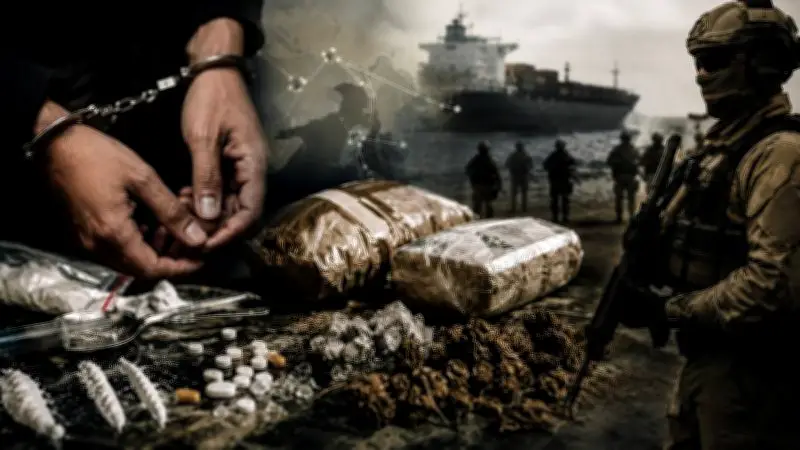
The emergence of synthetic drugs like methamphetamine ('ice') has spread rapidly across South Asia. Unlike heroin, synthetic narcotics do not depend on large-scale cultivation and can be manufactured in clandestine laboratories using precursor chemicals. UNODC warns that synthetic drugs represent one of the fastest-growing segments of the global narcotics market. Pakistan's strategic location presents additional challenges: maritime trafficking through the Arabian Sea has assumed increasing importance, with substantial quantities moving through corridors connecting South Asia, East Africa, the Gulf, and international markets.
The World Drug Report 2025 should compel policymakers to rethink assumptions. While governments have become more efficient at seizing drugs and arresting traffickers, criminal networks have become even more efficient at adapting. The challenge is not merely to suppress narcotics but to confront the political, economic, and financial structures sustaining the narcotics economy. As long as hundreds of billions of dollars generated by drug trafficking find sanctuary within the global financial system, enforcement alone will produce limited results.
The UNODC theme for 2026 captures this reality: threats are changing, synthetic drugs replace traditional narcotics, criminal organizations exploit digital technologies, terrorist groups seek financial support through illicit networks, and drug money moves through sophisticated financial channels. The future of drug control lies in reducing demand, strengthening public health systems, dismantling criminal finances, creating economic opportunities in vulnerable regions, and enhancing international cooperation. Above all, it requires acknowledging that the war on drugs has largely been a war against symptoms rather than causes. Until governments address the nexus between narcotics, illicit finance, organized crime, and geopolitical conflict, the world drug problem will continue to evolve faster than policies designed to contain it.