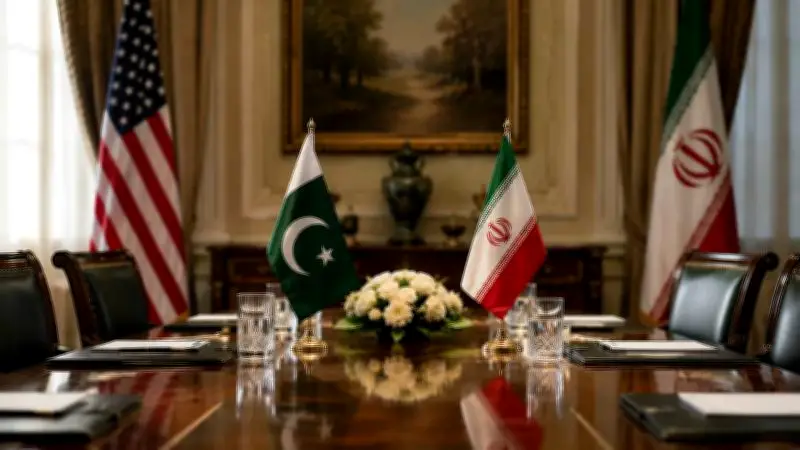
The ongoing era of "hyperrealism" in International Relations is shrinking the space for states to maintain strategic ambiguity, pushing them to redefine and reveal their organic state objectives. The strategic choices of regional and global states in the West Asian crisis have evidenced this reality brazenly clear. Meanwhile, Pakistan did the unthinkable, emerging as a modern Pivot State, a concept recently explored in an interview with World Geostrategic Insights, while advancing Muhammad Ali Jinnah's vision of Pakistan as the "pivot of the world" through its stellar shuttle diplomacy alongside regional partners to help bring about peace between the United States and Iran.
US-Iran Negotiations and Regional Tensions
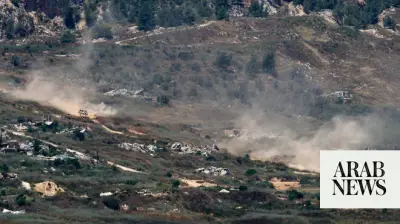
The first round of negotiations wrapped up at Bürgenstock, Switzerland, but tensions soon escalated between the US and Iran over the Strait of Hormuz. As of today, CNN reported both sides are "standing down for now" and aiming for talks in Qatar while Israel and Hezbollah are still fighting in Lebanon. The Guardian confirmed that Israel’s presence in Southern Lebanon is already adding further complexity to the US-Iran interim ceasefire. In many ways, this reflects a concern raised in a recent Pakistan TV interview: that Lebanon and Palestine would remain the trigger points most likely to keep peace fluid and fragile in West Asia.
The Core Obstacle: Radical Zionism
Let's not forget that the ones who seek peace are the pragmatists, not the radical Zionists. For them, peace is a cliché, a roadblock to the strategic design of accomplishing a fanatically motivated, delusional pursuit of greater Israel. And to me, that is the nub of the problem that has disrupted the peace in the Arab region for decades. This raises a deeper question of political will and civilizational readiness: whether what is morally desirable is still historically achievable. A long-standing peace requires context-specific diplomatic actions, but actions can only justify the means when the right questions are raised in time.

Muslim World and the Two-State Solution
By that logic, this is the pressing time for the Muslim world to revisit the rationale for the two-state settlement, as part of a solution or part of the problem, if it wants long-lasting peace to prevail. This is precisely the dilemma of confusing long-term political objectives with short-term survivability, where incremental “pragmatism” risks hardening into permanent acceptance of an eroding status quo. Pakistan can initiate this conversation, but it cannot wage it on behalf of the entire Muslim world.
Pakistan's Founding Ideology on Palestine
This is not a recent diplomatic posture; it is rooted in Pakistan's founding ideology. The founding fathers of Pakistan, Dr. Allama Muhammad Iqbal and Muhammad Ali Jinnah, resolutely rejected the partition of Palestine even before Pakistan's creation. After independence, the posture remained uncompromising: no recognition of Israel or an illegitimate partition. Jinnah declared, "Israel is a dagger thrust into the heart of the Ummah. This is an illegitimate state that Pakistan will never accept." Liaquat Ali Khan told Ben-Gurion: "Gentlemen, our soul is not for sale." But this creates a strategic dichotomy: while Pakistan’s passport doesn’t recognise Israel, its foreign office still peddles a policy of the two-state solution, which buries the principle our founding generations refused to accept.

Pakistan's Diplomatic Credentials
Pakistan has already proven its diplomatic credentials. If Pakistan can deliver such a Herculean task as brokering peace through its rigorous diplomacy and growing leverage in the Muslim world, it stands as the ideal candidate to convene the moot on the viability of the territorial division template, especially among Muslim capitals. This credibility, however, rests on its standing in the international system and its ability to initiate and sustain high-level political dialogue across the Muslim world. Pakistan demonstrated such diplomatic finesse under Prime Minister Zulfikar Ali Bhutto, in what could be called one of the finest hours in Pakistan's diplomatic history, when it led to the convening of Muslim leaders at the Lahore Islamic Summit in 1974. That summit demonstrated Islamabad's ability to bring together Muslim leaders during a period of strategic uncertainty to discuss the future of the Muslim Ummah, a challenge that mirrors the strategic confusion confronting the Muslim world today.
Israeli Expansion and the Collapse of the Two-State Framework
On what grounds is the Muslim world still clinging to a divided-state arrangement, especially when the apartheid, illegitimate state of Israel continues to violate that very blueprint through its unabated illegal expansion and mayhem into Arab lands? The most recent evidence shows that Tel Aviv is no longer merely weakening the partition framework in practice; leaders in the Israeli government are now openly declaring projects of territorial expansion and control. Far-right Israeli Finance Minister Bezalel Smotrich has shamelessly announced the incorporation of large parts of the West Bank, and its National Security Minister, Itamar Ben-Gvir, has repeatedly called for the full occupation of Gaza and the displacement of Palestinians. Despite shallow condemnation from other Israeli officials, Israel's current leadership is determined to end the very idea of Palestinian sovereignty from its foundations.
Land Grabbing and Palestinian Concessions
In the West Bank, Israel is dismantling statehood through settlements, land confiscation, and military violence. In Gaza, Israel has destroyed infrastructure and continues to maintain military control over large areas. Estimates from the Palestinian Central Bureau of Statistics (PCBS) reveal that out of 27,000 square kilometers of historical Palestine before 1948, 20,700 square kilometres, Israel's territory until the 1967 war, accounts for roughly 77% of the Palestinian land. This Israeli land grabbing doesn't include the Golan Heights or the Sinai Peninsula from the 1967 Arab War. In a recent exchange with the Palestinian journalist Muhammad Safiya, he observed that the Palestine Liberation Organization accepted a state on 22 percent of historic Palestine in 1988, the West Bank, Gaza, and East Jerusalem, in exchange for ending the occupation. That was an extraordinary concession. Yet Israel never honoured its side. Instead of facilitating Palestinian statehood, Israel expanded settlements, fragmented the land, and steadily dismantled the very state Palestinians had already agreed to accept.
Civilizational Readiness and Strategic Compromise
Undoubtedly, the wisdom and foresight of Pakistan's founding elites remain relevant today, especially in light of current Zionist designs in the Arab world. And those designs are reflected in the blatant pursuit of Greater Israel through pulverising people into ashes, through reducing the infrastructure into rubble, through the mass raping of kids and women, through usurping Arab lands illegally into its fold, and through silencing global objections into programming slogans of antisemitism and through legitimising narratives to deflect ferocious acts into claims of self-defence. When I discussed this with Ambassador Ashraf Jehangir Qazi, he agreed that the contradictions identified here are fundamentally correct, but immediately reframed the issue in broader civilizational terms. The real question, he suggested, is whether contemporary Muslim societies are prepared for the rigours of struggle, sacrifice, and loss that accompany any serious pursuit of long-term political objectives. He cautioned against confusing what is desirable with what is immediately achievable, noting that “the best” is often made the enemy of “the good” when historical patience is replaced by political impatience. In this sense, strategic compromise is not an abandonment of principle but a recognition of the temporal limits within which political systems are forced to operate. In his reading of Muslim history, decline has repeatedly followed moments when intellectual adaptation gave way to closure — first after the destruction of Baghdad, and later under colonial domination, when defeatism and nostalgia displaced renewal and reform. Unless Muslim societies move beyond what he termed the condition of Eliot’s “The Hollow Men,” strategic compromise risks becoming not a bridge to renewal, but a permanent state of surrender.
Pakistan's Role in Initiating Discourse
Under the current realities, Pakistani policymakers have enough credibility, history, and diplomatic weight to initiate a discourse on this so-called two-state cover-up for genocide. Islamabad's advocacy of territorial division needs a thorough revisit, tested against its foundational historical realities and the shifting geopolitical dynamics. Pakistan can initiate this conversation, but it cannot wage it on behalf of the entire Muslim world. Ultimately, only when the Muslim world truly embraces the fidelity of Islam will the long betrayal of Palestine begin to receive the overdue justice it deserves.