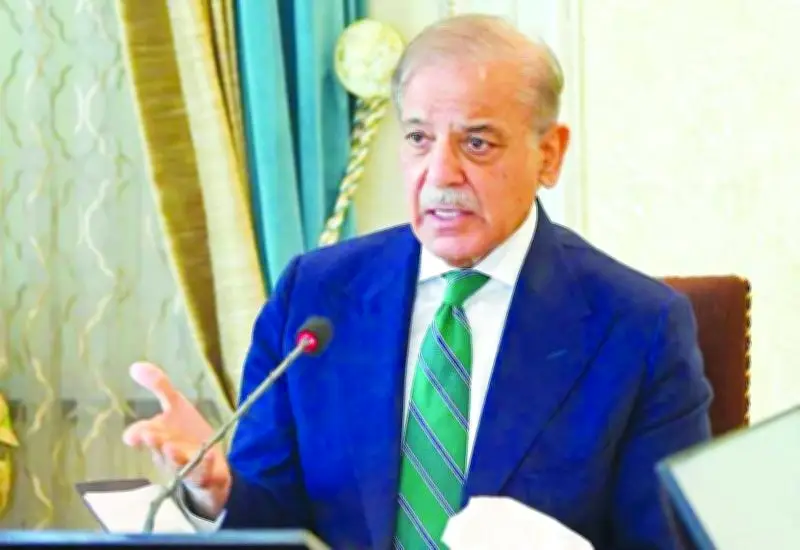
Prime Minister Shehbaz Sharif, a key mediator in US-Iran peace talks, is expected to attend a funeral ceremony for Iran's slain Supreme Leader Ali Khamenei over the weekend, alongside senior officials from Russia, China, India and other countries.
PM's Visit to Iran and Turkey
“Prime Minister, Muhammad Shehbaz Sharif, will go to Iran and Turkey from 3-5 July… he will go to Iran first for (the) supreme leader's funeral,” Pakistan's Foreign Ministry spokesman Tahir Andrabi told reporters on Thursday. Foreign Office said PM will travel to Tehran to participate in the funeral ceremony of Iran's late Supreme Leader Ayatollah Seyyed Ali Khamenei, where he will convey condolences on behalf of the Government and people of Pakistan and reaffirm Islamabad's solidarity with the Iranian nation.
Following the visit to Iran, Prime Minister Shehbaz Sharif will travel to Istanbul at the invitation of Turkish President Recep Tayyip Erdogan for wide-ranging discussions on bilateral relations, with particular emphasis on expanding trade, investment and economic cooperation.

Business Conference in Istanbul
During his stay, the Prime Minister will also address a Pakistan-hosted business conference aimed at showcasing investment opportunities in special economic zones, energy, information technology and the privatisation sector before leading Turkish investors and business leaders.
India and Indus Waters Treaty
On relations with India, the spokesperson reiterated Pakistan's categorical rejection of India's decision to place the Indus Waters Treaty in abeyance, describing the move as illegal, unilateral and without legal basis. Also, Foreign Office said it has “nothing to hide” on any issue with India and would welcome constructive international engagement to promote peace and security in South Asia.
Islamabad also reaffirmed that Pakistan will continue playing a facilitative role in ongoing diplomatic efforts aimed at reducing tensions between the United States and Iran. Speaking at a weekly news briefing, Foreign Office spokesperson Tahir Andrabi said Pakistan's positions on all outstanding issues with India, including Jammu and Kashmir, the Indus Waters Treaty (IWT) and counterterrorism, were firmly grounded in international law and the United Nations Charter.
“We have nothing to hide,” the spokesperson said, adding that Pakistan was confident of its legal and political standing and would welcome any positive role by the international community, including the United States, in advancing regional peace and stability. The spokesperson maintained that India had consistently shied away from international engagement because its positions on key disputes could not withstand scrutiny under international law. Pakistan, he said, remained open to dialogue and any genuine peace initiative that respected international legal principles.
US-Iran Peace Mediation
On the Middle East, Andrabi said Pakistan had significantly intensified diplomatic engagement with regional and international stakeholders to facilitate implementation of the Islamabad Memorandum of Understanding (MoU) between Iran and the United States, in line with the Pakistan-Qatar Joint Statement issued at Bürgenstock on June 21. He said Pakistani and Qatari mediators held separate meetings with US and Iranian negotiators in Doha, where “positive progress” was achieved on issues related to the Islamabad MoU, building upon understandings reached during the Lake Lucerne Summit.
The spokesperson said all parties agreed to continue negotiations, with the next round of talks expected to take place at the earliest opportunity following the funeral ceremonies of Iran's former Supreme Leader. While declining to disclose details of the negotiations, Andrabi described the continuation of dialogue as an encouraging sign, saying mediators remained optimistic despite strong public statements issued by the principal parties. “The dialogue has not broken down. The process is continuing and that itself is positive,” he said, adding that Pakistan could not rule out the possibility of hosting future rounds of negotiations if required.

Diplomatic Engagements
The spokesperson said Deputy Prime Minister and Foreign Minister Ishaq Dar had remained in close contact with regional and global partners, holding telephone conversations during the week with the foreign ministers of Saudi Arabia, China, Bahrain and Iran, as well as Britain's Foreign Secretary and the European Union's High Representative for Foreign Affairs and Security Policy. Earlier in the briefing, Andrabi announced that Prime Minister Muhammad Shehbaz Sharif would undertake official visits to Iran and Türkiye from July 3 to 5, accompanied by Deputy Prime Minister Ishaq Dar, cabinet ministers and senior officials.
Indus Waters Treaty Dispute
He said Pakistan rejected India's attempts to justify the suspension of the treaty through what he termed baseless allegations of terrorism, arguing that the real issue reflected an Indian mindset seeking unilateral control over shared international river systems. Water, he stressed, could never be used as a political weapon or instrument of coercion, warning that any attempt to deprive Pakistan of its legitimate share under the treaty would violate international law and undermine treaty-based relations. Referring to a recent seminar on the Indus Waters Treaty, Andrabi said the event had strengthened international understanding of the treaty's legal, humanitarian, hydrological and security dimensions and reinforced Pakistan's position that disputes over transboundary rivers must be resolved through international legal mechanisms.
The spokesperson also underlined the importance of broader regional cooperation on Himalayan water resources, describing the Himalayan watershed as a shared heritage supporting billions of people across South Asia, China and Southeast Asia. He said climate change and unilateral actions posed growing challenges that required wider regional engagement.
Security and Cross-Border Operations
On security, Andrabi said Pakistan remained committed to eliminating terrorism while preserving regional peace, noting that intelligence-based operations under Operation Ghazb Lil Haq had recently neutralised several militants, including senior commanders belonging to Fitna al-Khwarij and Jamaat-ul-Ahrar. He defended Pakistan's recent cross-border strikes against terrorist hideouts, saying they were intelligence-driven, proportionate and precisely targeted against terrorist infrastructure. Rejecting allegations of civilian casualties, he said Pakistan exercised due diligence and targeted only terrorists.
The spokesperson warned that Pakistan reserved the right to respond under Article 51 of the UN Charter if provocations from across the Afghan border continued, including drone incursions and terrorist attacks planned from Afghan territory. He reiterated Pakistan's longstanding position that Afghan soil must not be used to sponsor or facilitate terrorism against Pakistan, adding that the continued security threat had adversely affected bilateral trade and regional connectivity projects.
The spokesperson also confirmed that Pakistan had lodged strong diplomatic protests with Afghanistan following the recent Karachi terrorist attack, saying evidence showed Afghan nationals had participated in the assault, reinforcing Pakistan's concerns regarding the use of Afghan territory by terrorist groups.
Consular and Religious Matters
On consular matters, Andrabi said Pakistan had handed India an authenticated list of 753 Pakistani prisoners believed to be detained in Indian jails under the bilateral consular agreement, maintaining that Islamabad's records were comprehensive and carefully verified through diplomatic channels, family notifications and official information. He said Pakistan would continue pursuing the release and repatriation of all Pakistani nationals held in Indian prisons.
Addressing questions relating to religious sites, the spokesperson clarified that recent damage to a historic gurdwara in Farooqabad resulted from unauthorised actions by tenants occupying a dilapidated structure and not from any state-sanctioned activity. He said authorities immediately halted the work, cancelled the tenancy and initiated remedial measures while reaffirming Pakistan's commitment to protecting religious heritage.
Piracy and Olive Council
Responding to concerns regarding piracy off the Somali coast, Andrabi said Pakistan was continuing diplomatic efforts with Somalia, Puntland authorities, the International Maritime Organization, the European Union Naval Force and other international partners to secure the release of Pakistani crew members held hostage aboard MT Honor. He said the government remained in constant contact with all stakeholders to ensure the safety and welfare of the hostages while pressing for their earliest possible release.
The spokesperson highlighted Pakistan's recent assumption of permanent membership in the International Olive Council, describing it as a significant milestone for the country's expanding olive sector and growing international agricultural engagement.
Financial Accountability
On administrative matters, Andrabi rejected suggestions of financial impropriety following recent audit observations involving the Foreign Office, saying the overwhelming majority of observations related to documentation and procedural issues rather than misuse of public funds. He stressed that the ministry maintained a transparent audit mechanism through internal oversight, the Auditor General of Pakistan and the Public Accounts Committee, assuring that every rupee of public money would remain fully accountable.