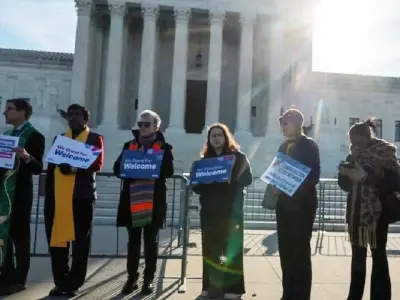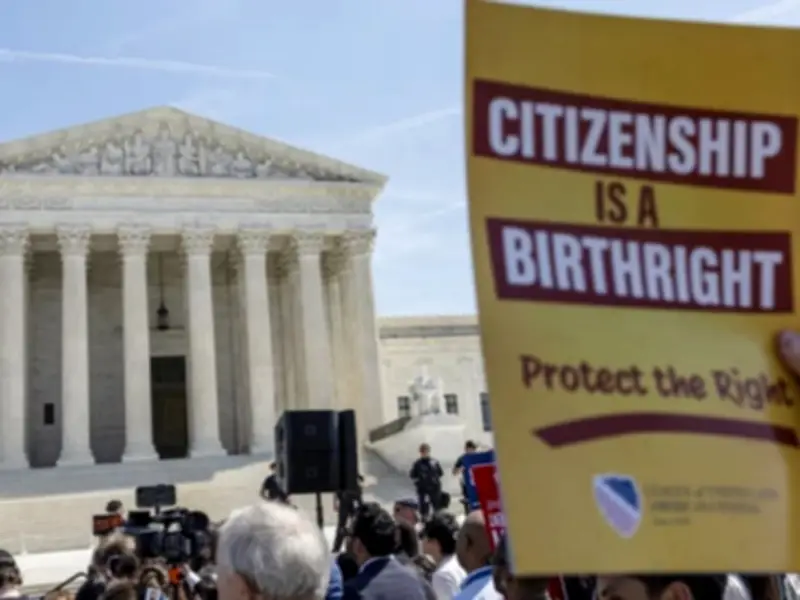
The US Supreme Court handed President Donald Trump a significant defeat on Tuesday, ruling 6-3 to reject his executive order that sought to restrict birthright citizenship. The decision upholds a lower court's block on the directive, which would have denied citizenship to children born in the United States unless at least one parent was a US citizen or legal permanent resident. The ruling marks the second time this year the court has invalidated a major Trump initiative, following its February decision against his global tariffs.
Constitutional Basis of the Ruling
Chief Justice John Roberts, writing for the majority, stated that Trump's order violated the 14th Amendment's Citizenship Clause, which guarantees citizenship to virtually anyone born on US soil. The clause reads: "All persons born or naturalized in the United States, and subject to the jurisdiction thereof, are citizens of the United States and of the state wherein they reside." Roberts emphasized the historical precedent set by the 1898 case United States v. Wong Kim Ark, which affirmed birthright citizenship for children of foreign nationals. "Not surprisingly, then, in the 128 years since, we have repeatedly understood the rule of Wong Kim Ark to guarantee citizenship to all children born in the United States and subject to its power," Roberts wrote. "We see no reason to depart from that view today."
Trump's Response and Congressional Push
Following the ruling, Trump took to his Truth Social platform, calling the decision "too bad for our Country" but expressing confidence that Congress could address the issue through legislation. "No long and unwieldy Constitutional Amendment is necessary! Congress should start TODAY to work on ending expensive and unfair to our Country, Birthright Citizenship. They will have my Complete and Total Support!" Trump wrote. Critics have accused the Republican president of racial and religious discrimination in his immigration policies, which have included a crackdown on both legal and illegal immigration since he took office.

Details of the Legal Challenge
The case originated as a class-action lawsuit in New Hampshire, filed by parents and children whose citizenship was threatened by the executive order. The plaintiffs argued that the order violated the 14th Amendment, a position supported by Democratic state attorneys general. California Attorney General Rob Bonta hailed the decision, stating, "Today's decision affirms a foundational tenet of American democracy: that every child born in this country, no matter their background, is equal under the law and can pursue the American Dream." New York Attorney General Letitia James called birthright citizenship "a constitutional guarantee that has defined this nation for generations."
Administration's Arguments and 'Birth Tourism' Claims
During oral arguments on April 1, Trump made history as the first sitting president to attend a Supreme Court hearing, though he left midway. US Solicitor General D. John Sauer, representing the administration, argued that the Citizenship Clause's phrase "subject to the jurisdiction thereof" excludes children of immigrants who are in the country illegally or temporarily, such as students or those on work visas. Sauer claimed that birthright citizenship has spawned a "birth tourism" industry, with "uncounted thousands of foreigners from potentially hostile nations" giving birth in the US to secure citizenship. However, when pressed, he conceded that "no one knows for sure" the extent of the phenomenon, citing primarily media reports.
Historical Context and Precedent
The 14th Amendment was ratified in 1868 after the Civil War, overturning the 1857 Dred Scott decision that denied citizenship to people of African descent. The administration argued that the amendment was intended only to grant citizenship to freed slaves and their children. However, the Supreme Court rejected this "dramatically revisionist view," with Roberts noting "scant evidence" to support it. Conservative Justice Brett Kavanaugh concurred with the ruling but disagreed on the rationale, arguing that the order violated federal law codifying birthright citizenship rather than the Constitution itself.

Impact and Estimates
Experts had estimated that Trump's directive could affect up to 250,000 babies born each year and require millions of families to prove their newborns' citizenship. The Supreme Court's decision came just ahead of the July 4 holiday, when the US marks the 250th anniversary of its founding. The court's conservative majority has supported Trump on other immigration policies, such as stripping humanitarian protections from Haitian and Syrian immigrants and expanding mass deportation measures, but has also ruled against him on tariffs and the firing of Federal Reserve Governor Lisa Cook.