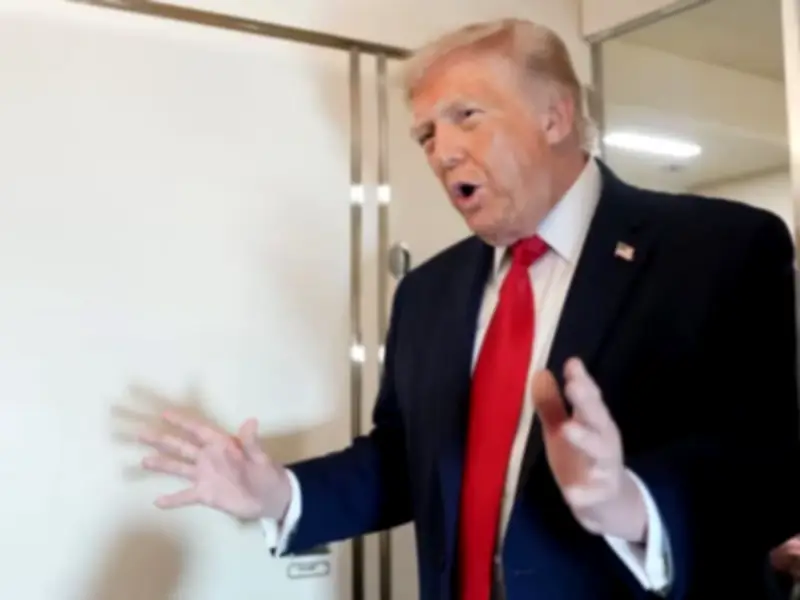
United States President Donald Trump on Monday called on Iran and Israel to immediately halt hostilities after the two adversaries exchanged direct attacks on each other's territory for the first time since a fragile ceasefire paused five weeks of war. Iran launched dozens of missiles at Israel overnight, and Israel retaliated by targeting military sites in the Islamic republic, sparking concerns that the escalation could trigger a new full-scale conflict following the April 8 truce.
Netanyahu Defies Trump's Calls for Restraint
With Israel's response, Prime Minister Benjamin Netanyahu apparently ignored appeals from his ally Trump for restraint, amid reports of a growingly strained relationship between the two leaders. "Israel and Iran must immediately stop 'shooting'," the US leader wrote on his Truth Social network. Minutes later, he added in a new post that "final negotiations" towards peace were proceeding "subject to ignorance or stupidity getting in its way."
Iran's Strikes Follow Hezbollah Attacks
Tehran's strikes followed Israeli attacks on Hezbollah targets in the southern suburbs of Beirut. Iran had repeatedly warned it would strike Israel if the Lebanese capital was targeted. Oil prices surged more than 5% on fears that war could reignite, dashing hopes for a rapid end to the standoff that has restricted shipping through the strategic Strait of Hormuz, raising concerns about global energy and goods shortages.

Diplomacy at a Critical Juncture
The strikes came at a crucial moment, with diplomatic efforts to end the conflict, involving mediator Pakistan, on a knife-edge. Iranian foreign ministry spokesman Esmaeil Baqaei warned that "it is perfectly natural that the diplomatic process initiated to put an end to this imposed war would be affected." However, he added that "diplomatic consultations are naturally continuing in all circumstances." As he spoke, a huge explosion shook the foreign ministry building, followed by repeated blasts believed to be from air defense systems, an AFP reporter said. Local media reported that a "hostile drone" was shot down over Tehran by air defenses.
Pakistan's Mediation Role
Interior Minister Mohsin Naqvi visited Tehran to deliver a "special letter" to Iran's supreme leader, Mojtaba Khamenei, according to Iranian state television. He has since returned to Pakistan, an official Pakistani source confirmed on Monday. Tehran insists that any permanent deal to end the war must also halt the parallel conflict in Lebanon, where Israel is pursuing a campaign against Hezbollah.
No Casualties Reported, but Tensions High
No casualties have been reported in either Israel or Iran. The Israeli military said it struck and dismantled Iranian defense systems deployed across several areas. Iran fired nearly 30 missiles towards Israel since Sunday night, an Israeli military official said. AFP journalists in Jerusalem and Ramallah heard explosions, and the Israeli army said it intercepted a new wave of Iranian missiles. Iran's Revolutionary Guards claimed they struck Israel's Nevatim and Tel Nof air bases and targeted a petrochemical facility in retaliation for an attack on a similar site in southwestern Iran. The Guards warned that Israel "has initiated a dangerous game, the scope of which will encompass all energy-related targets in the region." A military source told Tasnim news agency that "Iran is prepared for a long-term war with the Zionist regime and for strikes against US interests" in the region.
Regional and International Reactions
Yemen's Iran-backed Houthi rebels announced a missile attack on Israel on Monday, the first since early April, and declared a ban on Israeli shipping in the Red Sea. European Union top diplomat Kaja Kallas called on both sides to "sit down to a negotiation table and agree," adding that "the region does not need an escalation."

Uncertainty in Tehran's Leadership
It remains unclear who is leading decision-making in Tehran, as Mojtaba Khamenei is said to have been wounded in a US-Israeli strike and has yet to appear publicly after taking over from his father, Ali Khamenei, who was killed on the first day of the war on February 28. On Monday in Tehran, there was little sign of a return to war. Under sunny skies, cafe terraces were packed, and motorcycles weaved through lunchtime traffic, an AFP correspondent reported. However, traffic seemed lighter than usual, and more people were queuing at gas stations, suggesting some had stayed home.