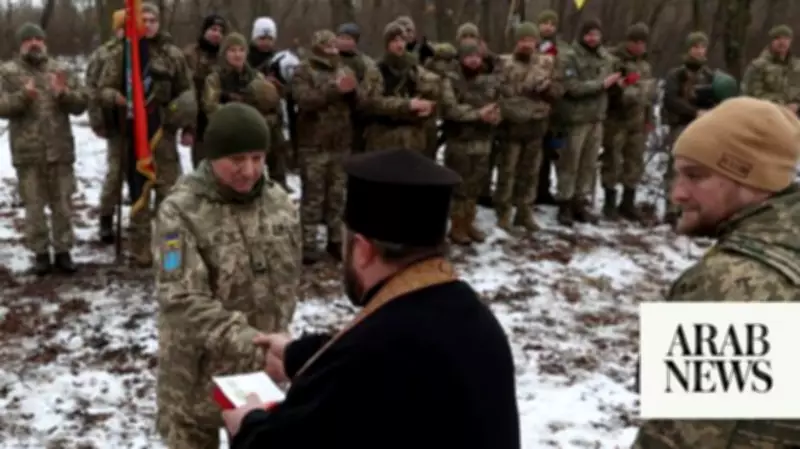
In a forest in northeastern Ukraine, several dozen kilometers from the front line, Chaplain Mykola Bagirov set up an altar behind a camouflage net. He placed pieces of consecrated bread on it as Ukrainian soldiers gathered around, emerging from the rows of pine trees. "Dear brothers and sisters, the liturgy will last about three hours. If anyone gets hungry and eats a bit of sausage, just make sure I don't see you!" Bagirov joked, nodding at a table piled with food. Fortunately for those present, the early morning service lasted only about an hour.
The 39-year-old Greek Catholic priest, with close-shaven auburn hair, has learned that humor and food help him connect with a sometimes-difficult audience. Since Russia invaded Ukraine in February 2022, he has been one of hundreds of clerics attached to military units, confronting the daily challenge of spreading faith in the midst of Europe's deadliest conflict since World War II.
A Chaplain's Journey
Bagirov admitted that no one was prepared for this role. "No one had studied for this, no one was ready. I never thought I'd be wearing one uniform and the other. It was very difficult at first: I didn't know how to approach people, how to choose my words, or even where to go," he said. Now serving with the 33rd separate mechanized brigade in the northeastern Kharkiv region, he is over 1,000 kilometers from his home in the Carpathian mountains.

He grew up in the Greek Catholic community, which was banned by Soviet authorities along with all other religions. Greek Catholic believers recognize the authority of the pope but perform Eastern rites, similar to most Orthodox churches. Covert services were once held in people's homes, a tradition that continued after the Soviet Union fell. For young Bagirov, this cloaked religion with an aura of mystery. He was particularly impressed by priests who returned from Gulag prison camps with their faith intact. "That was a serious experience of faith, and this is probably the force driving me," he told AFP.
From Burying to Supporting
According to the Razumkov Center pollster, about 70 percent of Ukrainians describe themselves as believers, with most being Orthodox and around 12 percent Greek Catholic. When Russia invaded in 2022, the first bodies of fallen soldiers soon began arriving at Bagirov's parish. The church held funeral after funeral, he recalled. He decided to enlist with the military chaplaincy after a ceremonial gun salute during one farewell ceremony frightened the daughters of a killed soldier. "These girls got scared and pressed themselves against their mother, while their father was lying there dead. When I saw that scene, when I saw how frightened they were, I thought: that's it. I don't want to bury anyone else. I'd rather be here with the guys, to laugh with them, talk to them, see them alive," he said.
Around 1,700 people from 13 different religious organizations are part of Ukraine's army chaplaincy service. Bagirov quickly learned that his duties extended beyond spiritual guidance. Soldiers turn to him for practical help, such as seeing a doctor or solving legal or financial issues. "At first I knew nothing!" he said. In one instance, a soldier was anxious that his mother, living alone, could not fix her broken heating pipes. Bagirov called a local chaplain, who contacted the town's mayor, who then accompanied plumbers to fix the problem. "Soldiers know that we care not only for them but also for their mother, brother or sisters back home," Bagirov explained.
Faith Amid Grief
Across the frontline, the grief of war—tens of thousands of soldiers and civilians killed—has strained belief among Ukraine's fighters. "They hate God inside because their brother-in-arms was killed," Bagirov told AFP. He suggests honesty: "They should tell God the truth. I always think arguments with God can even make for a better prayer."

Earlier in the war, he used to drive to the front to comfort soldiers. But as drones have infested the skies above the battlefield, he now stays further behind, running services online and holding phone calls with soldiers. Before new troops head out on a rotation, Bagirov usually tries to see them, encouraging them to pray. "When they return from combat positions, they are the ones telling me about God. It's the other way round," he said.