Every section of Pakistan's water crisis has a known technical solution. Every one of those solutions has been blocked not by engineering failure but by rational political choices: the electoral cost of unpopular decisions, the capture of policy by powerful lobbies, and the systematic preference for short-term survival over long-term sustainability. This is a failure of governance design and of political courage. And it has never mattered more than now, because India has decided to pull the lever upstream.
India's Clear Intentions
India's intentions are no longer ambiguous. On August 15, 2025, speaking from the Red Fort on Independence Day, Prime Minister Modi declared, "India has now decided, blood and water will not flow together. The people have come to realise that the Indus Waters Treaty is unjust. Water from the Indus River system has been irrigating the lands of the enemy, while our own farmers have suffered." His Jal Shakti Minister C R Patil had been more specific still: on April 25, 2025, following a high-level meeting chaired by the Home Minister, Patil declared that his government would ensure "not a single drop of water from the Indus River reaches Pakistan." This was doctrine, not rhetoric. The Prime Minister set it. The minister was executing it.
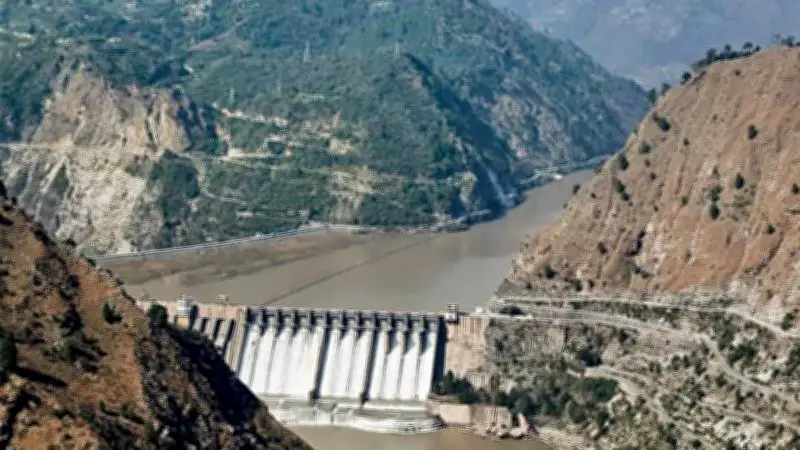
With the Pakal Dul Dam, the largest storage component yet approved on a Chenab tributary, targeting commissioning by late 2026, New Delhi has shifted from incidental pondage to active seasonal regulation. The Chenab River, which irrigates an estimated million acres of Punjab's most productive farmland through the Upper and Lower Chenab Canal systems, is no longer merely a natural resource. It is a geopolitical lever.

Physical Evidence of Manipulation
The physical record matches the declaration. WAPDA's hourly telemetry at Marala has recorded flows swinging from below 8,000 cusecs to over 32,000 cusecs within hours during May 2026, the hydropeaking signature of cascade management on the Chenab, while monthly volumes remain within treaty limits.
India is building the Chenab–Beas Link Tunnel, an 8.7-kilometre bore and 113-kilometre canal approved for Rs 2,352 crore, to move Chenab water permanently into the Beas basin, a transfer that the Treaty nowhere permits. According to Reuters, citing internal government documents, the Ranbir Canal is being expanded from its treaty-permitted 1,000 cusecs to a proposed 5,300 cusecs, nearly five and a half times the limit. The Salal and Baglihar reservoirs on the Chenab were flushed in early May 2025, the first such operation since their construction, previously barred under the IWT; India's Central Water Commission has since recommended making such flushing a monthly routine. The Permanent Indus Commission has been shuttered and data exchange suspended. Pakistan is now operating blind, unable to verify diversions or anticipate releases.
Pakistan's Inadequate Response
Pakistan has responded by reaching for the same instruments it has always reached for: court filings, diplomatic missions, and Security Council appeals. The most recent PCA award, delivered on 15 May 2026, placed explicit, evidence-based limits on storage capacity at the Kishanganga and Ratle hydroelectric projects on the Jhelum and Chenab, respectively, requiring that pondage be justified by actual project hydrology rather than design assertions made after the fact. This is no longer a dispute about treaty interpretation. It is a dispute about whether international arbitration itself has any authority over India's conduct on the western rivers. India rejected the award within days, calling the tribunal "illegally constituted" and its award "null and void." The legal framework is intact; the PCA has seen to that. The enforcement mechanism is not.
World Bank President Ajay Banga was direct about what this means for Pakistan's strategy: "We have no role to play beyond a facilitator. There's a lot of speculation in the media about how the World Bank will step in and fix the problem, but it's all bunk."

Pakistan cannot build its water security strategy around legal remedies whose enforcement depends on Indian consent. International litigation may remain necessary, but it cannot substitute for domestic adaptation — and that would be true even if India were fully complying with the Treaty. What India does upstream is now beyond our control; what the river reflects downstream is not. Every rupee spent lobbying in Geneva is a rupee not spent on modern irrigation in Sanghar or Rajanpur, and every court filing defers the conversation about what we must do ourselves.
Internal Waste and Governance Failures
What we already know about our own system is damning enough. Of every 100 units diverted at our headworks, roughly 21 are lost in the main canals before reaching the watercourse outlet. Another 40 to 50 disappear through unlined, unmaintained watercourses before the water reaches the farm gate. A further 25 are wasted at the field itself, where flood irrigation has an efficiency ceiling of barely 50 per cent. The net result, an overall irrigation efficiency of between 36 and 40 per cent, is one of the lowest in the world for a system of this scale, confirmed by decades of Food and Agriculture Organisation and Water and Power Development Authority assessments. This has been documented since the 1970s. The technology to fix it has existed just as long. Our canals are unlined, not because the concrete technology is unavailable, but because the institutions responsible for lining them have other priorities. The engineering deficit and the governance failure are the same problem. We waste more water between the headworks and the crop root zone than India's entire Chenab cascade is designed to regulate. We then go to The Hague to argue about what India is doing upstream.
Groundwater Depletion Crisis
Farmers have responded to the canal system failure with the only tool available to them: groundwater. First diesel tubewells, then electric, and now solar. Each transition was rational at the individual level and catastrophic at the aggregate. Today, over 1.4 million private tubewells operate across Pakistan, with more than 85 per cent concentrated in Punjab, and solar conversion is accelerating at a pace no regulator can match.
Provincial governments have subsidised this transition because the political cost of telling a farmer he cannot pump is immediate and electoral, while the cost of aquifer collapse is distant and falls on a future government's term. According to the Pakistan Council of Research in Water Resources, Punjab draws 55 to 60 million acre-feet of groundwater annually against a natural recharge of only 3 to 5 million acre-feet. To put that in terms that require no specialist knowledge: Punjab is consuming its groundwater at roughly fifteen times the rate at which it is being replenished. This is not a crisis approaching. It is a crisis already underway. It is visible in falling water tables, deepening tubewells, and the creeping salinisation of soils that were productive a generation ago. The aquifer is not a resource being managed. It is a resource being liquidated, one subsidised pump at a time.
Coordination Failure Among Provinces
The coordination failure predates this crisis and cannot be blamed on any single government or constitutional arrangement. Irrigation was always a provincial subject; the federal government was never the answer. The 1991 Water Apportionment Accord was Pakistan's most serious attempt to manage the coordination gap, a negotiated settlement that fixed provincial shares and created the Indus River System Authority as the allocation mechanism. But the Indus River System Authority allocates quantities. It cannot mandate conservation, penalise waste, enforce transparency, or resolve the deeper political economy of head-end advantage and tail-end deprivation. The Accord's dispute resolution provisions have never been robustly tested, not because the disputes do not exist, but because testing them requires telling powerful constituencies what they do not want to hear.
Sindh's position illustrates the incentive failure most starkly, precisely because the stakes are highest. It sits at the tail end of the canal system, endures temperatures exceeding 50 degrees Celsius, and depends on surface water delivery in a way Punjab, with its vast private tubewell network, does not. Unlike Punjab, where decades of canal seepage have built up thick freshwater lenses, Sindh's usable groundwater sits in thin, shallow lenses above native saline aquifers, vulnerable to overextraction and saltwater intrusion. According to Pakistan Council of Research in Water Resources data, 52 per cent of Sindh's canal command areas have marginal groundwater quality, and 14 per cent is saline to highly saline. There is no deep aquifer buffer. When surface water fails, there is no fallback.
Whether it is Punjab subsidising the liquidation of its own aquifer or Sindh defending its share against upstream delay while struggling to reform its own internal pricing, every actor in this basin is navigating the same calculus. This is not a contradiction. It is rational short-termism. None of this diminishes Sindh's legitimate grievance about upstream allocations. It simply illustrates that every actor in the basin responds to the same incentive logic, including the most vulnerable one. The question is not what needs to be done. The question is what would have to change for the right choices to become the rational choices for those who hold power.
Potential Solutions Through Incentive Design
Consider a single example. Regulating over a million solar tubewells is not feasible at the pump. The intervention point is the market. Restrict water-intensive crops, particularly rice and sugarcane, not at the field but at the mill and at procurement, making them economically unviable in designated depleted aquifer zones. Remove the incentive rather than police the behaviour. A farmer who cannot profitably sell his rice has no reason to pump for it. This transition will not be painless: the rural labour market in affected zones depends heavily on these crops, and any serious reform will require accompanying investment in alternative livelihoods and crop diversification support. This approach does not require a new institution, a constitutional amendment, or a donor-funded programme. It requires a government willing to face the lobby that currently makes it politically irrational.
Real-time publication of the Indus River System Authority allocation and release data costs almost nothing, yet it has not been done because each province fears transparent data will be weaponised against it in the next allocation dispute. The way to break that deadlock is to make transparency profitable: tie access to Green Climate Fund disbursements and other international adaptation finance to verifiable data-sharing commitments through a voluntary Climate Adaptation Compact. Provinces will not share data out of goodwill. They will share it when withholding it has a cost and sharing it has a reward. That is not idealism. It is an incentive design.
The same logic applies to canal maintenance. Pakistan's irrigation infrastructure is deteriorating not because governments lack the knowledge to maintain it, but because maintenance spending is politically invisible. A repaired canal head does not generate a ribbon-cutting. A lined watercourse does not produce a press conference. The incentive is to build new infrastructure, announce it, and allow existing infrastructure to decay quietly. Reversing this requires making maintenance visible and accountable: publish canal condition indices by district, tie provincial development allocations to maintenance benchmarks, and make the cost of neglect as legible as the cost of construction. None of this is technically difficult. All of it is politically uncomfortable, which is precisely why it has not been done.
The Need for Political Courage
The Diamer-Bhasha Dam remains Pakistan's most significant hedge against upstream control, but it is years from completion — and its delay, rooted in land acquisition disputes and financing gaps that no government has resolved, is itself a measure of the governance failure this article describes. The danger zone is now. It will be navigated not by engineers but by those who can realign the calculations that currently govern every actor in this basin.
We have the technology to adapt, the finance to invest, and the legal frameworks to govern what we have: the 1991 Accord, the Punjab Irrigation, Drainage and Rivers Act 2023, and the Indus River System Authority's mandate. What we lack is the incentive structure that would make using any of them honestly the rational choice for those in power. India has made its decision. The question is whether we will make ours.