Saudi Arabia's non-oil activities now account for over half of the Kingdom's real gross domestic product, according to the annual Vision 2030 report for 2025. The document, released as the Kingdom prepares to enter the third phase of Vision 2030 in 2026, shows that 225 out of 1,290 initiatives have been fully implemented, while 935 more are on track. Some 309 out of 390 indicators have achieved their interim goals, leading to a 93 percent completion threshold.
Vision 2030: A Decade of Progress
Saudi Vision 2030 is a strategic framework launched in 2016 to diversify the Kingdom's economy, reduce oil dependency, and modernize society. King Salman bin Abdulaziz stated in the report: "Our country continues its journey toward a brighter future, building on a decade of remarkable progress achieved under Vision 2030." He added, "The Kingdom has emerged as a leading example of how to effectively harness its capabilities and resources to drive comprehensive development, with impact clearly reflected in the enhanced quality of life for its people."
Economic Transformation
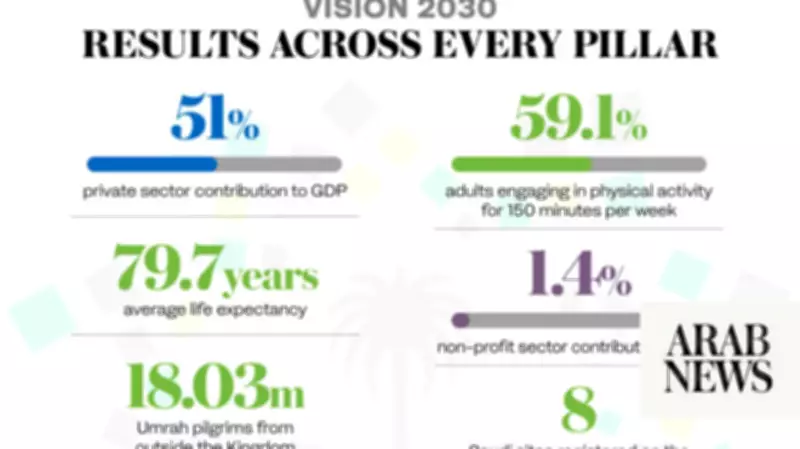
The Kingdom's real GDP reached $1.3 trillion in 2025, exceeding the target for the year. Non-oil activities now account for 55 percent of real GDP, while the private sector contributes 51 percent, marking a significant structural shift toward a more sustainable economy. The report noted that investment into Saudi Arabia has increased in recent years, supported by reforms that made the market more open and accessible for both domestic and international investors.

Foreign direct investment stock has grown by 119 percent since 2017, reaching SR293.3 billion in 2025. Assets under management stood at approximately $909 billion, broadly stable year-on-year following a period of rapid growth. The number of small and medium enterprises has surpassed 1.7 million, employing 8.8 million people with a 22.9 percent contribution to GDP.
Growth and Development
Real GDP grew by 4.5 percent in 2025, supported by continued expansion in non-oil sectors and higher oil production as OPEC+ supply constraints eased. Crown Prince Mohammed bin Salman commented: "After a decade of progress under Vision 2030, our nation has shown how ambition can be turned into real results through the determination of its people and the strength of its institutions." He emphasized the need to build on this momentum and strengthen plans to sustain progress and improve lives.
Social Development and Quality of Life
Social development and quality of life have seen remarkable improvement. Homeownership among Saudi families reached 66.24 percent, up from 47 percent at the launch of Vision 2030. Healthcare coverage hit 97.5 percent, and life expectancy is approaching the 2030 target of 80 years. The percentage of adults meeting recommended physical activity levels reached 59.1 percent, exceeding targets. The number of Umrah performers from outside the Kingdom exceeded 18 million, compared to 6.2 million in 2016.
Volunteering and Social Responsibility
Volunteering has seen a qualitative leap, with the number of volunteers rising from 22,000 to more than 1.75 million, surpassing the 2030 target ahead of schedule. The share of large companies implementing corporate social responsibility programs increased from 30 percent to 76.8 percent.
Global Standing
Internationally, Saudi Arabia has strengthened its position in global indicators, ranking first worldwide in cybersecurity and third in the global AI index, alongside advances in competitiveness and digital readiness. The report concluded: "From ambition to lived reality, Vision 2030 stands as both progress delivered and a journey still unfolding."