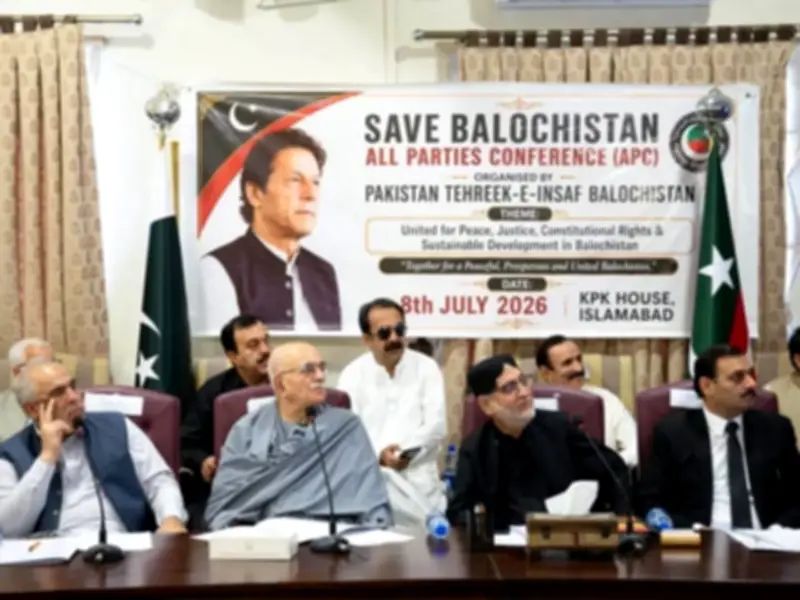
An All Parties Conference (APC) convened by the Pakistan Tehreek-e-Insaf (PTI) on the situation in Balochistan has called for resolving the province's longstanding challenges through political dialogue rather than the "use of force". The participants demanded the recovery of "missing persons, fair elections, and a fair distribution of Balochistan's natural resources among local communities".
Conference details and participants
The conference, organised by PTI Balochistan at Khyber-Pakhtunkhwa House in Islamabad on Wednesday, was chaired by Akhtar Mengal. It brought together opposition leaders and representatives of several political parties, including National Assembly Opposition Leader Mahmood Khan Achakzai, Shahid Khaqan Abbasi, Asad Qaiser, Mustafa Nawaz Khokhar, National Democratic Movement (NDM) leader Mohsin Dawar, National Party (NP) Senator Jan Muhammad Buledi, Awami National Party (ANP) Balochistan President Asghar Khan Achakzai, Jamiat Ulema-e-Islam's (JUI) Maulana Salahuddin Ayubi, Jamaat-e-Islami's (JI) Maulana Shakir, and others. The APC also issued a joint declaration on the Balochistan issue.
Calls for recovery of missing persons
Addressing the gathering, Maulana Shakir said Balochistan was witnessing rising numbers of widows, orphans, and graveyards, attributing the situation to prolonged violence and instability. He argued that poverty and unemployment were pushing young people toward crime and claimed that conditions in the province were worse than those in Jammu and Kashmir and Gaza. He called for the immediate recovery of missing persons and alleged that Balochistan lacked genuine political leadership.

Border closure criticised
JUI leader Maulana Salahuddin Ayubi criticised the closure of the Chaman border crossing with Afghanistan, saying authorities had justified the move on the grounds of curbing terrorism and smuggling. However, he argued that violence had increased despite the border remaining closed for the past two years. Ayubi said restrictions on cross-border trade were causing significant losses to Pakistani traders and adversely affecting both countries.
'Balochistan is a political issue'
NP Senator Jan Muhammad Buledi described the conference as an important initiative and stated that Islamabad had "consistently failed" to treat Balochistan as a serious political issue. He maintained that successive governments had not fulfilled promises to reduce the "role of state institutions in the electoral process". Referring to the province's representation in the National Assembly, he said Balochistan's 16 seats offered little political leverage. Buledi said while constitutional forums such as the Senate, the Council of Common Interests, and presidential elections provide equal representation, he regretted that "constitutional principles were not being implemented in practice". He stressed that Balochistan's problems could not be solved through a security approach alone and required a political solution.
ANP raises concerns over governance
Balochistan ANP President Asghar Khan Achakzai said constitutional safeguards had been weakened in "pursuit of control over resources". He said "terrorism was being fostered to facilitate the plundering of resources, adding that Pakistan's Constitution was being distorted to enable access to the resources of the oppressed people". "Current issues facing Balochistan cannot even be discussed today. Balochistan Assembly is the only provincial assembly where everyone was on the same page, from the passage of the budget to legislation." He further claimed that Rs1 billion had been allocated to each district for deputy commissioners. Asghar said an ordinary Afghan could neither run a business nor earn a livelihood in Pakistan and alleged that narcotics-related networks continued to operate with official patronage.

Dawar criticises security policy
NDM leader Mohsin Dawar said successive caretaker governments had continued to "approve deals" involving Balochistan's mineral resources while trade routes with Afghanistan remained closed. "A single policy is currently being pursued across the region to push people towards violence. Establishment is willing to fight proxy wars. Taliban now in power in Afghanistan continue to receive [official] protocol in Pakistan," Dawar said. He further said none of the Taliban's key figures had been killed in any of Pakistan's operations. He also claimed that Pakistan's attacks had strengthened the Afghan government by increasing its public support. "Terrorists have taken control of the entire Dera Ismail Khan district, but did not enter Punjab. The government of Khyber-Pakhtunkhwa is equally complicit in the province's deteriorating security situation. Conditions in K-P are even worse than those in Balochistan and the decisions made at the peace jirga held there are yet to be implemented." Dawar called for the release of all political prisoners in Balochistan.
Khokhar warns of institutional breakdown
Former senator Mustafa Nawaz Khokhar warned that governance and political institutions were steadily weakening in Balochistan. "The state's writ is eroding in Balochistan." Khokhar stated that the province's deteriorating law and order situation reflected broader structural failures and warned that illegal economies, including narcotics trafficking, were expanding. Drawing comparisons with conflict-hit countries such as Syria, Libya, and Yemen, he urged political stakeholders to address the crisis before it became irreversible. He argued that the first step toward resolving Balochistan's problems should be the holding of free, fair, and transparent elections, while also calling on mainstream political parties to give greater attention to the province despite its relatively small number of parliamentary seats.
APC demands and resolutions
The APC called for the formation of a Truth and Reconciliation Commission to address the province's grievances. It also demanded the release of PTI founding chairman and former prime minister Imran Khan, Mahrang Baloch, Ali Wazir, Shah Mahmood Qureshi, Imaan Mazari, Hadi Chattha and other political prisoners. The conference also urged authorities to prevent the alleged misuse of the Digital Rights Act (DRA) and other laws, while reiterating that the province's current crisis was the result of an "unrepresentative government".