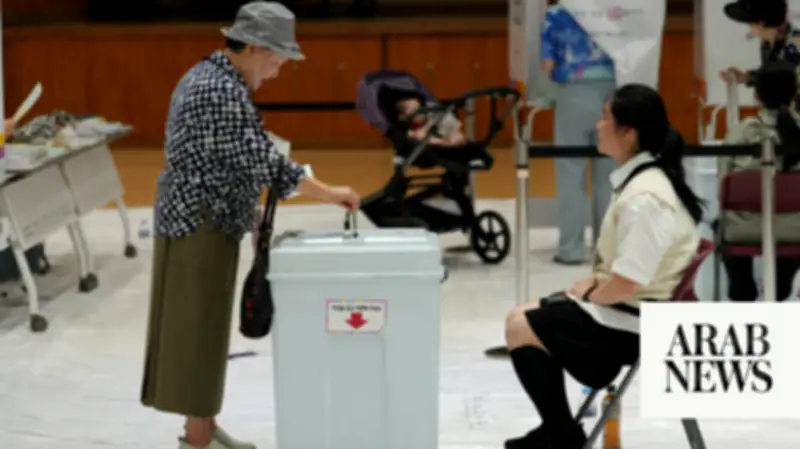
South Koreans went to the polls on Wednesday in mayoral and other local elections that are widely regarded as a barometer of public support for President Lee Jae Myung's year-old liberal government. Opinion surveys indicate that Lee's Democratic Party is likely to secure more victories than its main rival, the conservative People Power Party, which remains fractured following the removal and conviction of former President Yoon Suk Yeol for rebellion related to his martial law declaration in late 2024.
Key Races and Voter Turnout
Voters are electing 16 regional leaders, including mayors and provincial governors, with 12 of those posts currently held by the PPP. Additionally, 14 by-elections will fill vacancies in the 300-member National Assembly. Polls opened at 6 a.m. at approximately 14,300 stations and are scheduled to close at 6 p.m. As of noon, the voter turnout rate stood at 19 percent, according to South Korea's election commission. The country has 44.6 million eligible voters.
Political Landscape and Predictions
Experts suggest that the Democratic Party must achieve a landslide victory, particularly in key races like the Seoul mayoral election, to provide a clear boost to President Lee. Jeong Han-Wool, director of the Korean People Research Institute, noted, "The conservatives' support base has been fractured and weakened in the wake of Yoon's impeachment, while the liberals' support base has grown stronger. Results of the elections will determine whether their dominance would prolong for a considerable time."

Earlier surveys indicated the Democratic Party could win up to 15 of the 16 posts. However, more recent polls show opposition or independent candidates narrowing the gap or even taking the lead in five to seven races. Choi Jin, director of the Institute of Presidential Leadership, attributed the Democratic Party's advantage to lingering public resentment over Yoon's martial law imposition and a perception that the Lee administration deserves a chance to implement its agenda.
President Lee's Popularity and Foreign Policy
Thursday marks one year since Lee took office, with his approval ratings hovering above 60 percent. His popularity is partly due to what he describes as "pragmatic diplomacy," which has alleviated concerns that his rule might harm ties with the US and Japan. Experts believe that regardless of the election outcome, Lee's foreign policy agenda will remain unchanged.
Seoul Mayoral Race
Much attention is focused on the Seoul mayoral race, where Democratic Party candidate Chong Won-o, a former Seoul district head, faces current mayor and PPP heavyweight Oh Se-hoon. Chong gained political prominence after Lee publicly praised his governance last October. Oh, a seasoned politician, stated, "A Seoul mayor isn't a post that someone whose campaign solely relies on the president's coattails can afford." Chong countered, expecting Seoul voters to deliver "a stern verdict" on Oh's governance, which he called incompetent and irresponsible.
Implications for the Conservative Opposition
The PPP continues to struggle with internal divisions between reformists who supported Yoon's impeachment and loyalists who tried to protect him. In the Busan by-election, independent candidate Han Dong-hoon, a reformist leader expelled from the PPP, holds a slim lead over Democratic Party candidate Ha Jung-woo, a former Lee adviser on artificial intelligence. Jeong Han-Wool suggested that a Han victory could help anti-Yoon reformists regroup and emerge as a new conservative force. However, Choi Jin warned that it might worsen divisions, as Yoon loyalists could close ranks.