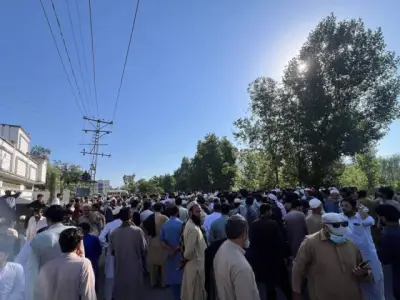
In October 2024, students across Punjab protested an alleged on-campus rape reported in Lahore. Police in Rawalpindi fired tear gas at a college demonstration. Schools, colleges, and universities across the province were shut for forty-eight hours. The chief minister announced an inquiry within the day. The Aurat Foundation issued statements. Major channels carried the story for the better part of a week. This is, give or take, what a public reckoning with sexual violence looks like in Pakistan. The point is not the protest. The point is that this kind of reckoning happens almost only in Punjab.
Data Reveals Stark Disparities
The Sustainable Social Development Organization's 2024 report on gender-based violence, drawn from provincial police data obtained through Right of Access to Information requests, records 5,339 rape cases registered nationally last year. Of these, Punjab accounts for 4,641. Roughly 87 percent of the country's reported rape cases come from a province that holds roughly 53 percent of its population. Sindh registered 243 cases. Khyber Pakhtunkhwa, 258. Balochistan, 21. The Islamabad Capital Territory, 176.
The obvious reading of these numbers is that Punjab has the most violent men. That reading is wrong, or at least so incomplete that it leads policy away from the people it most needs to reach. 87 percent is not a population effect. It is a measurement effect.

Conviction Rates Near Zero in Smaller Provinces
Twenty-one rape cases in Balochistan in a calendar year is not low. Balochistan's population is around fifteen million. None of those twenty-one cases ended in a conviction. Sindh's 243 cases ended in zero convictions. Khyber Pakhtunkhwa managed one conviction out of 258 — a 0.39 percent rate. The national rape conviction rate, per SSDO, is 0.5 percent. By any reading of these figures, the system in the smaller provinces is not so much underperforming as absent.
A counting system that depends on a permissive community, a functioning police, and an attentive media will always tell us most about the places where those three things are least dysfunctional.
Underreporting Masks True Scale
Even where the system does register, the cases that come through are not abstractions. On May 5, 2026, a father in Burewala, Vehari district, was arrested after his three daughters — aged nine, eleven, and fourteen — told their mother that he had been raping them for six months. The Human Rights Commission of Pakistan has long estimated that around 95 percent of child sexual abuse in this country happens inside the child's own home, often involving family members. Most such cases never reach an FIR. The Vehari incident became a number because Punjab has a system that, however badly, exists.
Sahil's Cruel Numbers report for the first half of 2025 records 72 percent of all child sexual abuse cases from Punjab, 22 percent from Sindh, and 6 percent from the rest of the country combined.
Barriers to Reporting Vary by Province
The reasons the smaller provinces' systems are absent vary, and they matter because the response that works in one is the wrong response in another.
In Sindh, the dominant pattern is non-registration, often with the police as the obstacle and sometimes as the perpetrator. The September 2024 gang rape of a polio worker on duty in Jacobabad was registered only after the district administration intervened; the victim's initial public statement denied the assault, citing, as the deputy commissioner later acknowledged in court, "our society's attitude toward such victims." In January 2026, fifteen-year-old Shadbano Mallah was found unconscious at Civil Hospital Sanghar with blade cuts on her face, nose, and tongue. The accused is the son of a local landlord; Shadbano's father is a peasant.
UN Special Rapporteurs have repeatedly raised concerns about a separate but overlapping pattern in the province: the abduction, forced conversion, and marriage of girls from the Hindu and Christian minorities, with the resulting sexual violence routinely reclassified as "marriage" and removed from the rape column entirely. Roughly 80 percent of forced-conversion cases recorded by UN experts in 2025 occurred in Sindh.

In Balochistan, the structural answer is different. Tribal authority, the sardar and his nahib, handles disputes in ways that bypass the state. The February 2025 abduction of Asma Jattak in Khuzdar district, where her family blocked the Quetta-Karachi highway with a three-day sit-in to get attention, sat at the visible end of a long pattern. The accused was the brother of a local sardar's secretary. The cultural insistence, repeated routinely on the floor of the Balochistan Assembly, that "Baloch society honours its women" is itself a denial mechanism. The crime that, by definition, does not happen cannot be registered.
In Khyber Pakhtunkhwa, the obstacles begin earlier, at the family and community levels. The province's 258 rape registrations in 2024 produced one conviction in twelve months. Civil society reporting concentrates on social pressure and university harassment, including documented cases at the University of Peshawar and the University of Malakand, where survivors were driven into silence by their own institutions.
Punjab's Infrastructure Exists but Inadequate
Punjab, by comparison, has built infrastructure that works badly but at least exists. The 2016 Protection of Women against Violence Act, passed five years before the federal Anti-Rape Act, established Violence Against Women Centers, the first in Multan, which co-locates police, prosecution, medical examination, and shelter in a single building. Women's police stations are more numerous than in any other province. The Punjab Safe Cities Authority runs helplines that get answered. None of this has fixed Punjab's 0.4 percent conviction rate. But it has meant that an incident in Sheikhupura or Faisalabad has a non-trivial chance of becoming a number.
Add the simpler fact that Punjab has more media, Lahore and Rawalpindi sustain national newspapers and television channels in a way that Quetta and Sukkur do not, and coverage forces registrations that would otherwise not happen. The Jattak family's sit-in on the Quetta-Karachi highway, three days in February cold, did not break through to comparable national coverage.
Federal Legislation Not Reaching All
The Anti-Rape (Investigation and Trial) Act of 2021 was, on paper, a serious piece of legislation. It mandated special courts, special prosecutors, anti-rape crisis cells in public hospitals, in-camera trials, a sex offenders register, and a Prime Minister's fund. The implementing rules were notified in 2023. As of late 2025, 174 special courts had been designated, though they are not exclusively dedicated to gender-based violence cases.
Maliha Zia of the Karachi-based Legal Aid Society told Dawn earlier this year that Sindh's rape conviction rate rose from 5 percent in 2020 to 17 percent in 2025 in districts where these courts have begun functioning. The architecture is real. The problem is that all of it operates on cases that have already entered the system. The Act presumes an FIR. It cannot help a woman whose police station refuses to write one.
Resource allocation under the Act is based on registered case volume, which means it follows Punjab. A federal anti-rape fund whose support tracks reported cases will overwhelmingly support the province that is best at reporting. A special court that requires a caseload to justify its designation is designated where the load is visible. None of this is malicious. It is what happens when a measurement system is fed back into the policy that produced the measurement.
Police Perpetration Case Highlights Gap
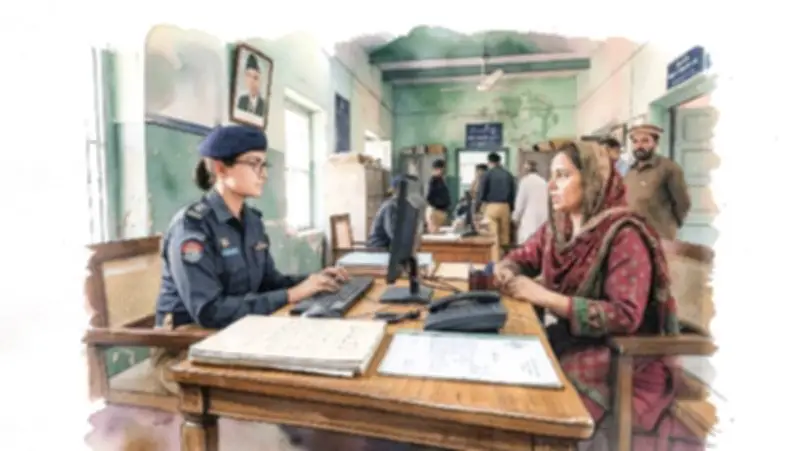
In January 2026, six policemen of Jacobabad district, including an assistant sub-inspector, were arrested and booked for the gang rape of a seventeen-year-old girl who, along with her sister and grandmother, had been picked up as part of a murder probe and detained at the RD-52 police station in Taluka Thul. According to the SSP's own inquiry, the station house officer went on leave one night; the in-charge took the keys; six men in uniform raped her. Her family, community elders, and the local bar association rejected the initial FIR, alleging that the SHO and other senior officers had been deliberately spared. The Federal Investigation Agency had to register a fresh FIR weeks later, adding two more officers.
Six policemen, in uniform, in a working police station, are raping a minor in their own custody. If this had happened in Punjab, every channel in the country would have led with it for a week. In Sindh, it took the FIA to widen the case. That is the gap.
Conclusion: Measurement Must Improve
Pakistan does have a rape problem in Punjab. It also has one less, is measured, less politically expensive, and is probably worse almost everywhere else. The 2024 numbers do not show this. They cannot. A counting system that depends on a permissive community, a functioning police, and an attentive media will always tell us most about the places where those three things are least dysfunctional. That is the data the country has. The question is whether the next round of policy will build measurement that fixes it, or keep mistaking the symptom for the map.