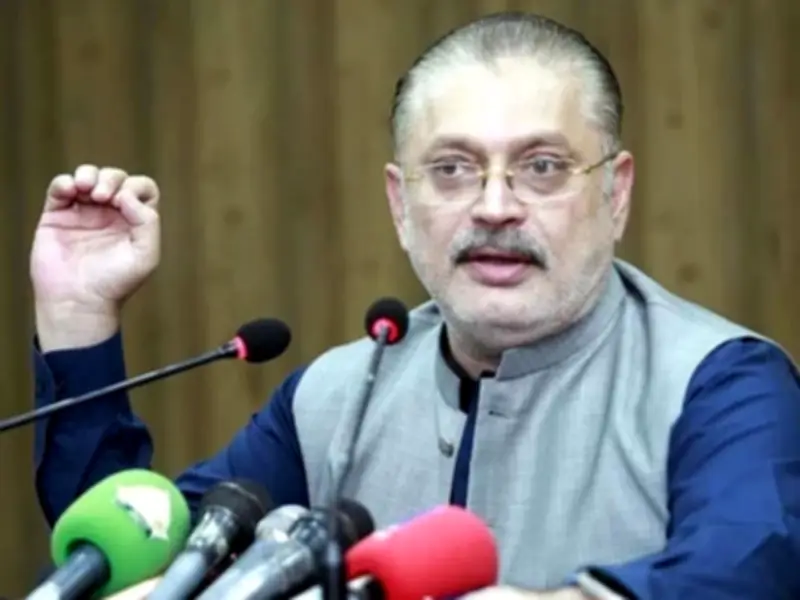
KARACHI: Sindh Senior Minister Sharjeel Inam Memon has accused the Muttahida Qaumi Movement (MQM) of unnecessarily politicizing various issues in an attempt to revive its dying political fortunes. He asserted that the gas shortage is the responsibility of the federal government, while K-Electric is not under the administrative control of the Sindh government.
Water shortage and federal responsibilities
Regarding the water shortage, Sharjeel stated that the Sindh government has already informed the Indus River System Authority (IRSA) through an official letter that the province is currently facing a 22 per cent water shortage, which is also affecting Karachi. He explained that Karachi is the last major city in Sindh to receive water from the provincial distribution system; therefore, when overall water availability declines, the impact is directly felt here.
He further said that the MQM frequently attempts to blame the Sindh government for issues that fall under the federal government's purview. Instead of focusing on resolving public problems, the MQM's politics in Karachi revolves around using such issues for political gain.

PPP's stance on federal government
Sharjeel clarified that the Pakistan Peoples Party (PPP) is not an ally of the federal government. The party has only extended support to the federal government for the continuation of the parliamentary system and the democratic process.
Karachi's decline and MQM's role
The senior minister lamented that Karachi was once regarded as one of the finest cities in the world. It was also the capital of Pakistan, and students from various regions, including the Gulf countries, came here for higher education. The city's decline began when the foundations of ethnic and linguistic politics were laid.
Sharjeel said that Karachi's problems worsened when parks were converted into marriage halls. He added that the MQM leadership is fully aware of the facts, as parks and sports grounds were encroached upon and individuals involved in serious crimes, including terrorism, were recruited into local government institutions.