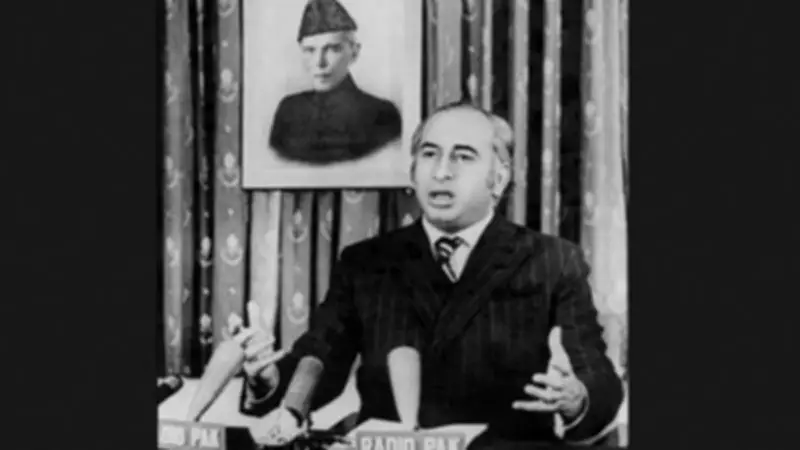
Zulfikar Ali Bhutto became a cabinet minister at the national level at the young age of 30, a rare achievement in history. Five years later, he rose to the rank of foreign minister. His rise to power seemed unstoppable, and he became prime minister at the age of 45. He was brilliant, well-read, and articulate. Yet he died on the gallows aged 51. This article explains his dramatic rise and fall, drawing on personal observations and historical analysis.
Early Encounters with Bhutto
I first heard Bhutto’s name while in middle school at St Mary’s High School, Sukkur. He was articulate on the radio against India after the 1962 war with China, and bold and eloquent against the US war in Vietnam. I saw him a few times a year at a club in Barrage Colony, Sukkur, where our house was across the street. In 1964, during national election campaigning, I saw his motorcade from the train station; President Ayub Khan was seated in the back of a limousine, and Bhutto sat beside him, both waving to crowds. I was one of many Cub Scouts showering rose petals on the motorcade.
In 1967, Bhutto broke with Ayub, his mentor, and founded his own political party based on "Islamic Socialism," promising to take money from the wealthy and give "bread, clothing, and housing" to the poor. My adulation peaked when I entered the University of Karachi to study economics in 1969. His doctrine appealed to me. A year later, friends pointed out contradictions between his words and actions, which I initially dismissed but later found troubling.

Contradictions and Disillusionment
Bhutto was virulently anti-American but sent his daughter to study in the US, where he had studied decades earlier. He talked about alleviating poverty yet was one of the wealthiest feudal lords, with a reputation for cruelty to peasants. When the army launched Operation Searchlight in East Pakistan on March 25, 1971, triggering a civil war, Bhutto returned from Dhaka and said at the Karachi airport, "God has saved Pakistan," instead of condemning the army’s onslaught against civilians, including intellectuals and academics. Doubts about his character and integrity surfaced.
I wrote to Bhutto requesting a meeting to resolve these contradictions. A response dated May 15, 1971, was arrogant and strident. My father ordered me to apologize, fearing consequences. I sent a second letter apologizing; Bhutto responded, saying he did not want to upset me and suggested a meeting when he was next in Karachi. But his demeanor put me off, and I never arranged it. He had fallen from grace in my eyes.
Populist Demagogue and Repression
Despite my disillusionment, I attended two of his massive public rallies at Nishtar Park in Karachi. At the first, he took off his jacket and threw it into the crowd, which tore it up as a sacred object. He referred to Indian Prime Minister Indira Gandhi with a derogatory term for older women and called Sheikh Mujib a congenital liar with a sick mind. At the second rally, he got the crowd to approve recognizing Bangladesh. An old man questioned him about abandoning the Kashmir cause; Bhutto ordered his henchmen to silence him, creating an ugly scene.
During a live broadcast on Radio Pakistan from Lahore, Bhutto addressed his addiction to alcohol, saying he drank alcohol but not the blood of the people, unlike landlords and industrialists. He used profanity, realized his blunder, and asked the technician to remove it, but it was live. My father and I were shocked; profanities were never used in our house. Seeing him up close confirmed my worst suspicions: he was a populist demagogue, rude to anyone who questioned him, and seething with revenge against political opponents, calling them demeaning names based on appearance.
He created the Federal Security Force, which could round up anyone he disliked. They were incarcerated, sexually abused, tortured, or killed, similar to Hitler's Gestapo or the Shah's SAVAK. This fate befell many opponents, including loyal companions like Mairaj Muhammad Khan and even his mentor JA Rahim, who wrote his party's manifesto.

Bhutto's Political Philosophy and the Simla Summit
After the army’s disastrous operation in East Pakistan, Bhutto wrote The Great Tragedy, absolving himself of guilt. He knew the end for Jinnah’s Pakistan was near but did not mention his role in the break-up. East Pakistan seceded on December 16, 1971, becoming Bangladesh. Pakistan became the largest post-colonial state to break into two pieces. The army overthrew General Yahya Khan and replaced him with Bhutto.
Italian journalist Oriana Fallaci interviewed Bhutto in April 1972. He bared his soul, discussing his approach to politics and views of other politicians. Fallaci had interviewed Indira Gandhi, who called Bhutto "an unbalanced man, that today you say one thing and tomorrow another." Bhutto quoted John Locke: "Consistency is a virtue of small minds." He said, "An intellectual should never cling to a single and precise idea—he should be elastic... Politics is movement per se—a politician should be mobile. He should sway now to right and now to left; he should come up with contradictions, doubts." He called Indira Gandhi "a diligent drudge of a schoolgirl, a woman devoid of initiative and imagination." When Mrs. Gandhi read the interview, she almost canceled the Simla Summit, which would decide the fate of 93,000 Pakistani prisoners of war and Kashmir. She asked how he could be very rich and yet a socialist, live like a Westerner and have two wives. He replied: "There are many conflicts in me. I try to reconcile them... I have a layman’s education and a Muslim’s upbringing. My mind is Western and my soul Eastern... I call myself a Marxist in the economic sense." When asked if he would last, he said yes, explaining the rule of politics: "you sometimes have to pretend to be stupid... have light and flexible fingers, to insinuate them under the bird and take away the eggs. One by one. Without the bird realizing it." The interview caused a firestorm; he repudiated it, but it appears in her book Interview with History.
Downfall and Execution
In 1973, Bhutto became Prime Minister. He appointed General Zia-ul-Haq as army chief, a junior officer who seemed sycophantic. Bhutto publicly humiliated Zia. According to Professor Stanley Wolpert's biography Zulfi Bhutto of Pakistan, Bhutto often made Zia the butt of ridicule, shouting "Where’s my monkey-general?" and pretending to pull him on an invisible string. He joked about Zia's teeth, humiliating the man he had elevated. Multiple factors led to Bhutto's undoing: language riots in Sindh, large-scale nationalization of industries and schools, nepotism in the civil service, the Federal Security Force, persecution of opponents and dissidents, humiliation of JA Rahim, and rigging of the 1977 elections. The Pakistan National Alliance, led by Air Marshal (retired) Asghar Khan, opposed him. Zia deposed Bhutto on July 5, 1977. Bhutto was hanged in 1979 for ordering the murder of a political opponent.
Legacy and Analysis
Veteran politician Sherbaz Khan Mazari, in A Journey to Disillusionment, wrote that over 23 years, Bhutto progressed from "a despondent political aspirant to a civilian martial law administrator and president." He had an unbridled lust for power and a dark admiration for Adolf Hitler, with possibly the largest collection of books about the Führer in Pakistan at his library in 70 Clifton, Karachi. He was also infatuated with Napoleon. This enabled him to engage in "lying, double-dealing and deceit" as normal means of attaining and keeping power.
Owen Bennett-Jones, in The Bhutto Dynasty, sums up Bhutto's contradictions: "variously a feudal lord who wanted to dispossess landlords, a socialist who admired Hitler, a civilian politician and chief martial administrator and, fittingly, a man who said coherence is the virtue of a small mind." Bhutto was gifted, educated at top universities, well-read, eloquent, and a prolific writer. He mesmerized millions and mastered diplomacy on the world stage. But like most populist demagogues, he failed to deliver on grandiose promises. His flawed character—marked by overwhelming superiority, cruelty, and vindictiveness—led to his downfall. That was his Great Tragedy.